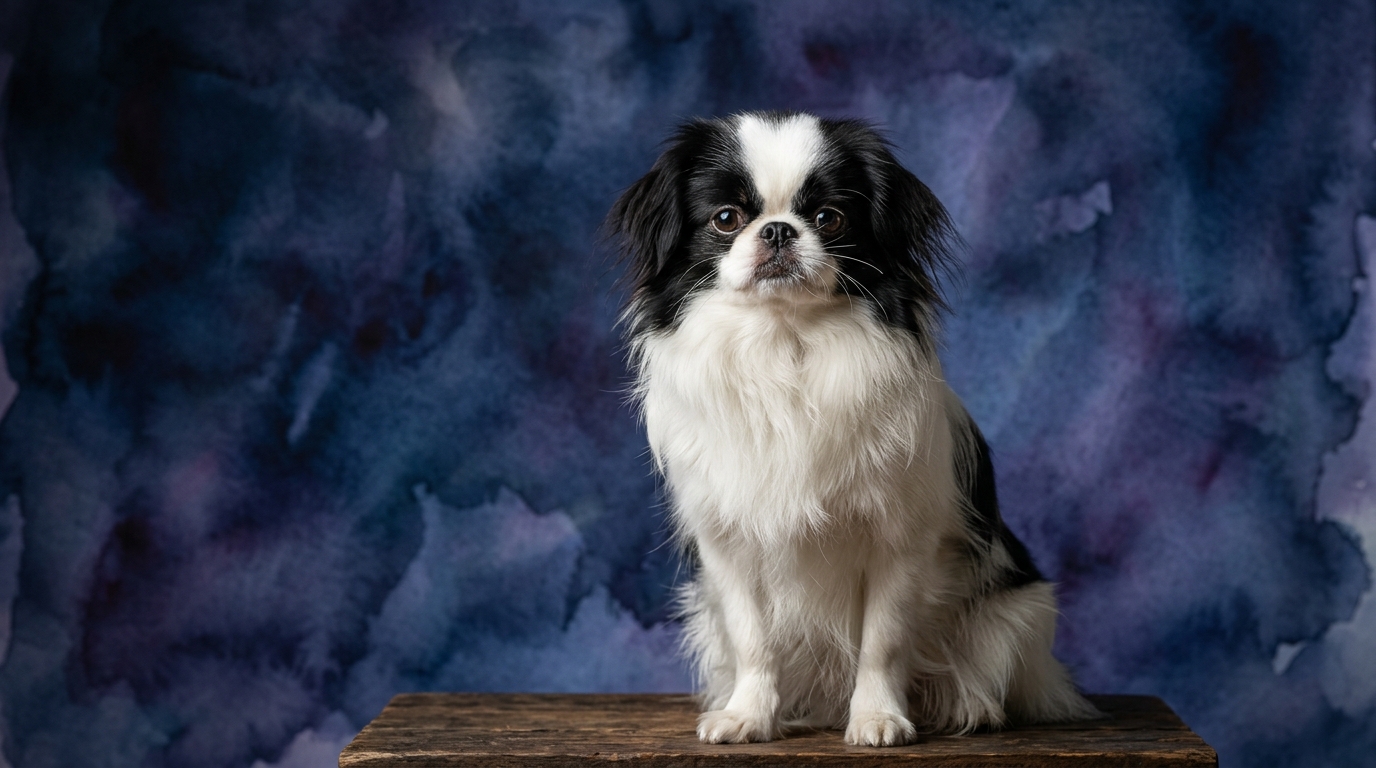

Side-by-Side IQ Profile: Japanese Chin vs. Irish Water Spaniel
The Cosmic Pet Pet IQ Lab employs a five-dimensional framework to assess canine cognition, offering a granular view beyond simple obedience. For the charming Japanese Chin, a toy breed not Coren-ranked, we observe a balanced set of aptitudes. Its Problem Solving is rated 3/5, indicating an ability to navigate straightforward challenges and learn basic environmental cues but perhaps less inclination for complex, multi-step puzzles. Training Speed also registers at 3/5, meaning these dogs absorb new commands at a steady, moderate pace, requiring consistent, positive reinforcement to solidify behaviors. Social Intelligence is 3/5, reflecting an awareness of human emotions and household dynamics, fostering deep companionship without overly complex social maneuvering. Instinctive Drive, at 3/5, suggests a moderate level of inherent predispositions, such as a gentle curiosity or a mild chase instinct, rather than a strong urge for independent action or specific tasks. Finally, Memory, also 3/5, allows them to retain learned commands and routines adequately, contributing to a predictable household presence.
In contrast, the Irish Water Spaniel, a sporting breed ranked #24 by Coren, presents a profile geared towards more demanding roles. Its Problem Solving capability stands at 4/5, indicating a greater capacity to analyze novel situations, overcome obstacles, and devise solutions, reflecting its working heritage. Training Speed is notably higher at 4/5, meaning these spaniels typically grasp new instructions and behaviors with impressive rapidity, often eager to engage in learning sessions. Social Intelligence mirrors the Chin's at 3/5, signifying a solid bond with humans and an understanding of social hierarchies, but not necessarily a nuanced interpretation of subtle human social cues beyond their immediate sphere. Instinctive Drive is also 3/5, which, for a sporting breed, translates into a balanced drive for retrieving and working, without being overwhelmingly intense or difficult to manage in a home setting. Memory, however, is a strong 4/5, enabling them to recall intricate sequences of commands, retrieve specific items, and retain complex associations over extended periods, which is crucial for field performance.
Where the Japanese Chin Cognitively Excels
While the Irish Water Spaniel scores higher in several categories, the Japanese Chin offers unique cognitive advantages, particularly suited for its role as a companion. Its moderate problem-solving (3/5) means a Chin is less likely to become a 'troublemaker' by figuring out how to open childproof cabinets, unlock gates, or orchestrate elaborate escapes from the yard. This cognitive profile often translates into a more content and less demanding presence in a home, requiring less intense mental stimulation to prevent destructive boredom. Their social intelligence (3/5), combined with a lower instinctive drive, means their cognitive energy is primarily directed towards forming strong, intuitive bonds with their human family, understanding subtle shifts in mood, and offering quiet, empathetic companionship rather than seeking complex tasks or independent ventures. This focus on relational intelligence, without the distraction of a high working drive, allows them to be exceptionally attuned to their owners' emotional states, making them superb emotional support animals in a subtle, understated way. Their moderate memory also ensures they recall routines and pleasant interactions, fostering a consistent and comfortable home environment without needing constant novelty to stay engaged.
Where the Irish Water Spaniel Cognitively Excels
The Irish Water Spaniel's cognitive strengths are clearly rooted in its sporting background, making it a standout for tasks requiring analytical thought, rapid learning, and excellent recall. With a Problem Solving score of 4/5, these spaniels demonstrate a keen ability to assess and navigate complex environments, such as figuring out the best path to retrieve an item in dense cover or understanding the mechanics of a new puzzle toy. This higher cognitive flexibility allows them to adapt quickly to new training scenarios and overcome novel challenges with enthusiasm. Their 4/5 Training Speed is a significant advantage, as they can pick up intricate commands, multi-part sequences, and nuanced signals much faster than many other breeds. This rapid assimilation means less repetition is needed, and trainers can progress to more advanced skills sooner, making them exceptionally rewarding for those interested in dog sports like agility, obedience, or field trials. Furthermore, their 4/5 Memory ensures that once a skill is learned, it is retained with remarkable durability, allowing them to perform reliably even after periods of inactivity. This robust memory also extends to remembering specific locations, people, and past experiences, contributing to their effectiveness as working dogs and their ability to follow complex instructions over time.
Training Dynamics: Which Breed is Easier and Why?
When considering ease of training, the Irish Water Spaniel generally holds an advantage due to its higher scores in Training Speed (4/5) and Memory (4/5), coupled with its inherent eagerness to work collaboratively. Their strong desire to please and their capacity to quickly grasp and retain information make them highly responsive to instruction. They thrive on engaging, task-oriented training sessions and often demonstrate a natural aptitude for intricate commands and problem-solving exercises. For instance, an Irish Water Spaniel is likely to master a multi-step retrieve, like finding a specific toy among others and bringing it back, with fewer repetitions and greater enthusiasm, thanks to their superior memory and problem-solving skills. Their focus during training tends to be intense, and they are motivated by the satisfaction of a job well done, alongside positive reinforcement.
The Japanese Chin, with 3/5 in both Training Speed and Memory, presents a different training dynamic. While certainly trainable and capable of learning a wide range of commands, they may require more patience, creativity, and a consistent application of positive reinforcement. Their motivation often stems from the desire for connection and comfort rather than a strong drive to perform complex tasks. A Chin might learn 'sit' and 'stay' perfectly, but if asked to perform a long sequence of tricks, their attention span might wane, or they might decide that cuddling on the couch is a more appealing activity. They are not 'stubborn' but rather selective; their cognitive energy isn't primarily geared towards rapid-fire obedience. Trainers might find success with shorter, more frequent sessions and by making training feel like a fun game that strengthens their bond, rather than a rigorous curriculum. Their independent spirit, characteristic of some toy breeds, means they might occasionally offer 'selective hearing' if they don't see immediate personal benefit or if the request isn't delivered with sufficient positive motivation, unlike the IWS whose working drive often ensures compliance.
Matching Breeds to Lifestyles: Active vs. Relaxed Owners
The cognitive profiles of these two breeds clearly delineate their suitability for different owner lifestyles. The Irish Water Spaniel, with its 4/5 Problem Solving, 4/5 Training Speed, and 4/5 Memory, is unequivocally suited for active owners who relish engagement and challenge. These dogs require not just physical exercise but substantial mental stimulation to remain content and well-behaved. An owner who enjoys dog sports like agility, competitive obedience, field work, or even complex scent games would find the IWS a willing and capable partner. Their cognitive capacity means they can easily become bored and potentially destructive if not given outlets for their intellect and drive. They thrive when given a 'job' to do, even if that job is learning new tricks or solving intricate puzzle toys daily. Owners looking for a canine companion to join them on long hikes, participate in weekly training classes, and constantly learn new things will find the Irish Water Spaniel to be an incredibly rewarding match.
Conversely, the Japanese Chin, with its consistent 3/5 across all cognitive dimensions, is an ideal fit for more relaxed owners seeking a devoted, low-key companion. While they still enjoy walks and gentle play, their contentment is primarily derived from close human interaction and a predictable, comfortable home environment, rather than intense mental or physical challenges. Their moderate instinctive drive means they are generally content with a less demanding routine, making them excellent apartment dwellers or companions for individuals with less active lifestyles. An owner who appreciates quiet companionship, enjoys gentle lap time, and values a dog that is attuned to household rhythms without constantly seeking new adventures would find the Japanese Chin to be a perfect fit. They are not intellectually idle, but their cognitive needs are fulfilled by affectionate interaction, simple routines, and the occasional puzzle toy, rather than complex training regimens or high-octane activities. Their balanced social intelligence and memory ensure they integrate seamlessly into a calm household, offering steady, affectionate presence without requiring constant cerebral engagement.
The Verdict
Choose the Japanese Chin if you seek a gentle, adaptable companion whose cognitive energy is focused on affectionate connection and a tranquil home life, without requiring extensive mental tasks.
Opt for the Irish Water Spaniel if you are an active owner eager for a highly trainable, intelligent partner for advanced obedience, dog sports, or challenging outdoor adventures.
🧠 Find Your Pet's IQ Score
Our Pet IQ Lab assessment covers 25+ tests across 5 cognitive dimensions — personalized to your breed.
Take the Full IQ Test →Frequently Asked Questions
Does the Coren ranking indicate overall intelligence?
The Coren ranking primarily measures 'working and obedience intelligence,' reflecting a breed's ability to learn and execute commands quickly. It doesn't fully encompass other aspects like problem-solving in novel situations or social intelligence, which are captured by The Cosmic Pet Pet IQ Lab's broader framework.
Are Japanese Chins difficult to train due to their 3/5 scores?
Not at all. A 3/5 in training speed and memory means they learn at a moderate pace, requiring consistency and positive reinforcement. They are perfectly capable of learning all necessary commands for a well-behaved companion; it simply means patience and making training engaging for them is key, rather than expecting rapid, complex task acquisition.
Do Irish Water Spaniels need a 'job' to be happy?
Irish Water Spaniels, with their higher problem-solving and memory scores, do thrive when given mental engagement. While a formal 'job' isn't always necessary, consistent mental stimulation through training, puzzle toys, and interactive play is crucial to prevent boredom and ensure their cognitive needs are met, contributing to their overall well-being.