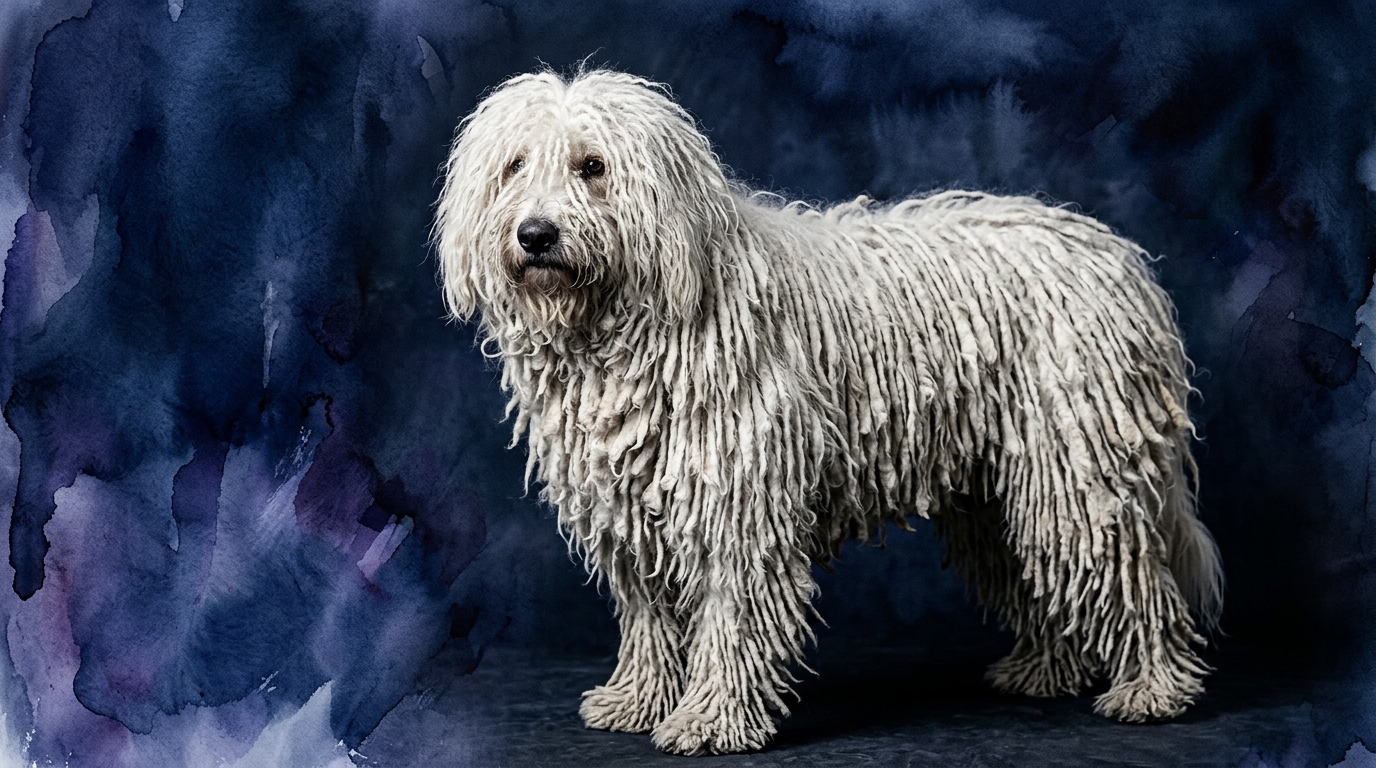

Side-by-Side Cognitive Profiles: Komondor vs. Cesky Terrier
At The Cosmic Pet Pet IQ Lab, both the Komondor (Working group, Coren rank #67) and the Cesky Terrier (Terrier group, Not Coren-ranked) register a consistent 3/5 across all five cognitive dimensions. While the numerical scores are identical, the context and manifestation of these abilities differ profoundly due to their historical roles.
For the Komondor, a 3/5 in Problem Solving reflects its capacity for independent decision-making when protecting livestock. This isn't about solving abstract puzzles, but rather assessing real-world threats and strategizing herd movements without direct human command, relying on its own judgment in critical situations.
Its Training Speed of 3/5 means the Komondor learns commands at a moderate pace, yet its independent guardian nature often leads it to evaluate the necessity of a command before compliance; consistency and patience are paramount. Social Intelligence at 3/5 points to a deep attunement to its family or 'flock,' discerning friend from foe with a strong protective bond, rather than navigating complex human social nuances broadly.
The Komondor's Instinctive Drive of 3/5 is powerfully geared towards guarding and territorial vigilance, the very core of its existence and purpose. Finally, its Memory at 3/5 demonstrates retention of spatial information about its territory, as well as past threats or routines essential for its protective duties.
The Cesky Terrier, also scoring 3/5 in Problem Solving, exhibits this as focused persistence in tracking and cornering small game, navigating complex underground burrows, and overcoming physical obstacles in pursuit. This is a highly task-oriented and determined form of cognitive application.
A 3/5 Training Speed for the Cesky indicates it can learn commands moderately quickly, but its inherent terrier tenacity and strong scent drive often make sustained focus a challenge; engaging, varied training methods are most effective. Its Social Intelligence at 3/5 means it forms strong, affectionate bonds with its immediate family, understanding household dynamics, while often being reserved or wary of strangers.
The Cesky Terrier's Instinctive Drive of 3/5 is a potent prey drive, manifesting as a keen interest in small animals, a desire to explore, and an inclination to dig, embodying its terrier heritage. Its Memory at 3/5 allows it to recall learned commands, established routines, and the locations of interesting smells or potential digging spots with good reliability.
Where the Komondor Excels Cognitively
The Komondor's cognitive strengths truly shine in its capacity for autonomous judgment and broad environmental oversight. Its combination of problem-solving, social intelligence, and intense instinctive drive confers an exceptional ability to make self-directed decisions in guardian roles. Unlike breeds that await instruction, the Komondor processes situations, assesses threats, and reacts independently, a crucial cognitive advantage when protecting vulnerable livestock in expansive, unsupervised settings.
Furthermore, the Komondor exhibits superior large-scale environmental awareness. Its memory and problem-solving are inherently geared towards understanding and managing vast territories. This involves creating intricate mental maps of its domain, identifying safe zones, potential dangers, and the movements of its charges and intruders. This spatial and situational cognition, honed over centuries, is a distinct advantage for overseeing extensive environments.
Where the Cesky Terrier Excels Cognitively
The Cesky Terrier's cognitive advantages are rooted in its focused persistence and adaptable resourcefulness within specific tasks. Its problem-solving and instinctive drive synergize to create an animal that excels at single-minded pursuit and navigation through complex, often confined, environments. This breed demonstrates a remarkable mental fortitude to overcome obstacles and 'think' its way through a challenge, such as tracking a scent through a dense undergrowth or into a burrow, until its objective is met.
Moreover, the Cesky's cognitive makeup grants it an agile adaptability within its immediate surroundings. While not tasked with guarding vast landscapes, its memory and problem-solving are adept at quickly learning and exploiting opportunities in dynamic, smaller-scale environments. It can rapidly adjust to new routines, learn new tricks, or figure out novel ways to engage with its surroundings, particularly if the task appeals to its innate drives for exploration and interaction.
Which is Easier to Train, and Why?
Neither the Komondor nor the Cesky Terrier are typically described as 'easy' to train in the conventional sense, largely due to their strong, independent temperaments. Their identical 3/5 training speed scores are deceptive without understanding their underlying behavioral drivers.
Training a Komondor demands exceptional patience and a profound understanding of its guardian mindset. While it possesses the cognitive capacity to learn commands, its independence often leads it to question the necessity of a directive, especially if it perceives it as conflicting with its primary duty or simply unnecessary. Compliance often stems from respect and a clear purpose, rather than blind obedience. An owner must respect its autonomy and establish a strong, trust-based relationship, understanding that its cognitive process involves evaluating the 'why' behind a command.
The Cesky Terrier's training speed is influenced by its characteristic terrier tenacity and potent prey drive. It can grasp concepts quickly, but its focus can easily be diverted by interesting scents or movements, requiring consistent, engaging, and highly motivating training sessions to maintain attention. Its independent streak can translate into stubbornness, making it challenging for novice owners. However, the Cesky's desire to interact and please its chosen family can be a powerful lever in training, provided the methods are fun and varied.
In practical terms for a typical pet owner, the Cesky Terrier might be perceived as 'easier' to train. Its independence often manifests as stubbornness or distraction, which can be managed with consistent, positive reinforcement and high-value rewards. The Komondor's independence, however, is a deeper cognitive trait rooted in self-sufficient decision-making, making it less inclined to follow commands it deems superfluous, requiring a more nuanced, respectful, and less coercive approach.
Active Owners vs. Relaxed Owners: Which Breed Suits Whom?
The Komondor generally suits more relaxed, yet highly vigilant, owners. This is not a breed for jogging partners or intense agility courses. Its 'activity' is predominantly mental – observing, surveying, and assessing its environment. It requires ample space, a clear sense of purpose (even if that's guarding the family and home), and an owner who respects its need for independence and quiet surveillance. Casual strolls in crowded urban areas are generally not ideal for its temperament; it thrives with a secure territory to oversee and a calm, confident handler.
The Cesky Terrier, conversely, is better suited for active owners, though not necessarily marathon runners. This breed needs consistent physical exercise through daily walks, opportunities for digging (perhaps a designated digging spot), and mental stimulation through engaging games and training sessions. Its activity is more about exploring, sniffing out novelties, and participating in terrier-like pursuits. It's a more 'hands-on' active companion that thrives on interaction and purpose-driven activities, making it an excellent fit for owners who enjoy regular, varied engagement with their dog.
The Verdict
Choose the Komondor if you are an owner seeking a formidable, independent guardian whose cognitive strengths lie in autonomous protection and broad environmental awareness, and who can respect a dog's self-directed decision-making and patient vigilance.
Opt for the Cesky Terrier if you are an owner seeking a persistent, adaptable companion whose cognitive strengths are in focused task completion and engaging problem-solving, and who can provide consistent, stimulating interaction and manage a spirited terrier personality.
🧠 Find Your Pet's IQ Score
Our Pet IQ Lab assessment covers 25+ tests across 5 cognitive dimensions — personalized to your breed.
Take the Full IQ Test →Frequently Asked Questions
Are Komondors good family dogs?
Komondors are deeply devoted and protective of their families, viewing them as their 'flock.' However, their independent nature and protective instincts require early, extensive socialization and a clear understanding of their role within the family hierarchy to ensure they are well-adjusted household companions.
Are Cesky Terriers good with children?
Cesky Terriers can be wonderful family companions and are generally good with respectful children. Their playful nature can make them enjoyable playmates, but due to their terrier instincts and potential for stubbornness, supervision is always recommended, especially with very young children.
Do Cesky Terriers bark a lot?
Cesky Terriers can be quite vocal. Their strong instinctive drive means they are often quick to alert to strangers, unusual sounds, or potential 'prey' in the yard. Consistent training from a young age can help manage excessive barking, but some level of vocalization is inherent to the breed.