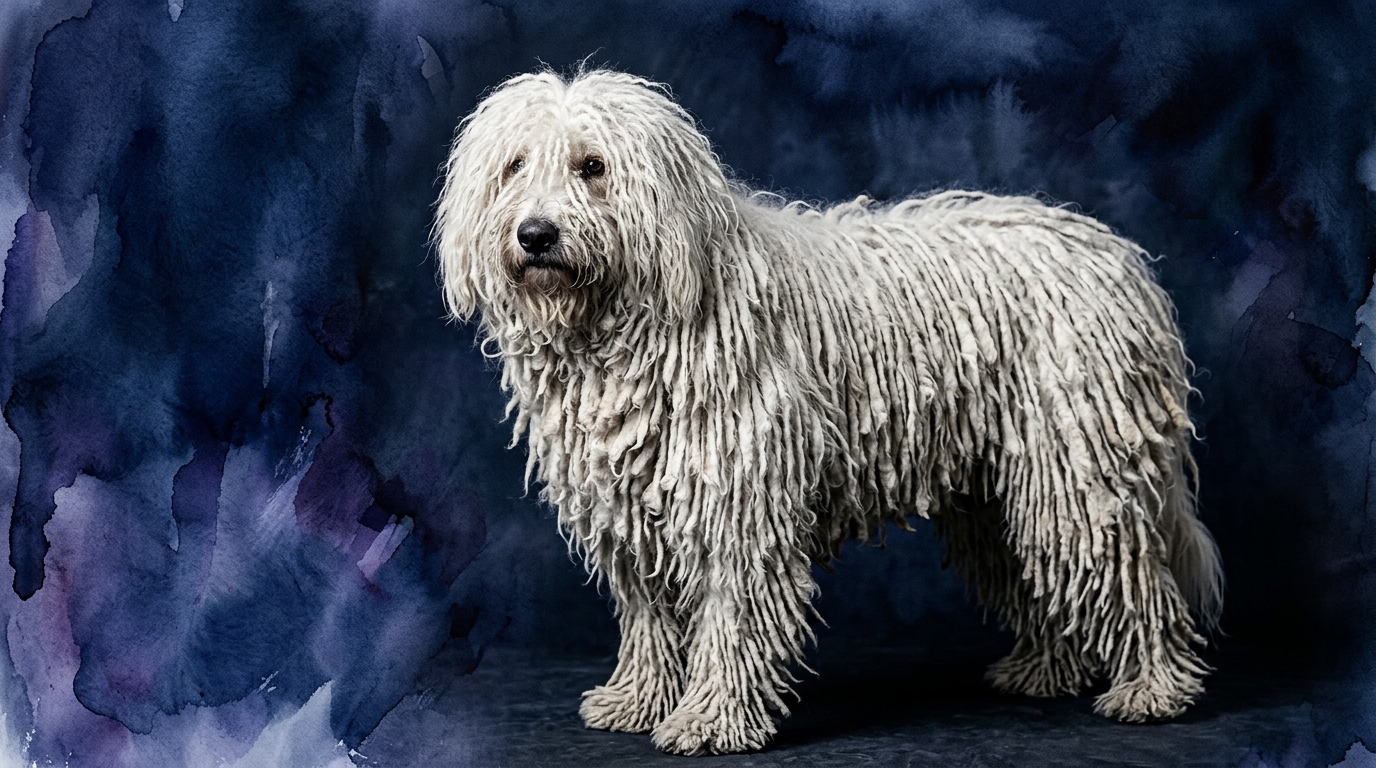

Side-by-Side Cognitive Profiles: Komondor vs. Chinook
At The Cosmic Pet Pet IQ Lab, we delve beyond simple scores to understand the unique cognitive landscapes of each breed. While both the Komondor and Chinook are rated similarly across five key intelligence dimensions, their historical roles and inherent temperaments shape how these mental faculties manifest. Understanding these nuances is crucial for any prospective owner.
The **Komondor**, a majestic livestock guardian from Hungary, brings centuries of independent decision-making to its cognitive profile. Its **Problem Solving** (3/5) is characterized by a self-reliant approach, often assessing threats and devising protective strategies without direct human intervention. This isn't about solving puzzles for treats, but rather analyzing environmental cues to safeguard its charges. Its **Training Speed** (3/5) reflects a thoughtful, deliberate learning style; Komondors are capable of learning, but their strong will means they often weigh commands against their own perceived priorities, requiring patience and consistent, trust-based methods. **Social Intelligence** (3/5) in a Komondor is highly specialized: deeply attuned to its family or 'flock,' it possesses an acute ability to distinguish trusted members from potential intruders, often appearing aloof or reserved with strangers. Its **Instinctive Drive** (3/5) is overwhelmingly dominated by its ancient guarding impulse, which dictates much of its behavior and decision-making. Finally, its **Memory** (3/5) is robust, particularly for territory, routine, and identifying individuals, essential for effective long-term guardianship.
In contrast, the **Chinook**, an American sled dog developed for companionship and utility, exhibits a more cooperative and people-centric intelligence. Its **Problem Solving** (3/5) is often geared towards practical tasks and collaborative efforts, such as navigating varied terrain or working alongside handlers. They excel at figuring out how to achieve a goal in partnership with their human. The Chinook's **Training Speed** (3/5) benefits from its inherent desire to please and bond with its family, making it generally receptive to positive reinforcement and eager to learn new commands and tricks. Its **Social Intelligence** (3/5) is broadly inclusive, marked by a warm, friendly disposition towards both familiar people and polite strangers, thriving on interaction and inclusion within the family unit. The primary **Instinctive Drive** (3/5) for a Chinook lies in companionship and a moderate desire for physical activity, often expressed through a strong bond with its owner and enthusiasm for shared adventures. Its **Memory** (3/5) is reliable for routines, learned commands, and social cues, contributing to its adaptability as a cherished family member.
Where the Komondor Excels Cognitively
The Komondor's cognitive strengths lie in its profound independence and strategic vigilance. Its problem-solving capabilities are honed for autonomous decision-making in complex, dynamic environments, such as assessing a perceived threat to its flock. This isn't about rapid obedience but rather a calculated evaluation of a situation, drawing on its memory of past experiences and innate guarding instincts to formulate the most effective response. Their social intelligence, while not broadly outgoing, is exceptionally discerning; they possess an unparalleled ability to identify and respond to subtle shifts in their environment and the intentions of unfamiliar individuals, a critical skill for a protector. This self-reliance means they can operate effectively without constant human directives, a distinct cognitive advantage in their traditional role.
Where the Chinook Shows Cognitive Prowess
The Chinook's cognitive advantages are rooted in its cooperative nature and adaptability. Its problem-solving shines in situations requiring partnership and communication with humans, such as navigating a new hiking trail or mastering a multi-step obedience sequence. This breed thrives on shared mental engagement, eagerly seeking to understand and fulfill human expectations. Their social intelligence is a broad asset, allowing them to integrate seamlessly into diverse family structures and enjoy interactions with a wide range of people, including children and other pets. This widespread sociability, combined with their moderate instinctive drive for companionship, positions them as highly adaptable and emotionally intelligent partners, excelling in roles that demand strong human-animal bonds and a willingness to learn within that partnership.
Training Dynamics: Komondor vs. Chinook
When considering ease of training, the behavioral distinctions between these breeds become pronounced, despite their identical 'training speed' scores. The Komondor, with its ingrained independence, approaches training with a thoughtful, often questioning demeanor. A command isn't merely an instruction to be followed; it's an input to be evaluated. This means that while they *can* learn quickly, their willingness to *perform* a command consistently depends heavily on their perception of its relevance or the strength of their bond with the trainer. Training a Komondor requires immense patience, clear communication, and a deep understanding of their guardian mindset, often taking longer to achieve reliable obedience because their self-directed problem-solving frequently overrides immediate compliance. They respond best to fair, consistent methods that respect their intelligence rather than demanding unquestioning submission.
Conversely, the Chinook's inherent desire for companionship and cooperative working spirit makes them generally more receptive and eager during training sessions. Their social intelligence and strong bond with their owners translate into a greater willingness to engage and please. While their 'training speed' is also rated 3/5, their cooperative drive means they are typically more motivated to actively participate and less likely to question the necessity of a command. They thrive on positive reinforcement, praise, and the opportunity to work alongside their human, making the training process often feel more fluid and rewarding for both parties. The Chinook's moderate instinctive drive for activity also means they enjoy the mental stimulation that training provides, viewing it as another form of shared engagement.
Owner Suitability: Active vs. Relaxed Lifestyles
Matching a dog's cognitive and behavioral profile to an owner's lifestyle is crucial. The Komondor is not a breed for the 'relaxed' owner seeking a low-maintenance companion, nor is it a typical 'active' dog in the sense of needing constant high-impact exercise. Instead, they require an owner who understands and respects their profound independence and guardian instincts. While they don't demand hours of running, they need mental engagement related to their protective nature, consistent boundaries, and a secure environment. Owners must be prepared to manage their aloofness with strangers and their self-assured decision-making. They suit individuals who appreciate a dog with a strong will and a thoughtful, rather than overtly eager, approach to life, and who can provide firm, patient leadership.
The Chinook, on the other hand, is an excellent fit for active owners who desire a cooperative and engaged canine partner. Their moderate instinctive drive for activity and strong social intelligence means they thrive on shared experiences like hiking, jogging, or participating in dog sports. They are not content to be left alone for long periods and flourish in environments where they are integral to family activities. While they can adapt to some downtime, consistent mental and physical stimulation is vital for their well-being. A truly 'relaxed' owner might find the Chinook's need for interaction and activity challenging. They are ideal for individuals or families seeking a devoted, versatile companion eager to participate in an adventurous and interactive lifestyle.
The Verdict: Choosing Your Canine Companion
Navigating the cognitive landscapes of the Komondor and Chinook reveals two distinct profiles, despite their numerically similar IQ scores. The choice between them hinges on the specific dynamics you seek in a canine partner and the lifestyle you can provide. Both breeds offer unique rewards to the discerning owner.
The Komondor’s intelligence is a testament to its ancient role: a self-sufficient guardian whose mental faculties are geared towards autonomous protection and discerning judgment. The Chinook, conversely, showcases intelligence that thrives on cooperation, social bonding, and adaptable partnership with its human family. Both are working breeds, but their work, and thus their cognitive application, differs significantly.
The Verdict
Choose the Komondor if you seek a highly independent, vigilant guardian with a self-reliant cognitive style, capable of making autonomous decisions for protection, and who appreciates a thoughtful, less overtly eager-to-please companion.
Choose the Chinook if you desire a cooperative, people-oriented companion that thrives on shared activities and interaction, valuing a dog that is eager to engage in learning and family life.
🧠 Find Your Pet's IQ Score
Our Pet IQ Lab assessment covers 25+ tests across 5 cognitive dimensions — personalized to your breed.
Take the Full IQ Test →Frequently Asked Questions
Is the Komondor's independence a sign of lower intelligence?
No, the Komondor's independence reflects a specialized form of intelligence developed for autonomous livestock guarding, where quick, self-reliant decisions are crucial without human direction, rather than a lack of cognitive ability. It signifies a distinct application of their cognitive capacity.
Why isn't the Chinook Coren-ranked if it's a working breed?
The Coren ranking system primarily evaluates obedience and working intelligence based on specific trials, and the Chinook, while capable, might not have participated in these particular trials or achieved widespread recognition within those parameters, which doesn't diminish its practical working intelligence or adaptability.
Do both breeds require similar mental stimulation?
While both breeds possess moderate problem-solving and memory, the *type* of mental stimulation differs; Komondors benefit from tasks that engage their guarding instincts and problem-solving around territory, while Chinooks thrive on interactive games, cooperative training, and activities that involve their family.