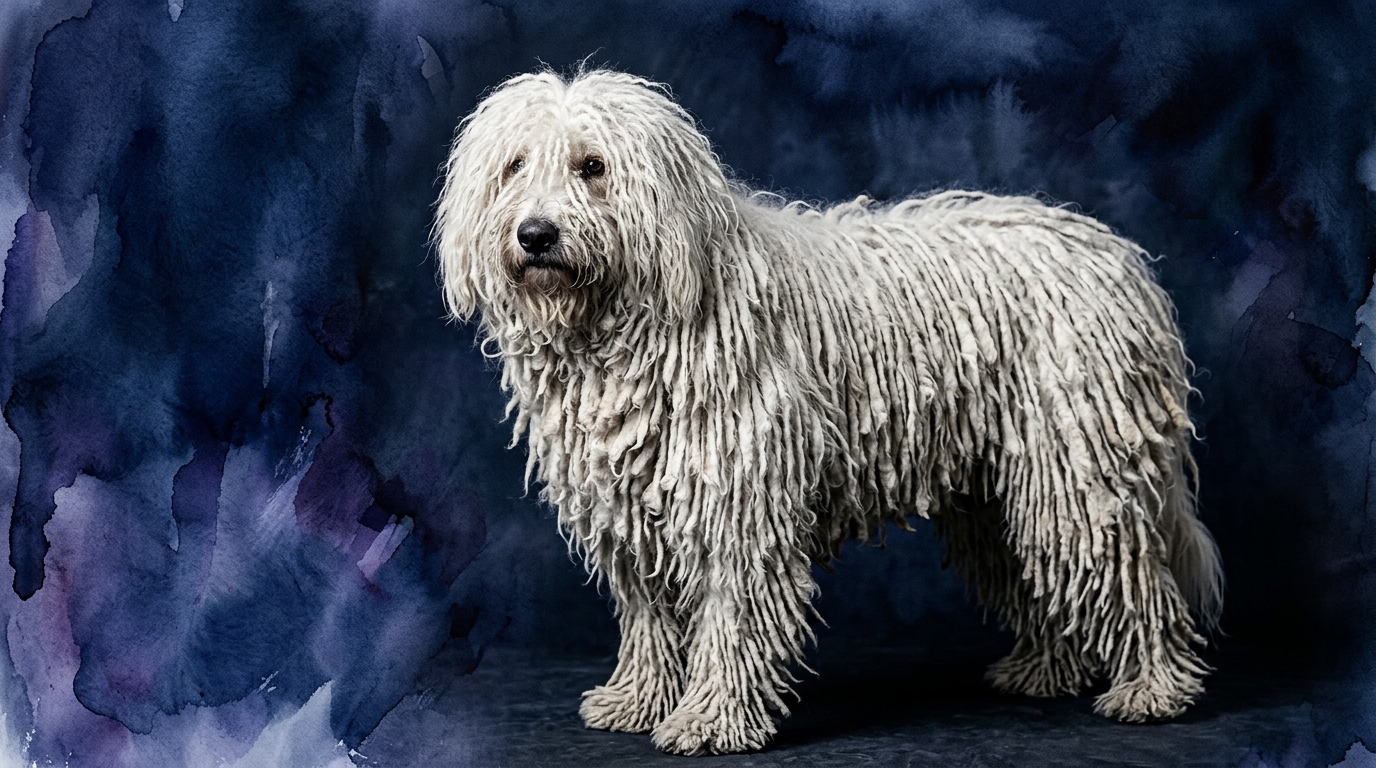

Side-by-side IQ profile: Guardians vs. Retrievers
The Komondor (Working, Coren #67) and Flat-Coated Retriever (Sporting, Coren #17) showcase divergent cognitive blueprints shaped by their historical purposes. Examining their individual IQ dimensions provides a nuanced understanding beyond simple ranking.
For the Komondor, problem-solving at 3/5 reflects an aptitude for independent decision-making, crucial for assessing threats and protecting livestock without constant human direction. Their training speed, also 3/5, suggests a deliberate learning pace, requiring patient, consistent reinforcement due to their self-reliant nature. Social intelligence is 3/5, indicating a solid capacity to understand social cues, applied discerningly within their protective duties. Instinctive drive, at 3/5, is strongly oriented towards guarding and territorial defense, a hardwired predisposition to survey and protect charges. Memory stands at 3/5, sufficient for recalling established routines, territory boundaries, and recognizing familiar individuals, essential for a vigilant guardian.
The Flat-Coated Retriever demonstrates a problem-solving score of 4/5, excelling at intricate tasks like navigating complex environments or figuring out multi-step retrieval challenges. Their training speed, 4/5, indicates a quick grasp of new commands and a strong willingness to perform, driven by a cooperative spirit and eagerness to please their handler. Social intelligence matches the Komondor at 3/5, manifesting as an affable, perceptive understanding of social dynamics, making them excellent companions. Their instinctive drive, 3/5, is profoundly rooted in retrieving, scent work, and joyful interactive play, a testament to their gundog heritage. Memory, scoring an exceptional 5/5, is where the Flat-Coat truly shines, exhibiting remarkable recall for complex sequences, specific item locations, and an extensive repertoire of commands, making them highly reliable.
Where Komondor wins cognitively
The Komondor's cognitive strengths lie in its autonomous decision-making and robust self-reliance. Its 3/5 problem-solving score, while not the highest, is perfectly adapted for evaluating potential threats and acting independently to protect livestock, often without direct human commands. This breed excels in contextual awareness, processing environmental cues to determine appropriate responses in dynamic, unsupervised situations. Their mental fortitude allows them to remain vigilant and make sound judgments over extended periods, a critical attribute for a guardian breed whose primary role historically involved solitary watchfulness and defense.
Where Flat-Coated Retriever wins cognitively
The Flat-Coated Retriever's cognitive prowess is evident in its exceptional memory and cooperative problem-solving abilities. With a 5/5 memory score, they can recall intricate sequences of commands, the precise location of objects over varied terrain, and adapt learned behaviors efficiently. Their 4/5 problem-solving skill thrives in collaborative tasks, where they can interpret subtle handler cues and apply learned strategies to overcome obstacles, such as navigating tricky retrieves or excelling in complex obedience routines. This breed demonstrates a superior capacity for processing and retaining information related to human interaction and task execution.
Which is easier to train and why
The Flat-Coated Retriever generally presents as the easier breed to train, primarily due to its higher training speed (4/5) and innate eagerness to cooperate. Their strong desire to please, coupled with their exceptional memory, means they typically grasp new commands swiftly and retain them effectively. They respond well to positive reinforcement and find joy in working alongside their human partners, making training sessions engaging and productive.
The Komondor, with a training speed of 3/5, requires a different approach. Their historical role as independent livestock guardians fostered a self-sufficient mindset, meaning they are less inherently driven to follow every human directive without question. Training a Komondor demands immense patience, consistency, and a deep understanding of their independent nature; they learn, but they often choose when to comply based on their own assessment, rather than simply obeying. Their training involves building trust and respect, recognizing that they are partners, not merely followers.
Which suits active owners vs relaxed owners
For active owners seeking a highly engaged and collaborative canine partner, the Flat-Coated Retriever is an ideal match. Their strong instinctive drive for retrieving and their high energy levels demand regular, vigorous exercise and mental stimulation, such as field work, agility, or extensive hikes. They thrive on being involved in family activities and require owners who can commit significant time to training, play, and exploration.
The Komondor, while requiring regular exercise to maintain physical health, is often better suited for owners who appreciate a more self-contained and observant companion. While they are not 'relaxed' in the sense of being sedentary, their activity often manifests as patrolling their territory and quiet vigilance. Owners must be consistent and firm, understanding that the Komondor's independence means it won't always be a 'go-getter' in the same way a retriever is. They suit experienced owners who can provide clear boundaries and appreciate a dog that operates with a degree of autonomy.
The Verdict
Opt for a Komondor if you seek an independent, vigilant guardian capable of autonomous decision-making, and you are prepared for a deliberate training journey built on mutual respect. They are ideal for experienced owners who appreciate a self-reliant companion with a strong protective instinct.
Select a Flat-Coated Retriever if you desire an enthusiastic, highly trainable partner for active pursuits, thriving on cooperative tasks and demonstrating exceptional recall and memory. They are perfect for engaged owners ready to invest in consistent training and ample mental and physical stimulation.
🧠 Find Your Pet's IQ Score
Our Pet IQ Lab assessment covers 25+ tests across 5 cognitive dimensions — personalized to your breed.
Take the Full IQ Test →Frequently Asked Questions
Does Coren's rank fully capture a breed's intelligence?
Coren's rank, while a useful general indicator of working and obedience intelligence, doesn't encompass the full spectrum of canine cognition. It primarily reflects trainability and problem-solving in human-directed tasks, often overlooking specialized instinctive drives or independent decision-making crucial to breeds like the Komondor.
How does a Komondor's problem-solving differ from a Flat-Coated Retriever's?
A Komondor's 3/5 problem-solving is geared towards independent threat assessment and protection, making autonomous decisions in a guardian role. A Flat-Coated Retriever's 4/5 problem-solving focuses on cooperative tasks, interpreting human cues, and efficiently executing complex retrieval or obedience challenges.
Why is memory so important for a Flat-Coated Retriever?
Exceptional memory (5/5) is vital for a Flat-Coated Retriever because their historical role as gundogs required them to recall the precise location of multiple fallen birds, remember complex scent trails, and execute multi-step commands over varied terrain, ensuring efficient and reliable retrieval.