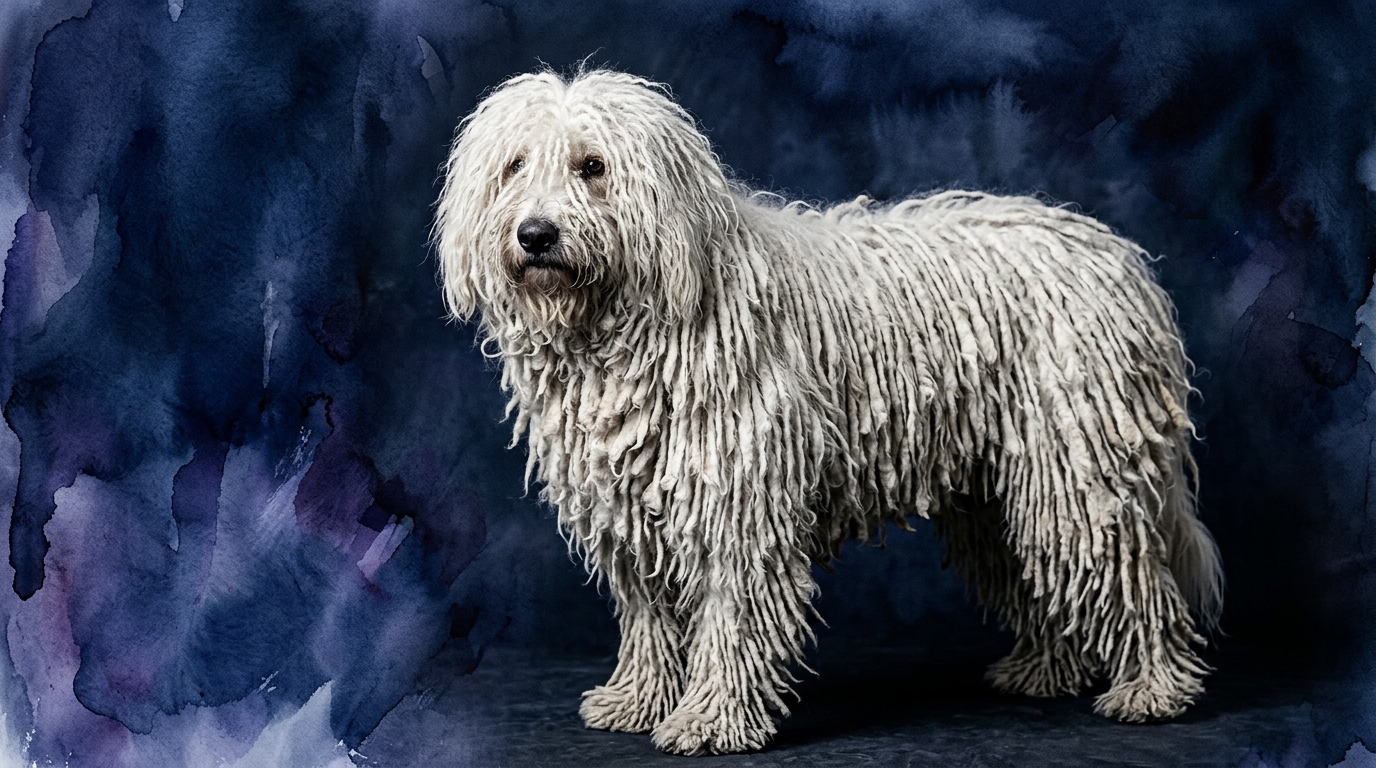

Side-by-Side Cognitive Profiles: Komondor vs. Russian Toy
At first glance, the Komondor and Russian Toy present an intriguing puzzle: both breeds share a uniform 3/5 rating across all five cognitive dimensions in The Cosmic Pet Pet IQ Lab. This parity, however, belies profoundly different manifestations of these abilities, rooted in their distinct historical roles and physical forms. Understanding what a '3/5' means in the context of a 100-pound livestock guardian versus a 6-pound companion is key to appreciating their unique mental landscapes.
For the Komondor, a 'Problem Solving 3/5' indicates a robust capacity for independent decision-making within its guarding duties. This isn't about solving abstract puzzles, but rather about assessing environmental threats, discerning friend from potential foe among livestock and strangers, and formulating a protective response without direct human command. Their 'Training Speed 3/5' suggests they are capable learners, but their inherent independence often means they will comply only when they perceive the command's value or necessity, rather than out of eager deference. Their 'Social Intelligence 3/5' is finely tuned to their protective role, allowing them to read intentions from a distance, understand flock dynamics, and gauge the safety of their human family. 'Instinctive Drive 3/5' is overwhelmingly channeled into guarding, territoriality, and a vigilant watchfulness. Finally, their 'Memory 3/5' enables them to recall territory boundaries, recognize familiar faces (both human and animal), and remember past threats or safe encounters across broad areas.
The Russian Toy, despite identical 3/5 scores, applies these cognitive strengths to a completely different world. Their 'Problem Solving 3/5' manifests as cleverness within a domestic setting—figuring out how to get attention, locating hidden treats, or navigating household obstacles. This is a practical, immediate form of problem-solving aimed at enhancing their comfort and interaction with their human family. Their 'Training Speed 3/5' often translates to a keenness to learn basic commands and tricks, driven by a desire to please and engage with their owners. While not excelling in complex obedience, they are generally receptive and quick to pick up routines. 'Social Intelligence 3/5' for the Russian Toy is highly refined for human interaction; they are adept at reading subtle shifts in owner mood, understanding household dynamics, and communicating their needs through nuanced body language. Their 'Instinctive Drive 3/5' is primarily expressed through strong companion instincts, a desire for closeness, and sometimes a surprising boldness or 'terrier' like feistiness despite their size. 'Memory 3/5' allows them to retain an impressive array of household rules, remember routines, and recall the locations of favorite people, toys, or sleeping spots.
Where the Komondor Excels Cognitively
The Komondor's cognitive strengths truly shine in scenarios demanding independent judgment and self-sufficiency, a direct legacy of their livestock guardian heritage. While both breeds score 3/5 in Problem Solving, the Komondor’s application of this skill is geared towards complex, real-world, and often solitary decision-making. Imagine a Komondor assessing a potential threat to its flock from a distance, weighing factors like wind direction, movement patterns, and the perceived intent of an approaching entity – all without a human handler to issue commands. This requires a robust form of practical intelligence, where the consequences of an incorrect decision can be severe. Their Social Intelligence, also rated 3/5, is similarly specialized; it's less about charming new acquaintances and more about discerning loyalty and threat within their immediate sphere of responsibility, making them astute judges of character in a protective context. Their memory, while rated average, is adept at retaining the layout of vast territories and the identities of countless individual animals and people within their charge, critical for effective, long-term guardianship.
Where the Russian Toy Excels Cognitively
Conversely, the Russian Toy's cognitive advantages are pronounced in the realm of nuanced human-animal communication and adaptability within a domestic setting. Their 3/5 Social Intelligence is a highly refined tool for intimate companionship, allowing them to pick up on the slightest human emotional cues, anticipate needs, and tailor their behavior to elicit specific responses from their owners. This makes them exceptionally engaging and intuitive companions. Their Problem Solving, also 3/5, is expressed through cleverness in navigating the intricacies of a human household, such as figuring out how to get attention during a busy moment or manipulating a situation to their advantage (e.g., 'accidentally' dropping a toy near a person to initiate play). This isn't about protecting livestock, but about optimizing their personal comfort and connection. The Russian Toy's memory, though rated 3/5, is particularly sharp for recalling complex household routines, the locations of preferred comfort items, and the specific quirks of their human family members, fostering a deep sense of belonging and predictability within their home environment.
Trainability: A Question of Motivation and Independence
Despite both breeds having a 'Training Speed 3/5,' the Komondor and Russian Toy present very different training experiences due to their underlying behavioral drivers. The Komondor, bred for independent decision-making, can be a challenging student. While capable of learning commands at an average pace, their compliance is often contingent on their assessment of the command's utility or their trust in the handler. They are not naturally eager to please in the way many other breeds are, and their strong-willed nature means they may simply choose not to obey if they don't see the point. Training a Komondor requires immense patience, consistency, and a deep understanding of their independent mindset, focusing on building a respectful partnership rather than expecting blind obedience. They respond best to positive reinforcement and clear, consistent boundaries, but their guarding instincts can make them wary of strangers or new situations during training.
The Russian Toy, on the other hand, often appears easier to train in basic obedience and tricks, largely due to their companion-oriented nature and desire for interaction. While their 'Training Speed' is also 3/5, their eagerness to please their beloved owners and their motivation for praise and treats can make them highly cooperative pupils. They thrive on positive reinforcement and enjoy the mental stimulation of learning new things alongside their people. However, their small size and sometimes delicate nature can mean they are not suited for highly rigorous or physically demanding training. Their potential for 'small dog syndrome' if not properly socialized and trained can manifest as bossiness or timidity, requiring a firm yet gentle hand to ensure they learn appropriate social behaviors and household manners. So, while both learn at an average speed, the Komondor's independence presents a greater hurdle to consistent application compared to the Russian Toy's inherent desire for connection.
Matching Breeds to Lifestyles: Active vs. Relaxed Owners
The Komondor, with its historical role as a guardian, is best suited for owners who embody a certain active vigilance, even if their own lifestyle isn't physically demanding in the traditional sense. These dogs require owners who are prepared to manage a strong-willed, independent thinker with significant protective instincts. They thrive in environments where they have a 'job' to do, even if that job is simply monitoring a large property or family. Their physical exercise needs are moderate, but their mental needs for security and clear leadership are high. They are not for the faint of heart or those seeking a highly compliant, 'easy' dog. Owners must be committed to extensive socialization and consistent, patient training to channel their impressive cognitive and instinctive drives effectively. They suit owners who appreciate a dog's autonomous judgment and are comfortable with a less overtly affectionate, more dignified companion.
The Russian Toy, conversely, is an ideal fit for more relaxed owners who desire a highly interactive, devoted companion. Their cognitive profile, with its emphasis on social intelligence and domestic problem-solving, makes them perfectly adapted to life as a cherished household member. While they benefit from regular walks and play, their exercise requirements are modest, making them suitable for apartment living or less active individuals. Their mental stimulation comes from engaging with their human family, learning new tricks, and participating in daily routines. Owners should be prepared for a dog that thrives on close proximity and interaction, often seeking to be the center of attention. They are perfect for those who enjoy a dog that communicates subtle cues, offers constant companionship, and brings a lively, affectionate presence into their home, without the demands of a large, independent working breed.
The Verdict
Choose the Komondor if you seek an independent, vigilant guardian with a dignified presence, are prepared for a committed training journey, and value a dog's autonomous problem-solving in a protective capacity.
Opt for the Russian Toy if you desire a highly interactive, affectionate companion adept at reading human emotions, thriving on domestic engagement, and fitting seamlessly into a relaxed, companion-focused lifestyle.
🧠 Find Your Pet's IQ Score
Our Pet IQ Lab assessment covers 25+ tests across 5 cognitive dimensions — personalized to your breed.
Take the Full IQ Test →Frequently Asked Questions
Do Komondors need extensive physical exercise?
Komondors have moderate exercise needs; they enjoy regular walks and having space to patrol, but they are not high-energy dogs requiring constant strenuous activity. Their mental stimulation often comes from their guarding duties and observing their environment.
Are Russian Toys good with children?
Russian Toys can be good with older, respectful children who understand how to interact gently with a small dog. Due to their delicate size, they are generally not recommended for homes with very young children who might accidentally injure them.
How do their guarding instincts differ?
The Komondor possesses strong, inherent guarding instincts focused on livestock and territory, leading to independent protective actions. The Russian Toy, while sometimes bold, primarily exhibits a protective instinct towards its immediate human family, often manifesting as alert barking rather than direct confrontation.