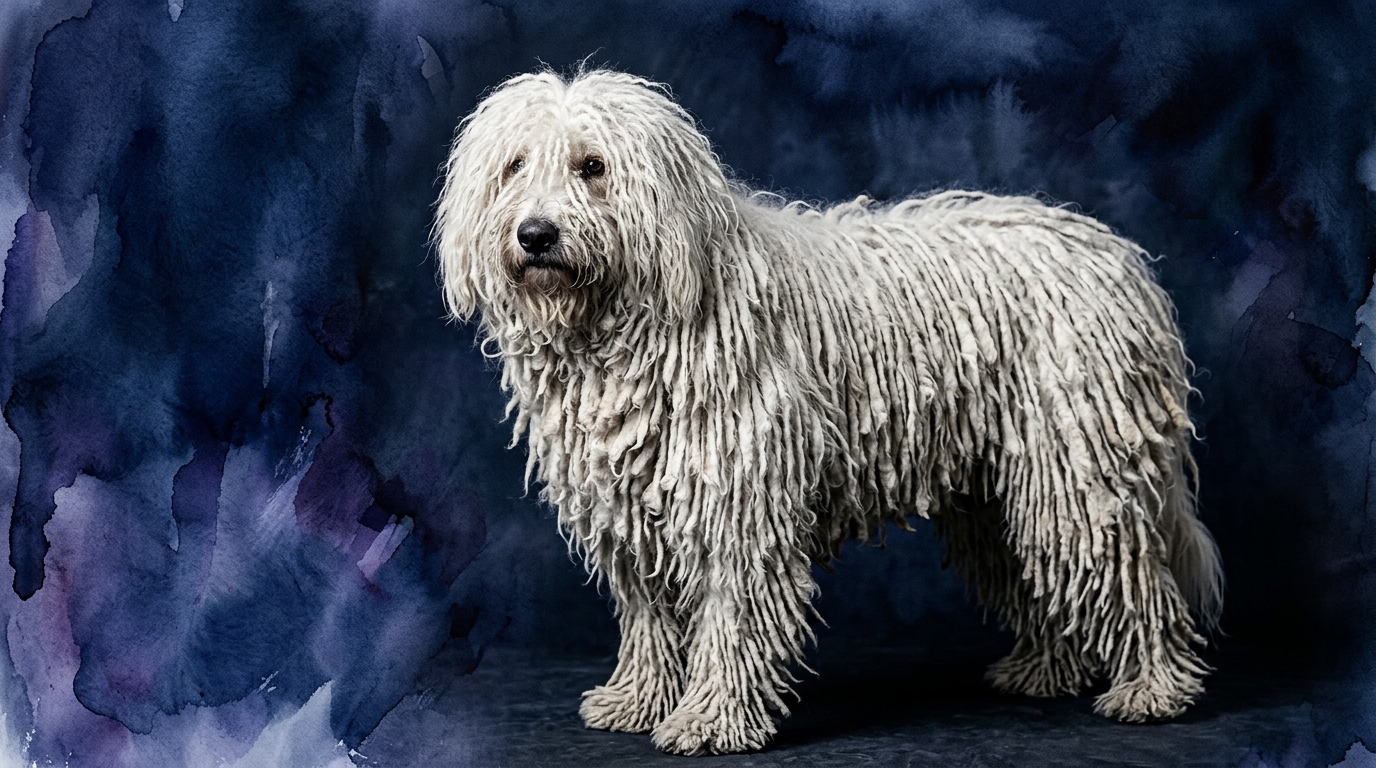

Side-by-Side Cognitive Profiles: Komondor vs. Wirehaired Pointing Griffon
The Komondor, a majestic Working Group dog recognized by its distinctive corded coat, holds a Coren rank of #67. Its cognitive profile shows Problem Solving at 3/5, reflecting an independent capacity to assess situations and act, crucial for its historical role as a livestock guardian where immediate human direction was often absent. Training Speed is also 3/5; while capable of learning, the Komondor's inherent self-reliance means it often processes commands through the lens of its guardian instincts, requiring patient and consistent guidance. Social Intelligence, rated 3/5, manifests as deep loyalty to its family unit, coupled with a naturally reserved and discerning demeanor towards strangers, a trait essential for protecting its charges. Its Instinctive Drive, 3/5, is strongly rooted in vigilance and territorial defense, always scanning its environment for potential threats. Memory, at 3/5, supports its protective duties, allowing it to recall safe individuals, established routines, and past perceived dangers within its domain.
Hailing from the Sporting Group, the Wirehaired Pointing Griffon, though not Coren-ranked, presents an equally balanced cognitive profile. Its Problem Solving is 3/5, showcasing an aptitude for navigating complex outdoor environments, tracking scents, and locating game, often requiring intricate decision-making in the field. Training Speed, rated 3/5, indicates a cooperative and generally eager learner, though its strong prey drive can sometimes lead to distraction, demanding engaging and consistent methods to keep its focus. Social Intelligence, also 3/5, highlights its affable nature with its human companions and a readiness to work in partnership, a cornerstone of its function as a versatile hunting dog. The Griffon's Instinctive Drive, 3/5, is powerfully geared towards pointing and retrieving, an innate desire to hunt that defines much of its behavior and mental engagement. Its Memory, 3/5, is adept at retaining commands, remembering scent trails, and recalling successful hunting patterns, crucial for its performance in the field.
Where the Komondor Excels Cognitively
The Komondor's cognitive strengths truly shine in scenarios demanding autonomous judgment and protective vigilance, a direct reflection of its ancestral role as a livestock guardian. Its 3/5 Problem Solving isn't about fetching a ball on command, but about independently assessing a potential threat to its "flock"—be it human family or livestock—and determining the appropriate response without direct human instruction. This involves complex environmental scanning, threat evaluation, and strategic action, often requiring a nuanced understanding of territory and perceived danger. The Komondor's 3/5 Social Intelligence excels in discerning friend from foe, exhibiting a profound, unwavering loyalty to its inner circle while maintaining a watchful, often aloof, stance towards outsiders, a cognitive filtering system vital for its protective duties. Its memory, also 3/5, is particularly robust for recalling patterns of its territory, identifying regular visitors, and remembering past perceived intrusions, allowing it to maintain consistent protective protocols. This breed's cognitive architecture is optimized for self-sufficient guardianship, a nuanced form of intelligence often underestimated in breeds that don't seek constant human direction.
Where the Wirehaired Pointing Griffon Excels Cognitively
In contrast, the Wirehaired Pointing Griffon's cognitive advantages are deeply rooted in collaborative problem-solving and highly refined instinctive behaviors geared towards its hunting heritage. Its 3/5 Problem Solving manifests as a keen ability to systematically quarter a field, utilizing its exceptional olfactory senses to locate hidden game and then "point" with unwavering focus, a multi-sensory puzzle it solves in close coordination with its human handler. This requires not just physical prowess but significant mental mapping and scent discrimination. The Griffon's 3/5 Social Intelligence is paramount in its ability to understand subtle handler cues, anticipate intentions, and work as a seamless partner in the field, valuing cooperation and communication. Its 3/5 Instinctive Drive, while matching the Komondor numerically, is channeled into specific, highly refined hunting tasks like pointing, flushing, and retrieving, showcasing a cognitive specialization for these complex sequences. The Griffon's memory, 3/5, excels at retaining intricate commands, remembering the nuances of various hunting terrains, and recalling the location of downed game, making it an exceptionally effective and responsive field companion.
Which is Easier to Train and Why?
When considering ease of training, the Wirehaired Pointing Griffon generally presents a more straightforward experience for the average owner compared to the Komondor, despite both having a 3/5 Training Speed rating. The Griffon's Sporting Group background has instilled a strong desire to work *with* humans, making it typically more eager to please and receptive to direction. Its 3/5 Social Intelligence fosters a cooperative spirit, where understanding and responding to handler cues is a rewarding part of its engagement. While its strong instinctive drive for hunting requires consistent focus management, this drive can also be effectively channeled into structured training, making it highly motivated by activities that mimic its natural inclinations. In contrast, the Komondor's 3/5 Training Speed is tempered by its inherent independence and guardian mentality. This breed was bred to make its own decisions in the absence of human command, meaning it often processes instructions through the lens of its protective duties. A Komondor may learn commands, but might choose to obey only if it aligns with its perceived role or judgment, requiring an owner with exceptional patience, consistency, and a deep understanding of its independent nature to build trust and respect rather than expecting immediate, unquestioning obedience.
Active Owners vs. Relaxed Owners: A Cognitive Match
The choice between these two breeds regarding owner activity levels hinges entirely on their historical functions and inherent drives. The Wirehaired Pointing Griffon is unequivocally suited for active owners. As a Sporting Group dog, its 3/5 Instinctive Drive for hunting translates into a significant need for regular, vigorous exercise and mental stimulation through activities like long hikes, running, swimming, and engaging in scent work or dog sports. A Griffon thrives when it has a "job" to do, and without sufficient physical and mental outlets, its energy can manifest in undesirable behaviors. A relaxed owner would quickly find themselves overwhelmed by the Griffon's persistent need for engagement and activity. Conversely, the Komondor, while requiring space and consistent mental stimulation related to its guardian role, is not a high-octane "go-go-go" breed in the same way. Its 3/5 Instinctive Drive is about watchful patrolling and territorial defense, which can involve periods of intense alertness interspersed with calm observation. While it needs daily walks and interaction, its energy expenditure is often more about surveillance and independent decision-making than continuous athletic exertion. It suits an owner who is present and engaged, but not necessarily seeking a constant athletic companion, understanding that its mental "work" is often more about observation and discernment.
The Verdict
Choose the Komondor if you appreciate an independent, watchful companion, prepared to commit to consistent, respectful training for a dog whose primary loyalty is to its "flock" and its own judgment.
Choose the Wirehaired Pointing Griffon if you are an active owner seeking a cooperative, energetic partner for outdoor adventures and structured activities, valuing a dog that thrives on working closely with its human.
🧠 Find Your Pet's IQ Score
Our Pet IQ Lab assessment covers 25+ tests across 5 cognitive dimensions — personalized to your breed.
Take the Full IQ Test →Frequently Asked Questions
How do the Komondor's and Wirehaired Pointing Griffon's problem-solving skills differ despite both being 3/5?
The Komondor's 3/5 problem-solving is primarily autonomous, focused on evaluating and responding to threats within its territory without human input, reflecting its guardian role. The Griffon's 3/5 problem-solving is collaborative, excelling in tasks like scent tracking and game location in partnership with a human handler, crucial for its sporting function.
Which breed is generally more outwardly social with strangers, considering their 3/5 social intelligence?
The Wirehaired Pointing Griffon, with its sporting background, tends to be more generally affable and open to friendly interactions with strangers once properly introduced. The Komondor's 3/5 social intelligence is highly selective, manifesting as deep loyalty to its family but inherent wariness and reservation towards unknown individuals, a protective instinct.
Does the Komondor's independence make it inherently less trainable than the Wirehaired Pointing Griffon?
While both breeds have a 3/5 training speed, the Komondor's independence means it often questions commands and prioritizes its own judgment, requiring exceptional patience and consistency. The Griffon, bred to work cooperatively, generally offers more willing compliance, making it feel "easier" to train for most owners due to its eagerness to please.