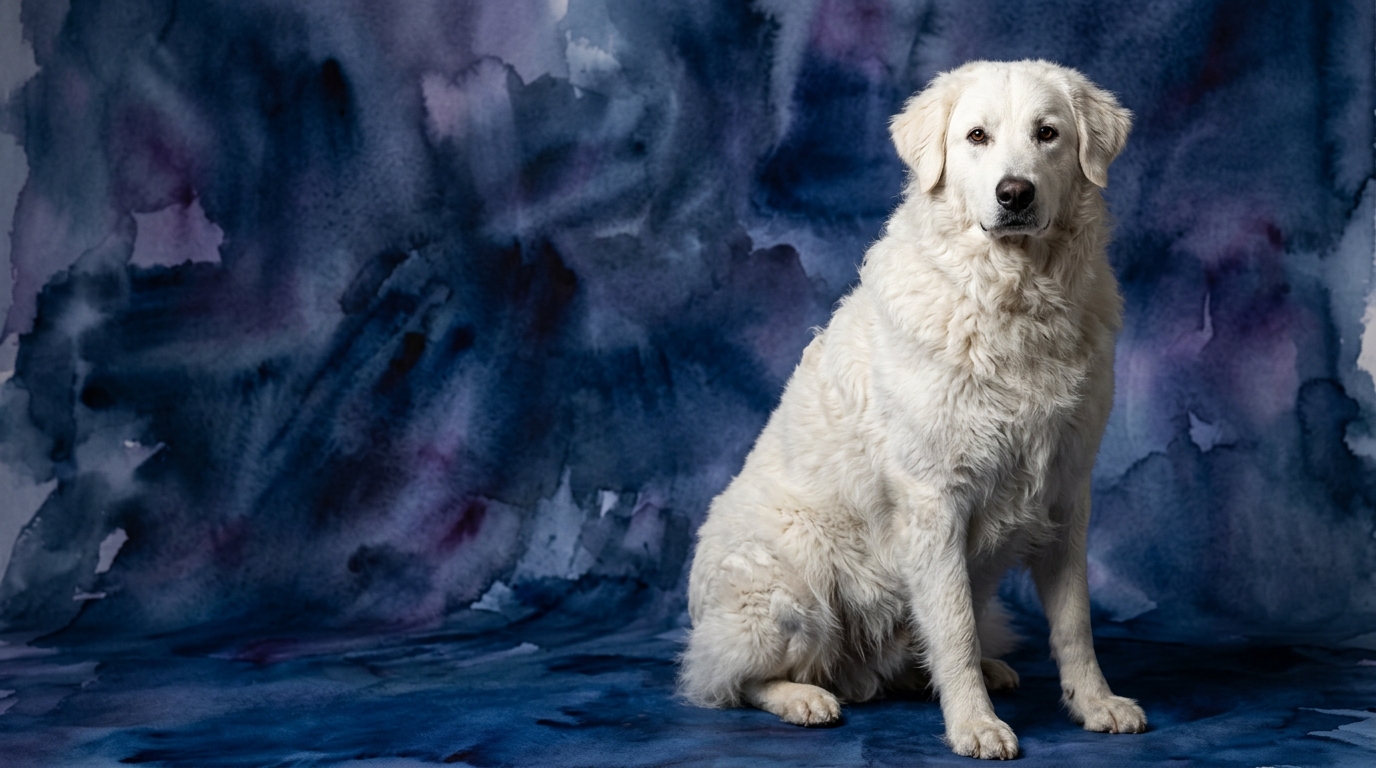
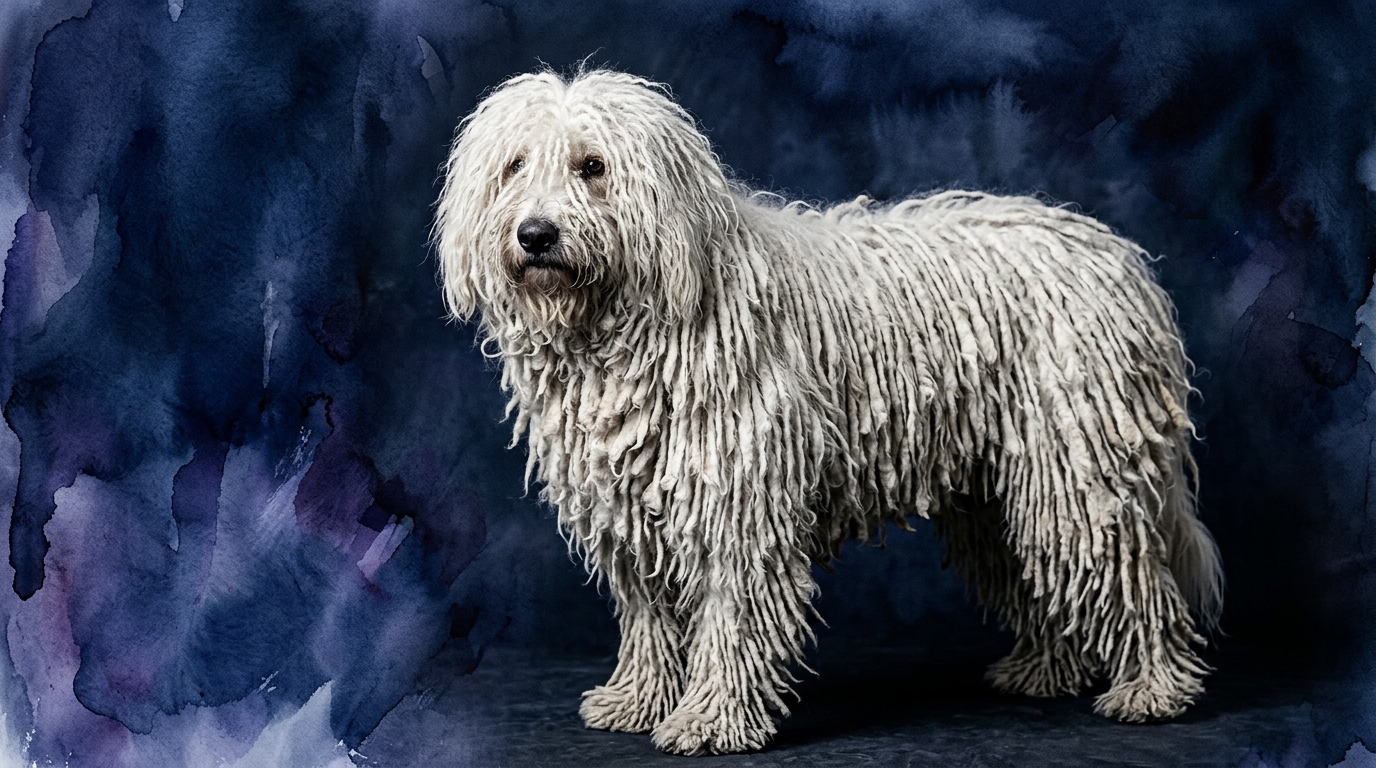
Side-by-side IQ Profile
Both the Kuvasz and Komondor belong to the Working Group, a classification that immediately hints at their purpose-driven cognitive architecture. Their roles as independent livestock guardians have sculpted their minds to prioritize vigilance, self-reliance, and protection over eager obedience, a common trait in many other working breeds. The Cosmic Pet Pet IQ Lab's assessment offers a granular view into these mental frameworks, beyond a simple Coren rank.
The Kuvasz, with a Coren rank of #42, demonstrates a balanced cognitive profile. Their Problem Solving is rated 3/5, indicating a solid capacity for navigating environmental challenges and making sound decisions, though not without deliberation. Training Speed also sits at 3/5, suggesting they absorb new commands at an average pace, requiring consistent, patient instruction. Social Intelligence is 3/5, meaning they are discerning in their interactions, forming deep bonds with their inner circle but remaining reserved with strangers. Their Instinctive Drive, crucial for their guardian role, scores 3/5, reflecting a strong, inherent desire to protect. Notably, their Memory stands out at 4/5, indicating a superior ability to retain learned behaviors, experiences, and routines over time.
The Komondor, positioned at Coren rank #67, presents a very similar, yet subtly distinct, cognitive makeup. Like the Kuvasz, their Problem Solving is 3/5, reflecting an independent and often solitary approach to challenges. Their Training Speed is also 3/5, underscoring the need for patient, consistent methods that respect their autonomous spirit. Social Intelligence is rated 3/5, signifying a characteristically aloof demeanor towards outsiders, coupled with profound loyalty to their family. Their Instinctive Drive, at 3/5, is a powerful force driving their protective nature, a non-negotiable aspect of their ancient heritage. The key difference lies in their Memory, which scores 3/5, indicating a solid but not exceptional capacity for recall and retention compared to their Kuvasz counterparts.
Where Kuvasz Wins Cognitively
The most pronounced cognitive advantage for the Kuvasz lies in its superior Memory, rated 4/5 compared to the Komondor's 3/5. This higher score translates directly into a more efficient learning process over the long term. A Kuvasz is more likely to remember complex sequences of commands, the boundaries of their territory, and past social interactions with greater clarity and for longer durations. This heightened recall means that once a lesson is learned, it is less likely to be forgotten, reducing the need for constant re-training on established behaviors.
Furthermore, the Kuvasz's Coren rank of #42, significantly higher than the Komondor's #67, suggests a greater general capacity for understanding and complying with human directives within a structured environment. While both breeds possess an independent streak, the Kuvasz might exhibit a marginally stronger inclination towards cooperative learning and engagement with an owner's guidance. This doesn't imply blind obedience, but rather a slightly more receptive mental framework for absorbing and acting upon human communication, making them potentially more adaptable to diverse training scenarios.
Where Komondor Wins Cognitively
While the Komondor's specific IQ dimensions largely mirror the Kuvasz, its cognitive strength isn't about outperforming in traditional metrics but excelling in its core purpose. The Komondor's lower Coren rank of #67, while often interpreted as less amenable to formal obedience, actually highlights a profound cognitive independence. This breed’s mind is wired for autonomous decision-making in complex, dynamic situations without direct human intervention, a critical asset for a solitary livestock guardian. This self-reliance ensures unwavering protection even when an owner is absent or unable to provide immediate direction.
The Komondor's 3/5 rating in Instinctive Drive, combined with its historical role and physical presence, manifests as an unshakeable, formidable protective instinct. Their cognitive 'win' is in the sheer, unyielding dedication to their charge, often expressed with a more intense and intimidating demeanor due to their unique corded coat and imposing stature. They are masters of assessing threats and reacting decisively based on their inherent judgment, a cognitive skill refined over centuries of solitary guardianship. This isn't a 'win' in terms of human-centric obedience, but a profound success in their designed evolutionary niche, prioritizing unwavering, independent vigilance above all else.
Which is Easier to Train and Why
When considering ease of training, the Kuvasz generally holds a slight edge, primarily due to its superior Memory (4/5) and higher Coren rank (#42). While their Training Speed is similar to the Komondor at 3/5, the Kuvasz's enhanced recall means that once a concept or command is grasped, it is more firmly embedded. This translates to fewer repetitions over time and a greater likelihood of the dog generalizing learned behaviors across different environments and distractions. Owners will still need considerable patience and positive reinforcement, as the Kuvasz retains its independent working dog nature, but their memory aids in long-term retention.
The Komondor, with a Memory score of 3/5 and a Coren rank of #67, demands a different approach to training. They are not inherently 'difficult,' but their strong sense of autonomy means they question commands that don't align with their perceived purpose or logic. Training a Komondor requires an owner to understand and respect this independent mindset, making sessions engaging, positive, and relevant to their natural guarding instincts. Consistency is paramount, as their average memory means lessons may need more frequent revisiting. Success hinges on building a relationship based on trust and mutual respect, rather than expecting eager compliance, as their problem-solving is geared towards self-sufficiency.
Which Suits Active Owners vs Relaxed Owners
Neither the Kuvasz nor the Komondor are suited for truly 'relaxed' owners in the sense of minimal engagement. Both are robust working breeds requiring significant commitment, though the nature of this 'activity' differs from that of a high-energy retriever. Both breeds need ample space, secure containment, and consistent mental stimulation. Owners must be actively involved in their socialization from a young age, especially given their 3/5 Social Intelligence, which predisposes them to reservation with strangers. This active commitment shapes their temperament and ensures they become well-adjusted family guardians.
Owners who are 'active' in terms of consistent, structured training and who enjoy engaging their dog in various learning activities might find the Kuvasz a more suitable companion. Their 4/5 Memory and slightly higher Coren rank suggest they might enjoy advanced obedience or even some low-impact dog sports more readily, provided the training is positive and motivating. They thrive with owners who are actively involved in their mental development and can provide purposeful, supervised outdoor time, rather than just endless free-roaming, though they do need space to patrol.
The Komondor suits owners who are 'active' in managing a powerful, independent guardian with an unshakeable sense of purpose. This means active supervision, consistent reinforcement of boundaries, and a deep understanding of their self-reliant nature. They are not typically jogging partners or eager participants in complex dog sports, but they need purposeful activity that allows them to 'work,' such as patrolling a large, securely fenced property. Their strength lies in their independent judgment (Problem Solving 3/5), making them ideal for owners who appreciate a dog that can think for itself and doesn't require constant direction, but still demands active leadership and socialization to thrive.
The Verdict
Choose the Kuvasz if you seek a formidable, devoted guardian with a superior memory, making long-term training and retention slightly more straightforward, and you are prepared for consistent engagement and early socialization.
Opt for the Komondor if you deeply value unwavering independence and a self-reliant guardian whose cognitive strength lies in autonomous decision-making, and you are ready for patient, purpose-driven training that respects their ancient, solitary working heritage.
🧠 Find Your Pet's IQ Score
Our Pet IQ Lab assessment covers 25+ tests across 5 cognitive dimensions — personalized to your breed.
Take the Full IQ Test →Frequently Asked Questions
Are Kuvasz or Komondors good family dogs?
Both breeds are profoundly devoted to their immediate families and children within their household, forming strong protective bonds. However, their 3/5 Social Intelligence means they are naturally reserved and often aloof with strangers, requiring extensive early socialization to ensure they are discerning rather than overly suspicious.
Do these breeds require a lot of exercise?
While not typically high-energy endurance athletes, both the Kuvasz and Komondor require consistent, purposeful activity and ample space to patrol their territory. Their 'exercise' often involves vigilant observation and patrolling rather than intense physical exertion, though regular walks and supervised outdoor time are essential for their physical and mental well-being.
What's the biggest challenge in owning a Kuvasz or Komondor?
The primary challenge lies in managing their inherent independence and strong protective instincts, which are rooted in their 3/5 Instinctive Drive and Problem Solving. This requires experienced owners who can provide consistent leadership, patient and understanding training from puppyhood, and thorough, ongoing socialization to channel their guardian traits appropriately and prevent unwanted behaviors.