
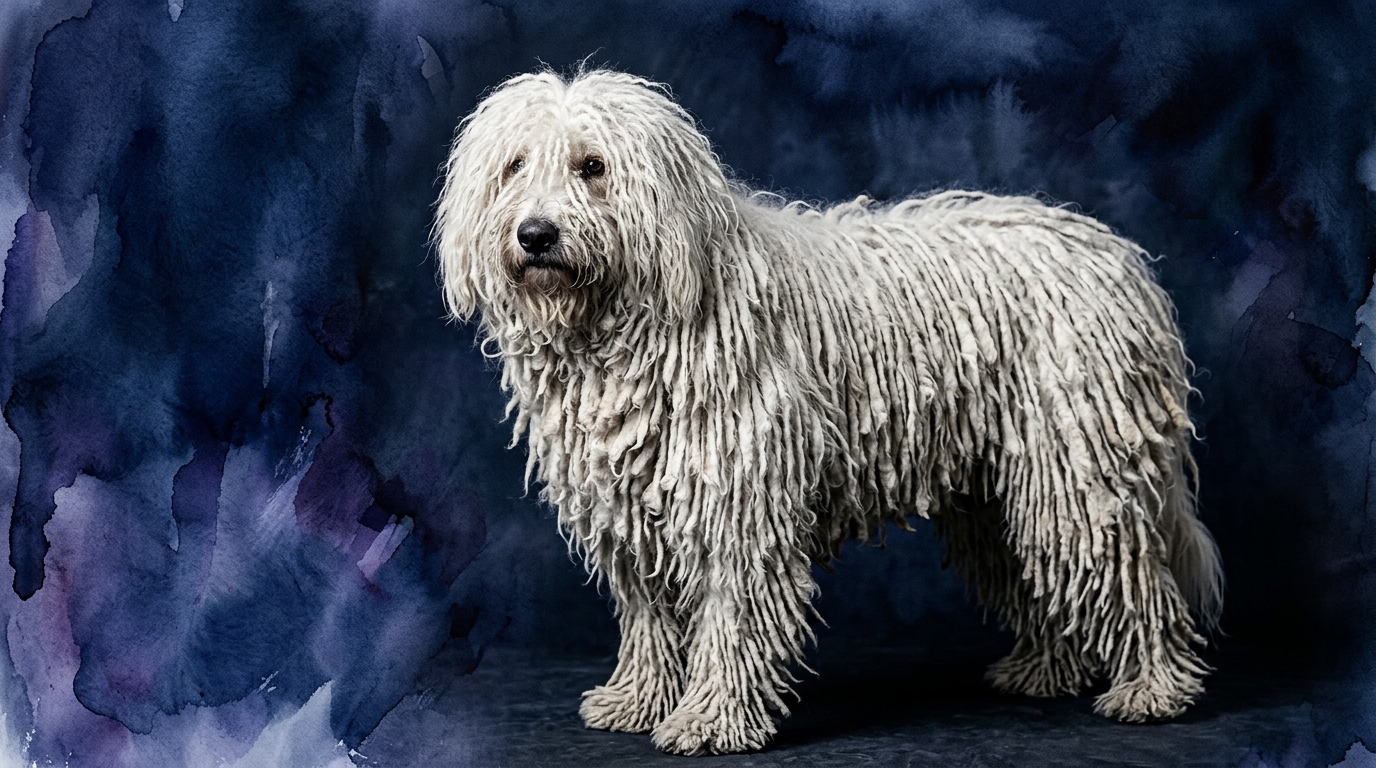
Side-by-Side IQ Profile: Mastiff vs. Komondor
The Cosmic Pet Pet IQ Lab analysis reveals that both the Mastiff (Coren rank #72) and Komondor (Coren rank #67) consistently score 3 out of 5 across all five key cognitive dimensions. While these numerical scores are identical, a closer look at their specific applications, shaped by their distinct ancestral roles, uncovers fascinating differences.
**Mastiff (Coren Rank #72):**
**Problem Solving (3/5):** Exhibits practical intelligence, often seeking solutions through direct engagement or relying on human guidance. Excels at navigating familiar routines and tangible obstacles.
**Training Speed (3/5):** Learns at a moderate pace, thriving on consistent, positive reinforcement. Retains commands effectively, though early and patient training is essential for managing their size.
**Social Intelligence (3/5):** Demonstrates a strong capacity for understanding human emotions within its family, forming deep, empathetic bonds. Tends to be reserved with strangers.
**Instinctive Drive (3/5):** A calm, vigilant guardianship defines its drive. This isn't overt aggression but a deep-seated desire to protect family, expressed through its imposing presence.
**Memory (3/5):** Possesses reliable recall for people, places, and established routines. Retains positive and negative experiences, aiding in training and social interactions.
**Komondor (Coren Rank #67):**
**Problem Solving (3/5):** Displays independent, self-sufficient problem-solving. Historically tasked with autonomous guarding, they assess situations and devise solutions related to protection without direct human instruction.
**Training Speed (3/5):** Learns moderately, but their independent nature often makes training feel more challenging. Requires clear, consistent methods and a compelling reason to comply.
**Social Intelligence (3/5):** Highly specialized, forming intense bonds with family while remaining naturally aloof or suspicious of outsiders. Adept at discerning threats within its protective sphere.
**Instinctive Drive (3/5):** A profound, intrinsic motivation for vigilance and defense, honed by centuries of livestock protection. Expressed through imposing presence and decisive action against perceived threats.
**Memory (3/5):** Excellent recall for territory, individuals under their care, and past events related to protective duties. Supports recognizing patterns and potential dangers.
Where the Mastiff Wins Cognitively
The Mastiff's cognitive strengths lean towards a cooperative and emotionally attuned intelligence. Its problem-solving, while practical, is often applied collaboratively with humans, such as figuring out how to retrieve an item or adapting to new environments under guidance. Its social intelligence allows for a nuanced understanding of human emotional states, enabling it to offer comfort or adjust behavior based on family mood. This empathetic connection, coupled with its reliable memory for positive interactions, fosters a smoother partnership in a domestic setting.
Where the Komondor Wins Cognitively
Conversely, the Komondor's cognitive advantages are deeply rooted in its independent, self-reliant nature from centuries of solitary guardianship. Its problem-solving manifests as a remarkable ability to assess and react to perceived threats or changes without human command. This breed excels at identifying unusual patterns or dangers within its territory, a testament to its instinctive drive. The Komondor's memory is robust for spatial awareness and discerning friend from foe, maintaining vigilant watch. Its specialized social intelligence effectively assesses intentions within its protective sphere.
Which is Easier to Train, and Why?
When considering ease of training, a notable distinction emerges despite identical 3/5 training speed scores. The Mastiff, with its social intelligence geared towards cooperative interaction and strong family bonds, generally offers a more straightforward training journey. It responds well to positive reinforcement, praise, and gentle guidance, eager to please its beloved human companions. While its size demands early, consistent training, its desire to be a well-integrated family member translates into a willingness to learn and comply. Its occasional stubbornness is typically manageable with patience. The Komondor, however, presents a different dynamic. Its independent problem-solving and strong instinctive drive mean it often questions commands, seeking a compelling reason to obey rather than simply complying. Bred to make its own decisions, training a Komondor requires an owner who can earn its respect, provide clear leadership, and offer highly motivating rewards. They learn, but often choose when and how to apply that learning, especially if it conflicts with their perceived guarding duty. This independent streak, while vital to its ancestral role, can make training a test of wills. For most households, the Mastiff would be considered easier to train due to its more cooperative and less autonomously driven nature.
Suitability for Active vs. Relaxed Owners
Suitability for active versus relaxed owners also diverges significantly based on temperament and needs. The Mastiff is an excellent match for more relaxed owners. Despite its size, it has low to moderate exercise requirements; a leisurely daily walk suffices. Indoors, they are calm, preferring to be near family. They are not suited for high-energy activities, making them ideal companions for those who enjoy a sedate pace of life but desire a devoted presence. The Komondor, while not a high-octane athlete, requires a different kind of owner engagement. Its powerful instinctive drive for guardianship means it needs a 'job' or dedicated territory to patrol to feel fulfilled. This isn't intense physical activity but rather mental stimulation and purpose related to protection. Komondors thrive where they can survey their domain, like a large, securely fenced yard. Owners must be 'active' in managing and channeling this protective nature through consistent training and socialization, rather than expecting a purely passive companion. Thus, while both might appear physically 'relaxed,' the Komondor demands a more intellectually and behaviorally engaged owner, making the Mastiff the clearer choice for truly low-key lifestyles.
The Verdict
Choose the Mastiff if you seek a gentle, devoted companion who thrives on close family bonds and a calm home environment, appreciating a dog that learns cooperatively with an empathetic connection to its humans.
Opt for the Komondor if you are an experienced owner prepared to understand and channel a powerful, independent guardian instinct, committed to consistent training, and value a dog whose primary fulfillment comes from vigilant protection of its domain.
🧠 Find Your Pet's IQ Score
Our Pet IQ Lab assessment covers 25+ tests across 5 cognitive dimensions — personalized to your breed.
Take the Full IQ Test →Frequently Asked Questions
Do Mastiffs and Komondors require extensive exercise?
Mastiffs generally need moderate daily exercise, like a leisurely walk, and are content relaxing indoors. Komondors, while not needing intense cardio, benefit from a 'job' or large yard to patrol, fulfilling their innate guarding drive and requiring mental engagement.
Are Mastiffs or Komondors typically better with children?
Both breeds can be good with children when properly socialized and supervised, given their protective instincts. However, a Mastiff's gentle nature often makes it more tolerant and less prone to misinterpreting boisterous child's play than a Komondor, which might perceive it as a threat.
What are the primary training challenges unique to each breed?
Mastiffs can exhibit stubbornness due to their size, but generally respond well to positive reinforcement and consistency. Komondors present a greater challenge due to their strong independent guarding instincts, often requiring an owner who can earn their respect and provide compelling reasons to obey.