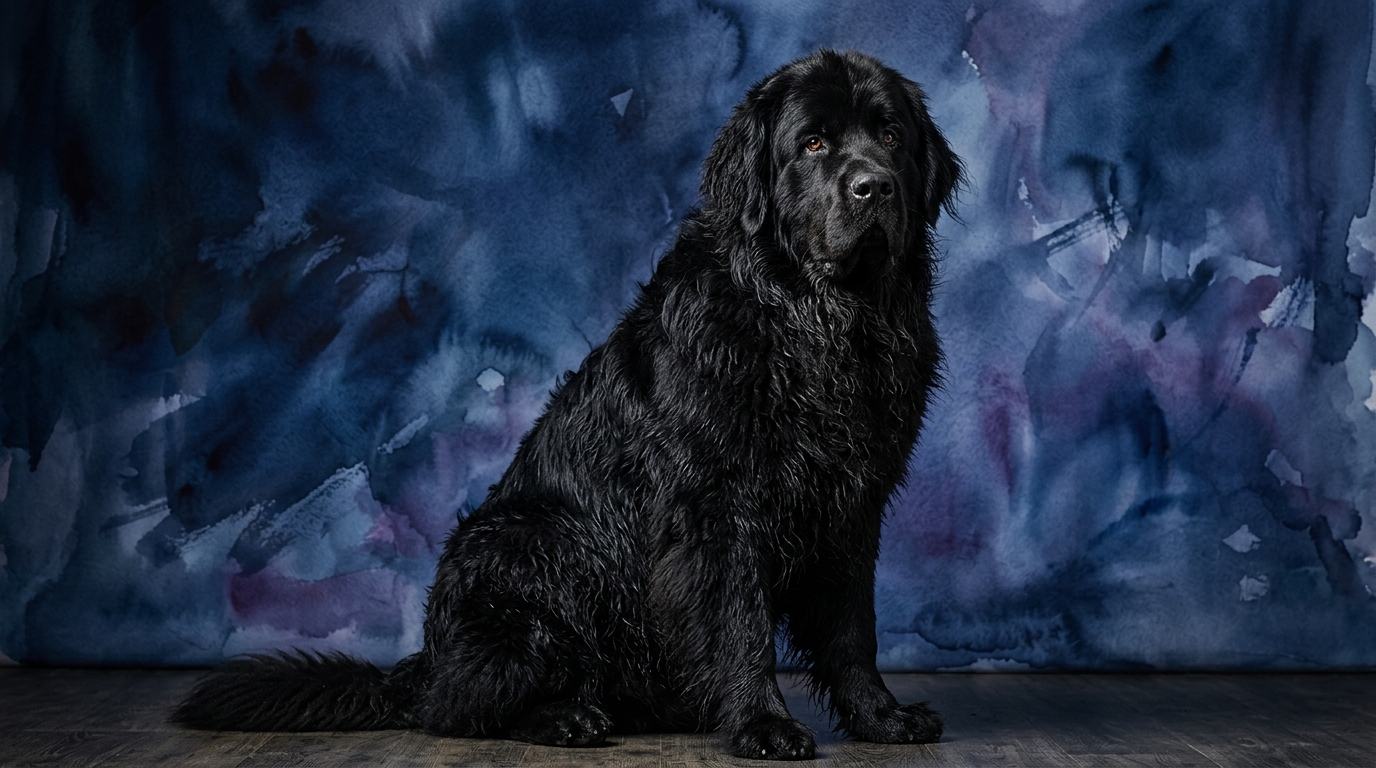

Side-by-Side IQ Profile: Newfoundland vs. Flat-Coated Retriever
The Cosmic Pet Pet IQ Lab employs a multi-dimensional approach to assess canine intelligence, moving beyond a single score to capture the nuanced cognitive abilities of each breed. For the majestic Newfoundland, our analysis shows a Problem Solving score of 3/5, indicating a thoughtful, often methodical approach to challenges rather than impulsive action. Its Training Speed stands at 4/5, reflecting a willingness and ability to learn new commands effectively. Where the Newfoundland truly shines is in Social Intelligence, earning a perfect 5/5, demonstrating an exceptional capacity for empathy and understanding human cues. Its Instinctive Drive also scores a robust 5/5, showcasing a powerful, innate urge for specific tasks like water rescue and protection. Finally, its Memory is rated at 4/5, indicating good retention of experiences and learned behaviors.
In contrast, the spirited Flat-Coated Retriever presents a different cognitive profile. Its Problem Solving ability is rated at 4/5, suggesting a quicker, more adaptable approach to novel situations. Training Speed matches the Newfoundland at 4/5, highlighting its aptitude for acquiring new skills. However, its Social Intelligence is rated 3/5, indicating a friendly and interactive nature but perhaps less profound emotional attunement than the Newfoundland. The Flat-Coat's Instinctive Drive is 3/5, primarily focused on retrieving tasks rather than the broader, complex drives of the Newfoundland. Its Memory, however, is outstanding, earning a 5/5, signifying an exceptional capacity for recall and spatial awareness.
Where the Newfoundland Wins Cognitively
The Newfoundland's cognitive victories are rooted deeply in its historical purpose and inherent nature. Its perfect 5/5 in Social Intelligence is a standout feature, enabling it to perceive and respond to human emotions with remarkable sensitivity. This isn't merely friendliness; it's a profound capacity for empathy, allowing a Newfoundland to sense distress in a family member or even a stranger, often acting as a natural comforter or protector without explicit instruction. This deep social awareness is crucial for its traditional role as a water rescue dog, where assessing a victim's state and reacting appropriately is paramount.
Coupled with this is its 5/5 Instinctive Drive, a powerful, unwavering predisposition for specific, complex tasks. For the Newfoundland, this manifests as an innate desire to guard, nurture, and especially to rescue from water. This drive isn't just a simple instinct; it's a complex cognitive program that enables the dog to make critical decisions in high-stakes situations, often demonstrating courage and initiative that far surpasses rote training. These two dimensions combine to create a dog that is not just a companion but a deeply understanding and instinctively capable member of a team, particularly in roles demanding emotional intelligence and proactive protective actions.
Where the Flat-Coated Retriever Wins Cognitively
The Flat-Coated Retriever's cognitive strengths lean towards active engagement and task mastery, reflected significantly in its higher Coren rank of #17 compared to the Newfoundland's #34. This ranking specifically points to its superior ability to understand and execute novel commands efficiently, making it a faster study in traditional obedience settings. Its 4/5 Problem Solving score underscores a quick-wittedness, allowing it to navigate new puzzles and obstacles with an agile, often exploratory approach. Flat-Coats frequently demonstrate ingenuity in figuring out how to retrieve a toy from a difficult spot or open a cabinet.
Perhaps its most remarkable cognitive asset is its 5/5 Memory. This exceptional recall isn't limited to basic commands; it extends to remembering complex sequences of retrieves, marking the fall of multiple birds in a field, or recalling specific locations where items were last seen. This superior memory is absolutely vital for a retrieving specialist, enabling it to perform intricate tasks with precision and reliability. While both breeds learn well, the Flat-Coat's combined strengths in Coren ranking, problem-solving, and memory equip it for a different caliber of rapid learning and intricate task execution, particularly in demanding sporting or working environments.
Which is Easier to Train and Why
Determining which breed is 'easier' to train depends heavily on the training goals and the trainer's approach, as both breeds score 4/5 in Training Speed. The Flat-Coated Retriever, with its Coren rank of #17, generally demonstrates faster acquisition of *novel* obedience commands. Its enthusiastic nature and quick problem-solving (4/5) mean it often picks up new exercises with gusto, responding well to positive reinforcement and engaging challenges. However, the Flat-Coat's exuberance can sometimes translate into a need for consistent focus and management during training sessions, as its joyful energy might lead to momentary distractions. Its exceptional memory (5/5) ensures that once a command or sequence is learned, it is retained with remarkable accuracy.
The Newfoundland, despite its Coren rank of #34, also learns commands readily (Training Speed 4/5) but perhaps at a more deliberate pace for purely abstract obedience tasks. Its profound Social Intelligence (5/5) means it is highly motivated by pleasing its human companion and forms strong emotional bonds, which can be a powerful training asset. Newfoundlands are often eager to cooperate, especially when they understand the purpose or benefit to their family. Their strong Instinctive Drive (5/5) means they excel in tasks that align with their natural predispositions, such as pulling a cart or participating in water rescue simulations, often requiring less explicit instruction for these specific behaviors. Therefore, while a Flat-Coat might master a new agility course faster, a Newfoundland might more quickly grasp the nuances of comforting a distressed child, driven by its innate empathy and desire to connect.
Which Suits Active Owners vs. Relaxed Owners
The choice between these two breeds often hinges on an owner's lifestyle and activity level. The Flat-Coated Retriever thrives with active owners who can channel its boundless energy and quick intellect into engaging pursuits. Its combination of a high Coren rank, quick problem-solving, and exceptional memory makes it an ideal partner for dog sports like agility, flyball, competitive obedience, or field trials. Owners who enjoy long, vigorous hikes, consistent training, and mental stimulation will find the Flat-Coat to be an enthusiastic and capable companion, eager to participate in every adventure. This breed requires a significant commitment to exercise and mental engagement to prevent boredom and channel its spirited nature productively.
Conversely, the Newfoundland, while still requiring regular exercise, is generally a better fit for more relaxed owners who appreciate a calm, stable, and deeply affectionate presence. Its perfect 5/5 Social Intelligence makes it an unparalleled companion for families seeking a dog that is attuned to their emotional needs and provides a comforting presence. Owners who enjoy leisurely walks, supervised water play, and have a deep desire for a dog that is an integral, gentle part of family life will find the Newfoundland's calm demeanor and profound bond incredibly rewarding. While its Instinctive Drive (5/5) means it benefits from purposeful activities like carting or supervised 'rescue' games, these can often be less physically demanding than the high-intensity sports favored by Flat-Coats, allowing for a more relaxed, yet still engaged, ownership experience.
The Verdict
If your life calls for unparalleled empathy, a gentle giant companion, and a natural aptitude for nurturing or rescue-oriented roles, the Newfoundland is your steadfast choice.
For those seeking a spirited, quick-witted partner in active pursuits, a dog that excels in learning complex sequences and boasts a remarkable memory for tasks, the Flat-Coated Retriever will undoubtedly be your joy.
🧠 Find Your Pet's IQ Score
Our Pet IQ Lab assessment covers 25+ tests across 5 cognitive dimensions — personalized to your breed.
Take the Full IQ Test →Frequently Asked Questions
Do Newfoundlands truly possess deep intelligence despite their lower Coren rank?
Absolutely. While their Coren rank (34) suggests they learn novel obedience commands at a more measured pace than some breeds, the Newfoundland excels in other critical cognitive dimensions. Their perfect 5/5 Social Intelligence and 5/5 Instinctive Drive highlight a sophisticated capacity for empathy, understanding complex social cues, and an innate ability for specific, life-saving tasks, which are profound forms of intelligence.
How does the Flat-Coated Retriever's high energy influence its training process?
The Flat-Coat's exuberant energy, while requiring consistent outlets, actually contributes positively to its trainability. This enthusiasm, combined with its 4/5 Problem Solving and 5/5 Memory, means it's often eager to learn and retain new commands quickly. Trainers need to harness this energy with engaging, positive reinforcement methods and provide sufficient physical and mental stimulation to maintain focus and prevent boredom-related behaviors.
Which breed is generally more suitable for a first-time dog owner?
Both breeds can be wonderful companions, but the Newfoundland might be slightly more forgiving for a first-time owner due to its calmer demeanor and profound social intelligence, which often translates to a strong desire to please and connect. The Flat-Coated Retriever, while trainable, requires a more significant commitment to daily rigorous exercise and consistent, engaging mental stimulation to manage its higher energy levels and prevent destructive behaviors, which can be challenging for inexperienced owners.