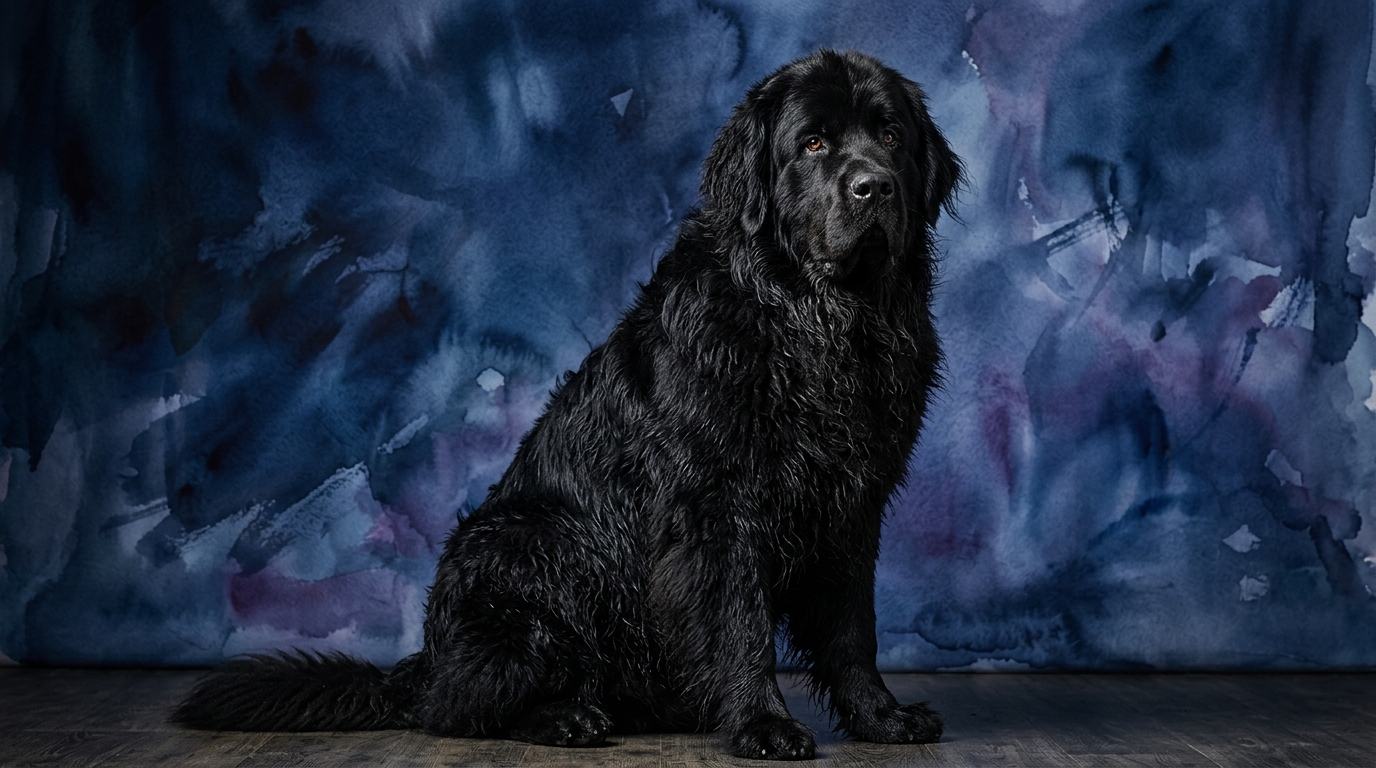

Side-by-Side IQ Profile: Newfoundland vs. Norfolk Terrier
The Cosmic Pet Pet IQ Lab employs a five-dimensional framework to assess canine cognition, providing a nuanced view beyond a simple 'smart' label. Let's examine how the Newfoundland and Norfolk Terrier stack up across these specific metrics.
**Problem Solving (Newfoundland: 3/5, Norfolk Terrier: 3/5):** Both breeds share a moderate capacity for problem-solving, indicating they can navigate new challenges and figure out solutions, but often benefit from human guidance or established routines. Neither is predisposed to independently devise complex strategies for novel situations without some initial prompting or learned experience. For the Newfoundland, this might manifest as needing direction to find a hidden toy, while for the Norfolk, it could mean requiring assistance to open a tricky gate. Their scores suggest they are capable of learning solutions rather than inventing them spontaneously.
**Training Speed (Newfoundland: 4/5, Norfolk Terrier: 3/5):** Here, a noticeable difference emerges. The Newfoundland, with its 4/5 score, typically grasps new commands and behaviors quite rapidly, eager to engage with its handler and please. This quick uptake makes them responsive to positive reinforcement and consistent methods. The Norfolk Terrier, scoring 3/5, demonstrates a more deliberate pace. While certainly trainable, they may require more repetition and patience, often needing to be convinced that the task is worthwhile or more engaging than their independent pursuits.
**Social Intelligence (Newfoundland: 5/5, Norfolk Terrier: 3/5):** This is where the Newfoundland truly shines, securing a perfect 5/5. They possess an exceptional ability to read human emotions, understand social cues, and form deep, empathetic bonds. This high social intelligence makes them attuned companions, often anticipating needs and responding with gentle affection. The Norfolk Terrier, at 3/5, exhibits a more independent and less overtly people-focused social intelligence. They are affectionate with their families but tend to be more self-contained, less driven by the subtle nuances of human emotional states, and more interested in their immediate environment or personal agenda.
**Instinctive Drive (Newfoundland: 5/5, Norfolk Terrier: 3/5):** Both breeds possess strong drives, but for different purposes. The Newfoundland's 5/5 instinctive drive is rooted in its historical role as a water rescue dog and companion. This manifests as an innate desire to protect, to be useful, and to connect deeply with its 'pack,' often displaying a strong affinity for water and a gentle, watchful nature. The Norfolk Terrier's 3/5 drive, characteristic of a terrier, is focused on hunting small prey, digging, and exploring with tenacity. Their drive is less about cooperative work and more about independent pursuit of natural instincts, requiring outlets for this inherent curiosity and determination.
**Memory (Newfoundland: 4/5, Norfolk Terrier: 3/5):** The Newfoundland's 4/5 memory indicates a strong capacity to retain learned commands, routines, and experiences over time, contributing to their reliability in training and consistency in behavior. They remember what they've learned and the appropriate contexts for those behaviors. The Norfolk Terrier's 3/5 memory is solid but may require more consistent reinforcement to ensure long-term retention, particularly if the learned behavior isn't frequently practiced or intrinsically rewarding from their perspective. They can learn, but might need more frequent refreshers.
Where Newfoundland Wins Cognitively
The Newfoundland's cognitive strengths are deeply rooted in its social nature and working heritage. Its perfect 5/5 social intelligence means it excels at understanding and responding to human emotional states. A Newfoundland can often sense when a family member is distressed, offering comfort without explicit prompting, a level of empathy few breeds match. This makes them exceptional therapy or emotional support animals, where reading nuanced human signals is paramount. Their 4/5 training speed is directly enhanced by this social acumen; they are motivated by the desire to please and cooperate, making complex, multi-step tasks like retrieving specific items or assisting with mobility much more attainable.
Furthermore, the Newfoundland's 5/5 instinctive drive manifests as a powerful inclination towards service and companionship, rather than independent hunting. This drive translates into a cognitive advantage for tasks requiring sustained focus on a human partner or a 'job' that benefits the family. For example, their natural inclination to 'rescue' or 'guard' can be channeled into specific behaviors like staying close to children or alerting to unusual sounds, making them highly reliable and consistent in their protective roles due to their profound connection and memory (4/5) of past interactions and training.
Where Norfolk Terrier Wins Cognitively
While the Norfolk Terrier's scores are generally lower than the Newfoundland's, its cognitive profile is perfectly suited for its original purpose and offers distinct advantages in specific contexts. The Norfolk's 3/5 problem-solving, combined with its 3/5 instinctive drive for hunting, translates into a tenacious, independent intellect. They excel at figuring out how to get to a perceived 'prey' (be it a squirrel or a dropped treat) or navigate complex environments like dense undergrowth with determination. This isn't about human-directed problem-solving, but rather self-motivated, goal-oriented persistence.
Their moderate social intelligence (3/5) means they are less swayed by human emotional appeals than a Newfoundland, which can be a cognitive 'win' when independent action is required. A Norfolk isn't easily distracted from its perceived mission by a handler's anxiety; they remain focused on their task. This self-reliance, though sometimes challenging for training, means they are less prone to separation anxiety and more comfortable entertaining themselves, provided they have appropriate outlets for their energy and curiosity. Their memory (3/5) is sufficient for recalling essential commands, but their true cognitive 'win' is their unwavering focus on a scent or a perceived 'critter,' showcasing a specialized, highly effective form of intelligence within their terrier niche.
Which is Easier to Train and Why
Based on their cognitive profiles, the Newfoundland is generally easier to train for a wider range of tasks than the Norfolk Terrier. The Newfoundland's 4/5 training speed is a direct result of its exceptional 5/5 social intelligence and strong desire to please. They are highly attuned to their handler's cues, motivated by positive interaction, and quick to form associations between commands and desired behaviors. Their 4/5 memory ensures that once a behavior is learned, it is retained effectively, leading to consistent performance. For instance, a Newfoundland is likely to respond to a multi-step fetch command with enthusiasm, eager for the praise and connection with their owner.
The Norfolk Terrier, with its 3/5 training speed and 3/5 social intelligence, presents a different training challenge. Their independence and ingrained terrier drives mean they are less inherently motivated by human approval and more by their own instincts or high-value rewards. They might learn commands, but their focus can easily be diverted by a captivating scent or the rustle of leaves, requiring more creative, engaging, and consistent training methods. For example, teaching a Norfolk to 'stay' might require more frequent, shorter sessions with irresistible treats, whereas a Newfoundland might hold the 'stay' simply for the joy of cooperating. Their 3/5 memory means more repetition and practice are often necessary to cement behaviors.
Which Suits Active Owners vs. Relaxed Owners
Defining 'active' and 'relaxed' requires a look beyond just physical exertion. For the Newfoundland, an 'active owner' is one who can provide consistent mental engagement and a sense of purpose, often involving water activities, long walks, or 'work' like cart pulling or therapy visits. Despite their calm indoor demeanor, their 5/5 instinctive drive means they thrive when given a role or a task, benefiting from owners who actively incorporate them into family life and provide opportunities for their social and protective instincts to flourish. A 'relaxed owner' for a Newfoundland might struggle if they cannot meet this deep-seated need for connection and purposeful activity, potentially leading to a bored, albeit gentle, giant.
The Norfolk Terrier, while smaller, demands a different kind of 'active owner.' Their terrier nature means they need regular physical activity to burn off energy, but also consistent mental stimulation to satisfy their curiosity and instinctive drives. An active owner for a Norfolk enjoys daily walks, engaging in puzzle toys, earth dog trials, or agility, and provides a securely fenced yard where they can safely explore. Their independence means they don't constantly demand interaction, but they do require an owner who is proactive in managing their environment and channeling their tenacious energy. A 'relaxed owner' might find the Norfolk's determined digging, barking at perceived intruders, or independent 'adventures' to be more than they bargained for, as these are expressions of their inherent cognitive and instinctual makeup.
The Verdict
Choose the Newfoundland if you seek a deeply empathetic, cooperative companion eager to engage in purposeful activities and form profound social bonds, and you're prepared for their size and need for gentle, consistent mental engagement.
Opt for the Norfolk Terrier if you appreciate a spirited, independent companion with a tenacious problem-solving approach to its environment, and you're ready to embrace their terrier instincts with consistent, engaging training and plenty of outlets for their lively energy.
🧠 Find Your Pet's IQ Score
Our Pet IQ Lab assessment covers 25+ tests across 5 cognitive dimensions — personalized to your breed.
Take the Full IQ Test →Frequently Asked Questions
Do Newfoundlands really enjoy water activities?
Absolutely, their 5/5 instinctive drive includes a strong affinity for water, reflecting their heritage as fishing and rescue dogs. Many Newfoundlands love swimming, retrieving from water, and even pulling carts in watery environments, making these excellent outlets for their cognitive and physical needs.
Are Norfolk Terriers good for apartment living?
Norfolk Terriers can adapt to apartment living if their owners are committed to providing sufficient daily exercise and mental stimulation. Despite their small size, their independent nature and instinctive drives mean they need regular walks, playtime, and engaging activities to prevent boredom and potential destructive behaviors like digging or excessive barking.
How do their problem-solving scores (3/5 for both) impact daily life?
A 3/5 problem-solving score means both breeds are capable of learning solutions to common challenges, but they may not spontaneously invent complex solutions for novel issues. For instance, they might learn to open a specific gate with practice, but wouldn't likely devise an intricate plan to escape a new, unfamiliar enclosure without prior instruction or repeated attempts.