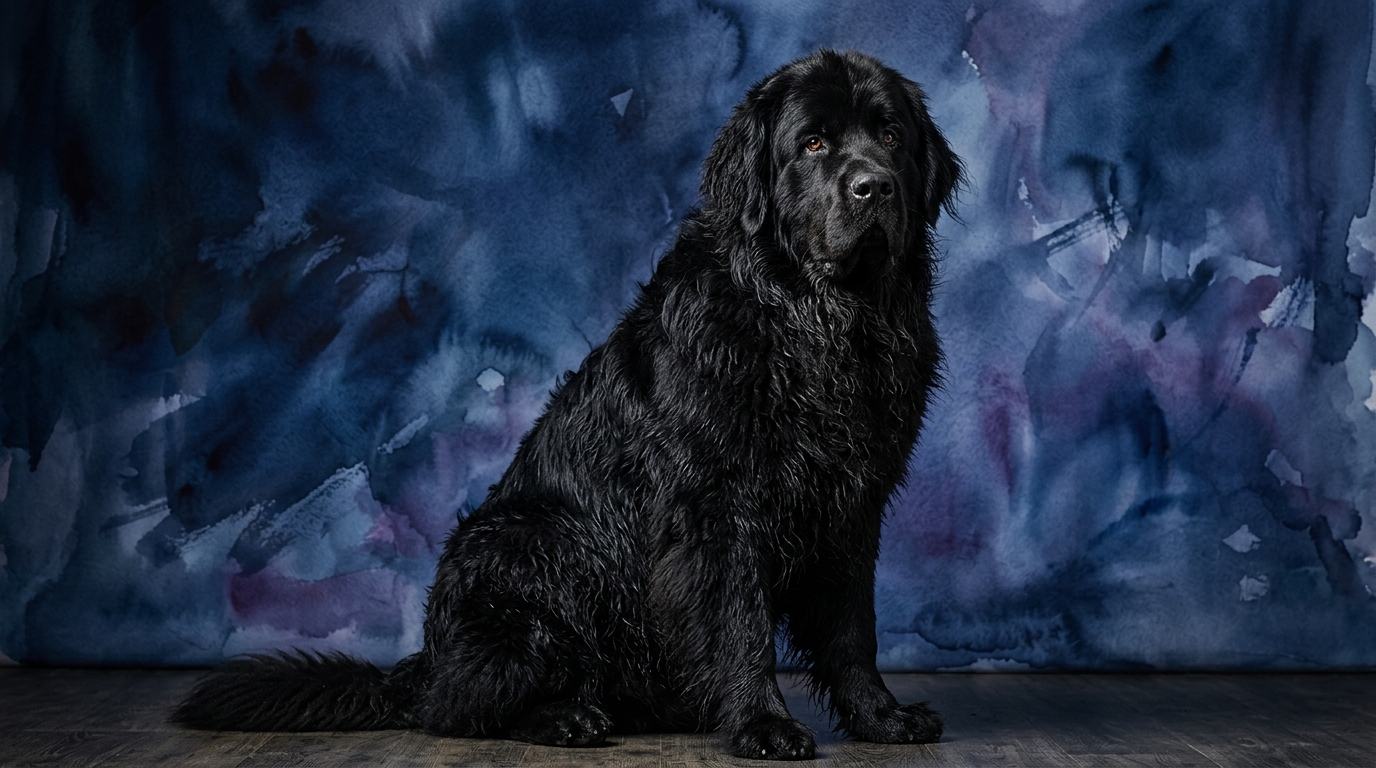

Side-by-Side IQ Profiles: A Cognitive Blueprint
The Newfoundland, a working breed, presents a robust cognitive profile, earning a respectable #34 in Coren's intelligence rankings. Its problem-solving capacity sits at a solid 3 out of 5, indicating a practical aptitude for navigating challenges. Where this breed truly shines is in its social intelligence, achieving a perfect 5 out of 5, reflecting its renowned empathy and connection with humans. Its instinctive drive also rates a maximum 5 out of 5, underscoring its historical roles in water rescue and companionship, driven by an innate desire to assist and bond. Training speed is impressive at 4 out of 5, suggesting a readiness to absorb new commands and routines efficiently. Finally, its memory is also strong at 4 out of 5, allowing it to retain learned behaviors and social cues over time. This overall profile paints a picture of a dog built for cooperative tasks and deep social bonds.
In contrast, the Russian Toy, a toy breed not featured in Coren's broader rankings, exhibits a consistently balanced cognitive profile across all measured dimensions. Its problem-solving skills are rated 3 out of 5, demonstrating an adequate capacity to figure out simple puzzles or daily obstacles. Training speed also registers a 3 out of 5, indicating a moderate pace for learning new commands, requiring patience and consistent methods. Social intelligence stands at 3 out of 5, suggesting it forms bonds and interacts with its human companions effectively, though perhaps with less overt emotional expression or broader group dynamics than its larger counterpart. Similarly, instinctive drive is 3 out of 5, reflecting a balanced internal motivation, not driven by intense working instincts but rather by companionship and engagement. Its memory, at 3 out of 5, allows it to recall routines and learned behaviors reliably. This profile suggests a companion dog whose cognitive abilities are perfectly suited to its role as a devoted and adaptable household member, rather than a task-oriented worker.
Where the Newfoundland's Mind Excels Cognitively
The Newfoundland's cognitive strengths distinctly align with its heritage as a devoted working companion. Its unparalleled social intelligence (5/5) means it is exceptionally attuned to human emotions and intentions. This isn't just about being friendly; it's about a deep, intuitive understanding of social cues, making them superb therapy dogs or companions for individuals needing emotional support. They can pick up on subtle shifts in mood, offering comfort or seeking interaction with remarkable precision. This profound social awareness also translates into seamless integration into family dynamics, often acting as a gentle guardian or “nanny dog.”
Coupled with an instinctive drive (5/5) that compels them towards helpfulness and protection, their minds are wired for cooperative ventures, whether it’s assisting in water rescue simulations or simply retrieving a dropped item for their owner. Their training speed (4/5) and memory (4/5) facilitate quick learning of multi-step commands and retention of complex routines, making them responsive and reliable partners in various activities, from obedience to specialized tasks. Their capacity to remember intricate sequences and associate them with specific contexts highlights a mental agility that belies their imposing physical presence, allowing for sophisticated behavioral responses.
Nuances of the Russian Toy's Cognitive Strengths
While the Russian Toy's cognitive scores are uniformly 3 out of 5, these numbers reflect a finely-tuned intelligence perfectly adapted to its role as a spirited and intimate companion, rather than a deficit. Its problem-solving ability (3/5) is more than adequate for navigating the intricacies of a home environment, whether figuring out how to get to a favored sunbeam or locating a hidden treat. This isn't about solving complex puzzles in a field, but rather about practical, everyday ingenuity within its domestic sphere.
The Russian Toy's social intelligence (3/5), while not as broadly expressive as a Newfoundland's, is intensely focused, often forging an incredibly deep, almost telepathic bond with its primary caregiver. They excel at reading individual human nuances, making them exceptional personal confidantes. Their instinctive drive (3/5) is channeled primarily into companionship and engagement with their chosen humans, rather than external working tasks. This translates into a dog that is consistently present, eager for interaction, and highly responsive to its owner's mood. Their moderate training speed (3/5) means they are trainable and capable of learning a wide array of tricks and commands, particularly when motivated by positive reinforcement and a strong bond, making them delightful partners for interactive play and small-scale agility. Their memory (3/5) ensures they reliably recall routines, cues, and the boundaries of their compact world.
Training Dynamics: Newfoundland vs. Russian Toy
When it comes to training, the numerical differences between these two breeds translate into distinct practical experiences. The Newfoundland, with its training speed of 4 out of 5, generally proves to be a more eager and cooperative student. Their strong desire to please, coupled with their high social intelligence, means they are often highly motivated by positive reinforcement and the opportunity to work alongside their human. They tend to pick up new commands and routines relatively quickly, making advanced obedience or specialized task training a more fluid process. Their robust memory (4/5) aids in retaining learned behaviors, reducing the need for constant repetition once a concept is grasped.
On the other hand, the Russian Toy's training speed of 3 out of 5 suggests a more moderate learning pace. While certainly trainable, they may require more patience, consistency, and a highly engaging approach to maintain their focus. Their smaller size and often more sensitive nature mean training sessions should be kept positive, fun, and relatively short to prevent boredom or overwhelm. They might be more prone to independent thinking or distraction, which necessitates clear, concise commands and a strong reward system, often involving high-value treats or enthusiastic praise from their beloved owner. For a Russian Toy, the bond with their trainer is paramount, and consistency is key to overcoming any potential for perceived stubbornness.
Lifestyle Fit: Active vs. Relaxed Owners
Considering their cognitive profiles alongside their physical attributes helps determine which breed aligns better with various owner lifestyles. The Newfoundland, with its profound instinctive drive (5/5) and expansive social intelligence (5/5), thrives with active owners who can provide both physical exercise and mental engagement. These dogs need a sense of purpose, whether it's participating in water sports, therapy work, or simply being an integral, active part of a bustling family. Their size and inherent drive for activity mean they are best suited for homes with ample space, ideally a yard, and owners who enjoy outdoor adventures. They are not content to be mere couch potatoes; their minds crave stimulation and their bodies require regular exertion.
In contrast, the Russian Toy's balanced instinctive drive (3/5) and focused social intelligence (3/5) make it remarkably adaptable to a wider range of living situations, including apartments or homes with less outdoor space. While they are spirited and enjoy play, their exercise needs are modest compared to a Newfoundland, often satisfied with indoor games and short walks. Their cognitive makeup makes them ideal companions for more relaxed owners who appreciate a constant, devoted presence without the demand for intense physical activities. However, "relaxed" doesn't mean neglecting mental stimulation; these clever little dogs still benefit from interactive toys, puzzle feeders, and consistent training to keep their minds sharp and engaged within their smaller world.
The Verdict
Choose the Newfoundland if you seek a deeply empathetic, cooperative giant whose cognitive strengths lie in social connection and purposeful work, and you are prepared for a devoted partner in active, outdoor pursuits.
Opt for the Russian Toy if you desire a spirited, intensely bonded companion whose intelligence shines in focused companionship and adaptable living, thriving with consistent, positive interaction in a more contained environment.
🧠 Find Your Pet's IQ Score
Our Pet IQ Lab assessment covers 25+ tests across 5 cognitive dimensions — personalized to your breed.
Take the Full IQ Test →Frequently Asked Questions
Does a Newfoundland's high instinctive drive make them difficult to manage?
Not necessarily; their high instinctive drive often manifests as a strong desire to please and a natural inclination towards helpfulness, making them responsive to direction when channeled appropriately through training and purpose-driven activities. This drive, when understood and managed, can be a powerful asset for cooperative tasks and companionship.
Are Russian Toys capable of learning complex tricks despite their moderate training speed?
Absolutely. While their training speed is rated as moderate, Russian Toys are intelligent and highly motivated by positive reinforcement and a strong bond with their owner, making them capable of learning a wide array of complex tricks and obedience commands with patience and consistency. Their agility and focus can be impressive in small-scale performance.
How does social intelligence differ between these two breeds?
The Newfoundland's 5/5 social intelligence indicates a broad, intuitive understanding of human emotions and group dynamics, often extending to a natural empathy for many individuals. The Russian Toy's 3/5 social intelligence is often more intensely focused on its primary caregiver, forming a deep, almost telepathic bond and excelling at reading that individual's subtle cues.