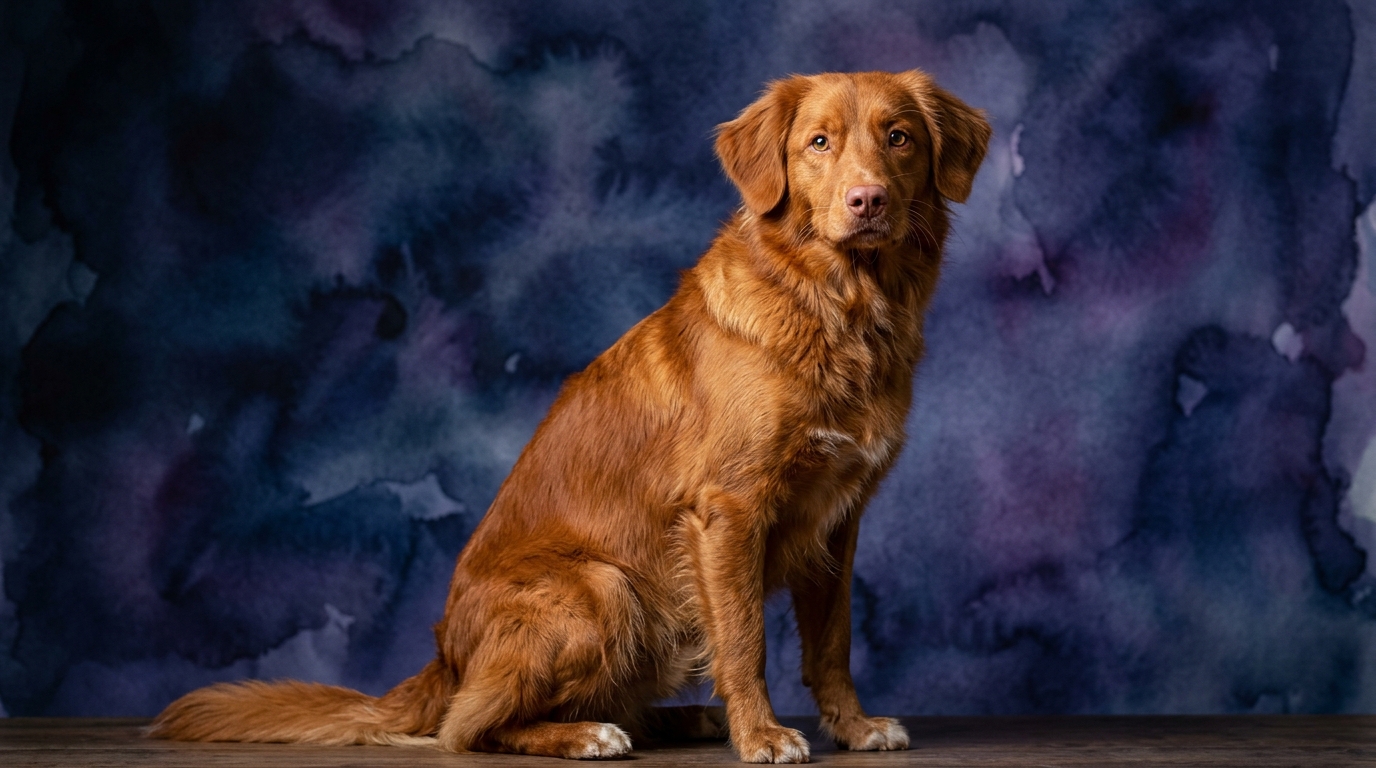

Unpacking the Cognitive Profiles: Toller vs. Brittany
The Cosmic Pet Pet IQ Lab employs a five-dimensional framework to assess canine cognition, moving beyond simplistic labels to offer a nuanced understanding of how breeds learn, adapt, and interact. These dimensions—Problem Solving, Training Speed, Social Intelligence, Instinctive Drive, and Memory—provide a comprehensive look into the mental makeup of our canine companions, helping owners align their expectations with a dog's inherent capabilities.
For the Nova Scotia Duck Tolling Retriever, the IQ Lab profile shows a consistent '3/5' across all five dimensions. Their Problem Solving at 3/5 indicates a practical, rather than highly innovative, approach to new challenges; they learn effectively through consistent repetition and application of learned methods. A Training Speed of 3/5 means they absorb commands and behaviors at a steady, reliable pace, requiring clear and patient instruction to solidify new skills. Their Social Intelligence, also 3/5, suggests they are capable of reading cues and forming bonds, often with a focus on their primary handler during work. An Instinctive Drive of 3/5 reflects their purposeful retrieving and luring instincts, present but generally manageable. Finally, a Memory score of 3/5 means they possess a good functional memory for routines and established tasks, though perhaps not for exceptionally complex, multi-layered sequences over extended periods.
The Brittany, in contrast, presents a profile with several elevated scores, including a notable Coren rank of #19, signifying their strong aptitude for obedience and working intelligence. Their Problem Solving is rated at 4/5, indicating a greater capacity for independent thought and quicker adaptation to novel situations, often figuring out solutions without explicit guidance. A Training Speed of 4/5 means they are generally quicker to pick up new commands and apply them, often requiring fewer repetitions than some other breeds. Their Social Intelligence mirrors the Toller's at 3/5, suggesting a similar ability to connect and understand human cues, particularly in a working context. The Instinctive Drive is also 3/5, reflecting a strong, purpose-driven hunting and pointing instinct comparable in intensity to the Toller's retrieving drive. Where the Brittany truly stands out is its Memory, scoring an impressive 5/5, which points to an exceptional ability to recall past events, training, and intricate sequences with remarkable fidelity.
Where the Toller Shines Cognitively
While the Brittany boasts higher scores in specific areas, the Toller's consistent '3/5' across all cognitive dimensions isn't a sign of cognitive limitation, but rather a testament to their balanced and tenacious approach to learning and interaction. This uniform profile contributes to a dog that, once a concept is grasped, applies it with steady reliability and predictability.
The Toller's strength lies in their dependable application of learned behaviors. Their 3/5 in Problem Solving, combined with a 3/5 Training Speed, means they excel at mastering established routines and executing tasks with precision once thoroughly taught. They might not invent a new way to open a gate, but they will consistently follow the steps they've been shown. This cognitive consistency makes them exceptionally reliable partners in activities that demand repeated, accurate performance, such as complex retrieving patterns or obedience trials where precision over innovation is key. Their 3/5 Memory ensures these learned skills are retained for functional use, supporting a predictable and steadfast working relationship. Their Social Intelligence, while 3/5, is often channeled into a focused, cooperative partnership, making them attentive to their handler's specific directives during tasks.
Brittany's Cognitive Strengths
The Brittany's cognitive profile showcases distinct advantages, particularly in its higher Problem Solving and Training Speed, culminating in an exceptional Memory score. These attributes combine to create a dog that is not only quick to learn but also adept at applying that learning in varied and complex scenarios.
The Brittany's superior Problem Solving (4/5) enables them to navigate novel situations with greater ingenuity, often devising their own effective solutions rather than solely relying on explicit instruction. This means they are more likely to adapt quickly to changes in environment or task requirements without becoming flustered. Their faster Training Speed (4/5) translates directly into a more efficient learning process, requiring fewer repetitions for a command to become ingrained. The standout feature, however, is their Memory (5/5). This exceptional recall allows them to build and retain a vast repertoire of commands, intricate sequences, and past experiences. This cognitive depth makes them outstanding candidates for advanced obedience, agility, or field work that demands the execution of complex, multi-step patterns and the ability to generalize learned behaviors across diverse contexts, remembering not just 'what' to do, but 'when' and 'how' in varying situations.
Training Dynamics: Which is Easier and Why?
When considering ease of training, the Pet IQ Lab scores for Training Speed and Memory offer clear distinctions between these two sporting breeds, influencing the owner's experience and the time investment required.
The Brittany, with its 4/5 Training Speed and remarkable 5/5 Memory, generally presents a more straightforward training journey for a broader spectrum of tasks. They absorb new commands and concepts with notable alacrity, often grasping an idea after just a few repetitions. Their superior memory means these skills are not only learned quickly but also retained robustly over time, reducing the need for frequent refreshers. Furthermore, their stronger problem-solving aptitude often allows them to anticipate or 'figure out' what is expected, sometimes even before the full command is given, leading to quicker mastery and a more fluid training progression.
Conversely, the Nova Scotia Duck Tolling Retriever, with its 3/5 scores in both Training Speed and Memory, typically requires a more consistent, patient, and methodical approach to training. While perfectly capable of learning, owners should anticipate needing more repetitions to solidify new behaviors and to ensure they are reliably recalled. Tasks may need to be broken down into smaller, more manageable steps, and consistency across different environments is crucial for the Toller to generalize learned skills effectively. This isn't a reflection of a lack of ability, but rather a difference in cognitive processing speed and retention depth, meaning the Toller thrives under a predictable, steady training regimen that reinforces skills over time.
Matching Cognitive Profiles to Lifestyles
Understanding these cognitive distinctions is vital for prospective owners to choose a companion whose mental makeup aligns with their lifestyle, whether they lead an active, demanding life or prefer a more relaxed, routine-oriented pace.
For active owners seeking a dog for advanced competitive sports, intricate field work, or complex, evolving tasks, the Brittany's cognitive profile makes it an exceptional match. Their high Problem Solving (4/5), rapid Training Speed (4/5), and outstanding Memory (5/5) allow them to excel in dynamic environments where quick thinking, fast learning, and the retention of vast information are paramount. They thrive on mental challenges that leverage their capacity for independent thought and their ability to execute sophisticated sequences. Their 3/5 Instinctive Drive ensures they are motivated and engaged, but their cognitive agility allows for more nuanced direction and a higher level of partnership in demanding activities like agility, advanced hunting trials, or search and rescue.
For owners who appreciate a steadfast, reliable companion and are prepared to invest consistent, patient effort into foundational training, the Nova Scotia Duck Tolling Retriever is an admirable choice. Their balanced 3/5 scores across all dimensions mean they are capable learners and diligent workers, but perhaps better suited to a more predictable routine or tasks that build on established patterns rather than constant novelty. Their cognitive approach leans towards mastering a set repertoire of skills with consistency. While still requiring an active outlet for their 3/5 Instinctive Drive, their learning style might be less demanding for owners who aren't looking to push the boundaries of canine learning with intricate, rapidly changing scenarios. Their 3/5 Social Intelligence supports a loyal and attentive partnership, especially when working directly with their handler on familiar tasks.
The Verdict
Choose the Nova Scotia Duck Tolling Retriever if you value consistent reliability and are prepared to engage in steady, patient training to build a strong, predictable partnership for activities like retrieving or companion sports.
Opt for the Brittany if you seek a quick-witted partner eager for complex challenges, capable of rapid learning and retaining an expansive behavioral repertoire for advanced field work, agility, or intricate obedience.
🧠 Find Your Pet's IQ Score
Our Pet IQ Lab assessment covers 25+ tests across 5 cognitive dimensions — personalized to your breed.
Take the Full IQ Test →Frequently Asked Questions
Is the Brittany truly smarter than the Toller?
The Pet IQ Lab data suggests the Brittany generally exhibits faster learning and superior memory, as indicated by its 4/5 training speed and 5/5 memory compared to the Toller's 3/5 scores. However, both breeds possess functional cognitive abilities well-suited to their respective working roles and are highly capable learners.
How does the Coren rank for Brittany relate to its Pet IQ Lab scores?
The Brittany's Coren rank of #19 aligns well with its Pet IQ Lab scores of 4/5 for problem-solving and training speed, and a remarkable 5/5 for memory. Coren's ranking primarily assesses obedience and working intelligence, which heavily relies on these cognitive dimensions and the ability to quickly grasp and recall commands.
Do these IQ scores mean one breed is better for a first-time owner?
Not necessarily. While the Brittany's quicker learning might seem advantageous, both breeds require dedicated training, socialization, and significant mental and physical exercise. A first-time owner comfortable with consistent, patient training and a dog that learns at a steady pace could thrive with a Toller, just as an owner ready for more advanced, mentally stimulating challenges could enjoy a Brittany.