
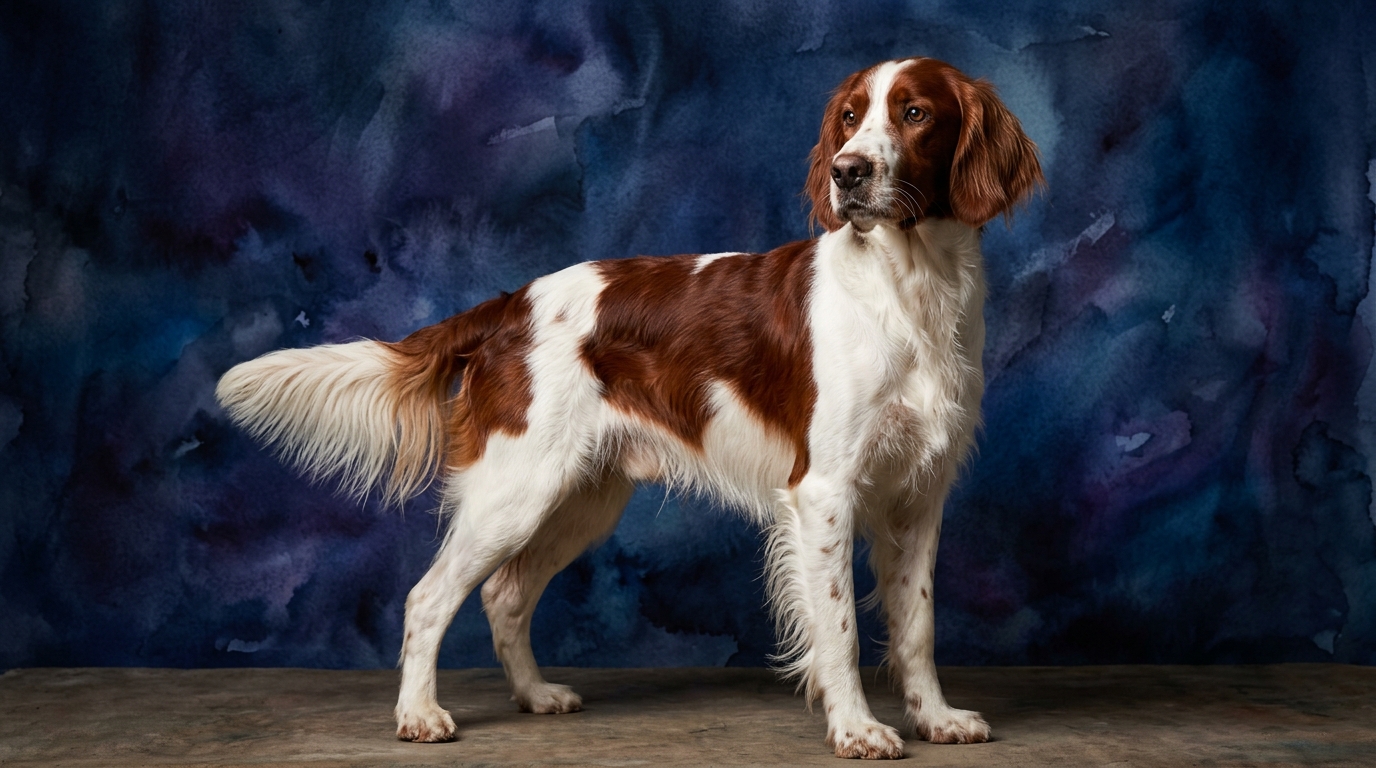
Side-by-Side Cognitive Profile: Unpacking Identical Scores
At first glance, the Nova Scotia Duck Tolling Retriever (Toller) and the Irish Red and White Setter (IRWS) appear cognitively identical, each earning a 3/5 rating across all five dimensions measured by The Cosmic Pet Pet IQ Lab. This uniformity presents a unique opportunity to examine how similar underlying cognitive capacities can express themselves through different temperaments and historical roles. Both are members of the Sporting Group, bred for specific tasks in the field, which inherently shapes their mental processing and behavioral outputs.
For the Toller, a 'Problem Solving' score of 3/5 often involves figuring out how to retrieve a decoy from an unusual angle in water or navigating dense, varied cover to locate a hidden object. Their natural drive makes them persistent in these challenges. Their 'Training Speed' at 3/5 reflects a capacity to absorb consistent, engaging instruction, especially when activities channel their high energy and retrieving instincts. 'Social Intelligence' at 3/5 suggests they form strong bonds, reading their primary human's cues, though they can be reserved with strangers. Their 'Instinctive Drive' (3/5) manifests as an intense desire to retrieve, often accompanied by their characteristic high-pitched 'Toller scream' when excited by game or play. Finally, their 'Memory' (3/5) allows them to excel at remembering complex retrieve patterns, locations of hidden objects, and training sequences, particularly those associated with their work or play.
The Irish Red and White Setter, with the same 3/5 'Problem Solving' score, might demonstrate this by independently locating birds across a wide field, using scent and terrain to outwit prey, or navigating complex cover while maintaining awareness of their handler. Their 'Training Speed' (3/5) indicates they learn effectively with patient, positive reinforcement. While perhaps not as intensely driven by repetitive tasks as a Toller, they absorb commands and routines steadily, especially when tasks align with their natural hunting instincts. Their 'Social Intelligence' (3/5) typically reflects a gentle, amiable disposition, often eager to please and interact with family members, being sensitive to human emotions and seeking harmony. The IRWS's 'Instinctive Drive' (3/5) expresses as a strong desire to hunt, range, and point birds, driven by scent and the thrill of the chase. Their 'Memory' (3/5) enables them to retain learned commands and routines consistently, and to recall locations of previous bird flushes or scent trails over time, aiding their methodical hunting style.
Where the Nova Scotia Duck Tolling Retriever Wins Cognitively
Despite identical numerical scores, the Toller's cognitive strengths often shine in scenarios demanding intense focus and repetitive, high-energy engagement. Their 3/5 problem-solving ability is particularly evident in dynamic retrieving tasks, where they must quickly assess and adapt to changing conditions, such as currents in water or moving targets. This specific application of their problem-solving, coupled with their strong retrieving drive, gives them an edge in activities like dock diving or advanced retrieving games where rapid, precise action is paramount. Their memory (3/5) is exceptionally tuned to remembering the fall of multiple birds or complex scent trails within a confined area, making them highly efficient in multi-retrieve scenarios.
The Toller's social intelligence (3/5), while potentially more reserved with outsiders, fosters an exceptionally deep, almost telepathic bond with their core family. They often anticipate their owner's next move or mood with remarkable accuracy, making them highly intuitive partners in structured activities. This intense focus on their handler, combined with their potent instinctive drive, means that when a Toller 'wins' cognitively, it's often through sheer, unwavering determination and a singular focus on the task at hand, often expressed through their unique vocalizations that signal excitement and anticipation.
Where the Irish Red and White Setter Wins Cognitively
The Irish Red and White Setter's cognitive strengths, while numerically matching the Toller's, differentiate themselves through their application in broader, more independent hunting roles. Their 3/5 problem-solving prowess is often displayed in their ability to systematically cover large expanses of terrain, making independent decisions about where to search for game based on wind, cover, and scent. This requires a different kind of strategic thinking than the Toller's focused retrieve, emphasizing self-reliance and environmental assessment over handler-directed precision. Their memory (3/5) supports this by allowing them to recall productive hunting grounds or complex scent patterns over long distances and extended periods.
The IRWS's social intelligence (3/5) typically manifests as a gentle, more universally amiable disposition. They are often perceived as more 'people-pleasing' in a general sense, extending their warmth beyond a primary handler to a wider circle of family and friends. This makes their cognitive engagement more about harmonious interaction and less about intense, task-specific bonding. Their instinctive drive (3/5) is geared towards methodical searching and pointing, requiring a nuanced understanding of bird behavior and terrain, allowing them to 'win' in situations demanding sustained, independent work over vast areas, where their elegant, far-ranging style is a testament to their cognitive and physical endurance.
Which is Easier to Train and Why
Both breeds score 3/5 for training speed, indicating they are capable learners, but their ease of training depends significantly on the owner's approach and understanding of their inherent behavioral differences. The Nova Scotia Duck Tolling Retriever, with its intense focus and high energy, often responds enthusiastically to consistent, reward-based training that incorporates play and retrieving. Their drive to work and please their handler can make them appear to pick up new commands quickly, especially if the training is engaging and varied. However, their vocal nature and potential for exuberance mean that channeling their energy and managing their excitement requires a firm yet fair hand and a commitment to structured activities. Without sufficient mental and physical outlets, their problem-solving skills might be applied to less desirable 'creative' endeavors.
The Irish Red and White Setter, while also a capable learner, possesses a more sensitive disposition. Their 3/5 training speed is best utilized with gentle, positive reinforcement methods, as harsh corrections can easily shut them down. They thrive on praise and connection, and their desire to please is strong, but they may not have the Toller's relentless drive for repetitive tasks. Training an IRWS often involves patience and making tasks feel like a collaboration rather than a strict command-and-response routine. Their instinctive drive for ranging means off-leash training requires diligent recall work from a young age, as their independent bird-finding can be a powerful distraction. In essence, the Toller might be easier to motivate with high-octane rewards, while the IRWS responds better to a calm, consistent, and relationship-focused approach.
Which Suits Active Owners vs. Relaxed Owners
Neither the Nova Scotia Duck Tolling Retriever nor the Irish Red and White Setter are suitable for truly 'relaxed' owners; both are sporting breeds with significant needs for activity and mental engagement. However, the *type* of activity they thrive on differs. The Toller suits active owners who enjoy high-intensity, repetitive, and often water-focused activities. They excel in dog sports like agility, flyball, dock diving, and advanced retrieving, requiring an owner committed to daily vigorous exercise and structured mental challenges. Their energy is often concentrated and intense, demanding an owner who can match their drive and provide consistent outlets for their focus and stamina.
The Irish Red and White Setter, while equally active, suits owners who prefer long-distance, scent-driven, and expansive field-based activities. They are built for covering vast amounts of ground at a steady pace, making them ideal companions for hiking, trail running, or field work. Their exercise needs are more about endurance and exploration than the Toller's explosive bursts. Owners who enjoy long walks or runs in open spaces, and appreciate a dog that can work independently with grace and stamina, would find the IRWS a better fit. While both require substantial exercise, the Toller's needs lean towards focused, high-impact tasks, whereas the Setter's are geared towards sustained, wide-ranging exploration.
The Verdict
Choose the Nova Scotia Duck Tolling Retriever if you're an active owner seeking a highly focused, intense partner for precision retrieving and high-energy dog sports, appreciating their deep bond and unique vocalizations. They thrive with consistent, engaging training that channels their powerful drive.
Opt for the Irish Red and White Setter if you're an active owner who enjoys long, expansive outdoor adventures and a graceful, independent companion with a gentle disposition. Their sensitivity requires patient, positive training methods, and they excel in activities requiring endurance and methodical exploration.
🧠 Find Your Pet's IQ Score
Our Pet IQ Lab assessment covers 25+ tests across 5 cognitive dimensions — personalized to your breed.
Take the Full IQ Test →Frequently Asked Questions
Are Nova Scotia Duck Tolling Retrievers good family dogs?
Tollers can be excellent family dogs, forming strong bonds with their immediate family members. However, their high energy and need for mental stimulation mean they thrive in active households that can provide consistent engagement and exercise, and they can be reserved with strangers.
Do Irish Red and White Setters bark a lot?
Irish Red and White Setters are not typically excessive barkers, but they will use their voice to alert to visitors or express excitement. Their vocalizations are generally less intense than the Toller's characteristic 'scream,' and can be managed with consistent training.
Which breed is better for apartment living?
Neither breed is ideally suited for apartment living due to their significant exercise and mental stimulation needs. Both require ample space to run and explore, and without sufficient outlets, they can become restless or destructive, regardless of their cognitive scores.