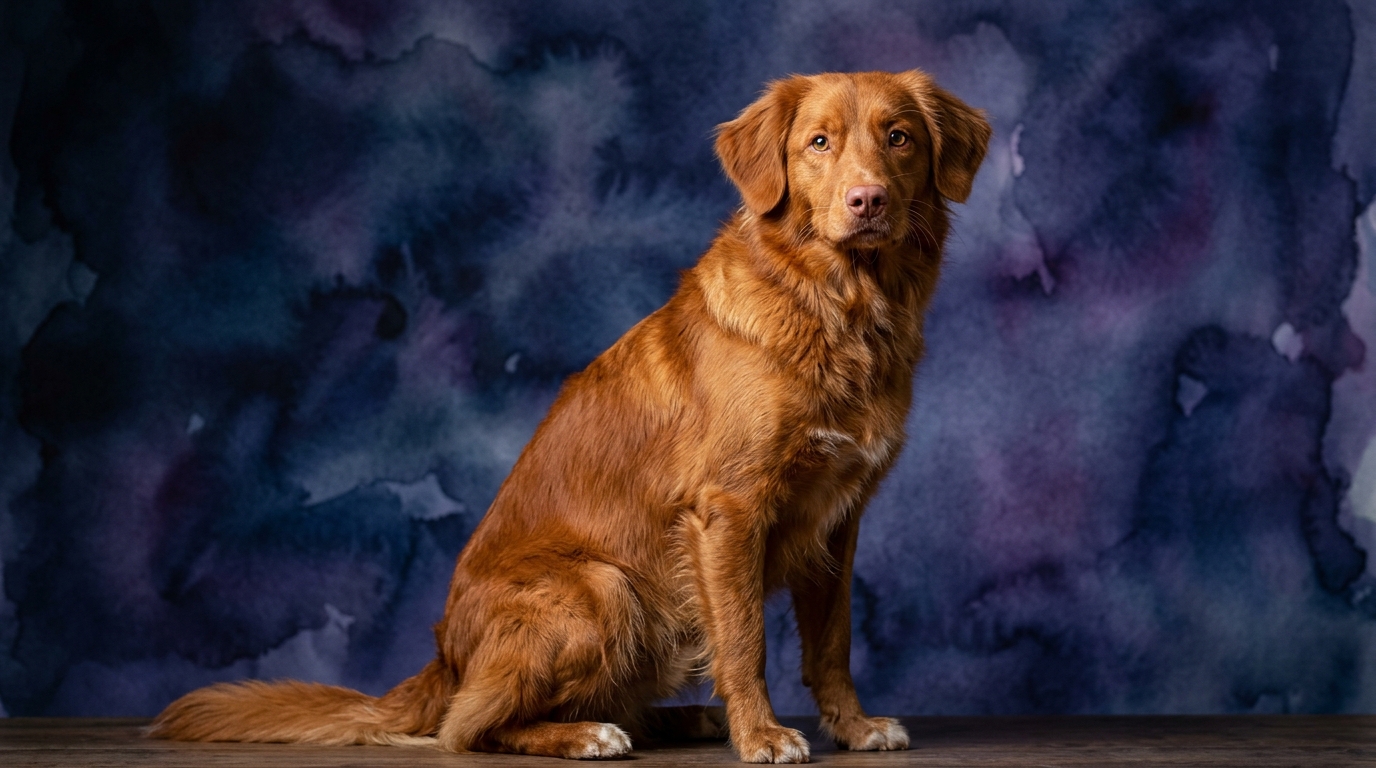

Side-by-Side IQ Profile: Toller vs. Irish Water Spaniel
The Cosmic Pet Pet IQ Lab provides a structured lens through which to examine the cognitive makeup of these two breeds. The Nova Scotia Duck Tolling Retriever (NSDTR) presents a remarkably balanced profile with scores of 3/5 across all five dimensions: Problem Solving, Training Speed, Social Intelligence, Instinctive Drive, and Memory. This consistent scoring suggests a generally competent and adaptable intellect, one that is neither prone to extreme independent strategizing nor notably swift in initial learning, but reliably capable across the board. Their 3/5 in Instinctive Drive indicates a solid, but not overwhelming, enthusiasm for their historical retrieving tasks, and a 3/5 in Social Intelligence means they typically read and respond to social cues well without exceptional nuance. Their memory and problem-solving capacities are robust enough for daily life and moderate challenges.
In contrast, the Irish Water Spaniel (IWS) shows a distinct cognitive advantage in several areas, underscored by its Coren rank of #24, placing it among breeds with a high capacity for working and obedience intelligence. The IWS scores 4/5 in Problem Solving, indicating a superior ability to analyze and navigate complex situations. Its Training Speed also rates 4/5, suggesting a quicker grasp of new commands and routines. Social Intelligence for the IWS matches the Toller at 3/5, implying similar proficiency in understanding social dynamics. Instinctive Drive is also a congruent 3/5, reflecting a strong, but manageable, desire for activity and work. Crucially, the IWS boasts a 4/5 in Memory, signifying a more profound recall of learned information and experiences. This profile points to a dog that not only learns rapidly but also retains that learning with impressive consistency.
Where the Nova Scotia Duck Tolling Retriever Excels Cognitively
The Toller’s primary cognitive strength lies in its harmonious and predictable intellect, reflected in its consistent 3/5 scores across all IQ dimensions. While it may not outperform the Irish Water Spaniel in specific metrics, this balanced profile means the Toller offers a reliable and steady learning companion. Owners can anticipate a dog that processes information at a competent pace (Training Speed 3/5) and approaches novel situations with a practical, albeit not highly inventive, problem-solving style (Problem Solving 3/5). This consistency can be a significant advantage for individuals who prefer a more gradual and patient training journey, where progress is steady rather than rapid bursts. Their moderate instinctive drive (3/5) ensures they are enthusiastic and engaged in activities without being overly intense or demanding, making their working drive more approachable for a wider range of owners. Furthermore, their social intelligence and memory, both at 3/5, allow them to integrate smoothly into family life, reading cues competently and retaining daily routines without excessive complexity or emotional intensity, contributing to a generally adaptable and cooperative temperament.
Where the Irish Water Spaniel Demonstrates Cognitive Superiority
The Irish Water Spaniel’s cognitive profile clearly indicates a breed with heightened intellectual capabilities in several key areas. Its Coren rank of #24 is a strong indicator of its capacity for advanced learning and obedience. The IWS’s 4/5 in Problem Solving underscores a superior mental agility, enabling them to independently assess and navigate intricate challenges, making them particularly adept at complex puzzle toys or adapting to new environments with minimal guidance. This aptitude for strategic thinking makes them excellent candidates for advanced dog sports that require ingenuity.
Furthermore, their 4/5 in Training Speed highlights a pronounced ability to rapidly acquire and master new commands and behaviors, often requiring fewer repetitions than the Toller. This accelerated learning curve makes the IWS a rewarding partner for owners keen on delving into high-level obedience or specialized tasks. Complementing this swift learning is their 4/5 in Memory, which ensures that lessons, once learned, are retained with remarkable consistency and accuracy. This robust recall contributes to a dog that performs reliably and can apply learned skills across various contexts, making them exceptionally consistent in their responses to commands over time.
Training Dynamics: Which Breed is Easier to Train?
Based on their respective IQ profiles, the Irish Water Spaniel generally presents as the breed that is easier and faster to train, especially for complex or advanced tasks. Its 4/5 in Training Speed signifies a remarkable aptitude for quickly grasping new commands and concepts, often needing fewer repetitions to achieve proficiency. This rapid assimilation of information translates into a more efficient and often more rewarding training process, allowing an IWS to advance through obedience levels or learn intricate skills at an accelerated pace. Their superior Problem Solving (4/5) further aids training, as they are more likely to independently figure out what is being asked of them or adapt to variations in training scenarios, requiring less explicit prompting.
The Nova Scotia Duck Tolling Retriever, with its 3/5 in Training Speed, is certainly trainable and responsive, but learns at a more measured, competent pace. While capable, they might require more consistent repetition and a slightly longer learning curve compared to the IWS. Their 3/5 in Problem Solving means they are capable of learning, but might not independently seek out solutions as readily, often benefiting from clearer, step-by-step guidance rather than open-ended problems. A consistent 3/5 in Memory suggests they retain information well for daily life but might need more frequent practice to maintain precision in advanced or less frequently used commands. Therefore, while both breeds are amenable to training, the IWS offers a quicker, potentially more dynamic experience for owners looking to delve into advanced obedience or dog sports with a rapidly learning partner, while the Toller thrives with a patient, consistent approach that builds skills steadily.
Matching Lifestyles: Active Owners vs. Relaxed Owners
Both the Nova Scotia Duck Tolling Retriever and the Irish Water Spaniel are sporting breeds with inherent needs for physical and mental engagement, making them generally better suited for active owners. However, their specific cognitive and drive profiles reveal nuances in their ideal living situations. The Toller, with its consistent 3/5 in Instinctive Drive, possesses a robust desire for engaging work and physical exercise, particularly retrieving and swimming. This means they thrive with owners who can provide daily outlets for their energy, such as long walks, runs, active play sessions, or participation in dog sports like agility or dock diving. Their balanced intellect means they appreciate mental engagement, but their drive is typically manageable for an active family seeking a capable companion without an overwhelming intensity. A relaxed owner might find the Toller’s daily exercise requirements a significant commitment, potentially leading to boredom and undesirable behaviors if their needs are unmet.
The Irish Water Spaniel, also with a 3/5 in Instinctive Drive, shares this need for substantial physical activity. As a water-loving gundog, they require outlets for their retrieving instincts and physical prowess, ideally involving water. However, their higher cognitive scores (4/5 in Problem Solving, Training Speed, and Memory) mean they demand even more profound and consistent mental stimulation alongside physical exertion. An IWS that isn't regularly challenged mentally can become bored, frustrated, or invent its own “work,” which might not align with human expectations. Therefore, active owners who enjoy advanced training, complex dog sports, or engaging in consistent intellectual challenges will find the IWS an exceptionally fulfilling partner. Relaxed owners would likely struggle significantly with the IWS’s combined need for both physical and mental engagement, as their sharp minds and energetic bodies require consistent, purposeful interaction to prevent frustration and channel their capabilities constructively into acceptable outlets.
The Verdict
Opt for the Nova Scotia Duck Tolling Retriever if you seek a consistently capable and balanced companion, appreciative of steady training and moderate daily activity without requiring constant advanced mental puzzles.
Select the Irish Water Spaniel if you are an experienced, active owner eager for a highly trainable and mentally agile partner, ready to engage in advanced dog sports and complex training challenges.
🧠 Find Your Pet's IQ Score
Our Pet IQ Lab assessment covers 25+ tests across 5 cognitive dimensions — personalized to your breed.
Take the Full IQ Test →Frequently Asked Questions
Are Tollers good with children?
Tollers, with their 3/5 social intelligence, generally adapt well to family life and can be good with children, especially when properly socialized from a young age. Their balanced temperament means they are typically playful and patient, though supervision is always important with any dog and child.
Do Irish Water Spaniels shed a lot?
Irish Water Spaniels have a unique, dense, water-repellent coat that sheds minimally, making them a potentially suitable choice for individuals concerned about dog hair. Regular grooming, including brushing and occasional clipping, is necessary to prevent matting and maintain coat health.
How much exercise does an Irish Water Spaniel need daily?
An Irish Water Spaniel requires substantial daily exercise, typically 60-90 minutes of vigorous activity, including walks, runs, swimming, or active play. Their high instinctive drive and cognitive capacity also necessitate significant mental stimulation through training and puzzle activities.