
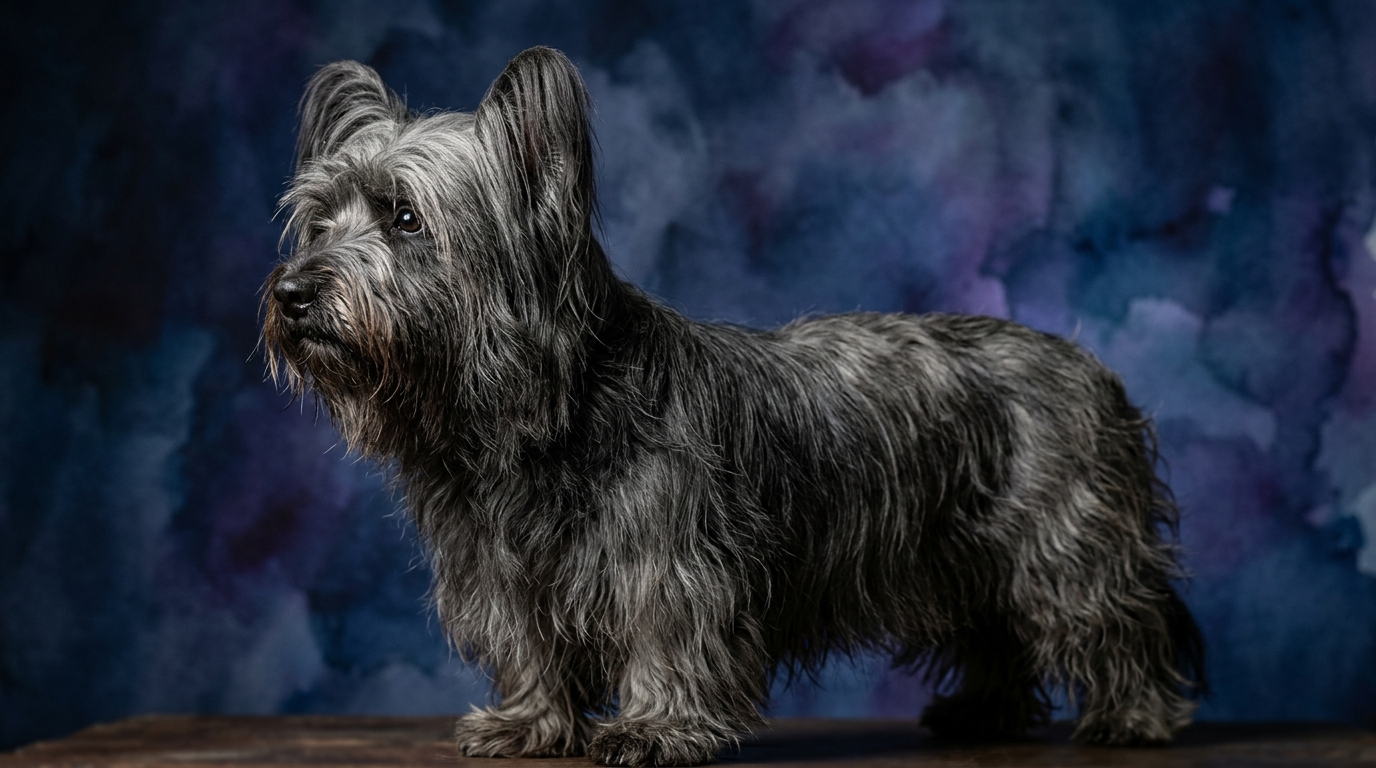
Side-by-Side IQ Profile: OES vs. Skye Terrier
The Cosmic Pet Pet IQ Lab employs a five-dimensional framework to evaluate canine intelligence, offering a nuanced perspective. For the Old English Sheepdog, we observe a balanced cognitive profile with standout memory. Its Problem Solving is rated 3/5, indicating aptitude for moderate challenges and learning multi-step sequences. Training Speed also sits at 3/5, suggesting a reasonable pace for acquiring new commands, often driven by its cooperative herding nature. Social Intelligence, at 3/5, reflects an ability to read human cues. Its Instinctive Drive, 3/5, primarily manifests as a strong herding impulse. The Old English Sheepdog truly shines in Memory, scoring 4/5, enabling it to retain complex command sequences and recall past experiences with notable accuracy. This breed also holds a Coren rank of #44, placing it within the average working/obedience intelligence category, signifying a solid capacity for understanding and executing learned tasks.
In contrast, the Skye Terrier, while sharing some similar scores, applies its cognitive abilities through a distinctly terrier lens. Its Problem Solving is rated 3/5, akin to the OES, but often directed towards tasks like navigating tight spaces or outsmarting small prey, requiring ingenuity in confined environments. Training Speed is also 3/5, meaning it learns at a moderate pace, though its independent spirit can sometimes influence its willingness to comply. Social Intelligence, at 3/5, demonstrates an ability to form strong bonds with human companions, though it may exhibit a more reserved demeanor with strangers. The Skye's Instinctive Drive, 3/5, is heavily geared towards its foundational purpose: hunting vermin, manifesting as keen prey drive and persistent digging. Its Memory score of 3/5 is perfectly adequate for its tasks, allowing it to remember routines, but it doesn't possess the same exceptional recall for intricate, long-sequence tasks seen in some herding breeds. Notably, the Skye Terrier is not included in Coren's traditional ranking, highlighting its distinct cognitive priorities.
Where the Old English Sheepdog Wins Cognitively
The Old English Sheepdog's cognitive strengths distinctly align with its historical role, particularly evident in its superior Memory score of 4/5 compared to the Skye Terrier's 3/5. This enhanced recall means an OES can more readily remember extensive strings of commands or complex routines, crucial for guiding livestock across varied terrain without constant human intervention. Their capacity to retain learned behaviors over longer periods allows for the development of sophisticated working partnerships, where subtle signals elicit precise actions. An OES might remember specific routes for different flocks or nuanced cues for separating sheep from lambs, tasks requiring high sequential memory.
Furthermore, the Old English Sheepdog's Coren rank of #44 underscores its capacity for "working and obedience intelligence," a measure of how quickly a dog learns new commands and how reliably it obeys them. While its individual scores for Problem Solving and Training Speed are similar to the Skye Terrier, its herding lineage imbues it with a natural inclination towards cooperation and directed effort. This inherent drive to work alongside a human partner, combined with its strong memory, often translates into a more consistent and predictable application of its cognitive abilities in structured environments, making it adept at tasks demanding cumulative understanding.
Where the Skye Terrier Wins Cognitively
While the Skye Terrier may not boast the same Coren ranking or a superior memory score, its cognitive advantages are deeply rooted in its independent and tenacious terrier spirit. Its Problem Solving, rated 3/5, is often deployed in scenarios requiring singular focus and self-reliance, rather than collaborative effort. Imagine a Skye Terrier confronting a burrow; its problem-solving isn't about herding a flock, but strategically assessing how to access or flush out its target in tight, confined spaces. This involves a unique blend of spatial reasoning and persistent effort, where success hinges on individual determination.
The Skye Terrier's instinctive Drive, also 3/5, is a powerful cognitive asset when viewed through its original purpose. This drive translates into an unwavering persistence that can be a cognitive "win" in specific contexts. While an Old English Sheepdog might pause, a Skye Terrier, once fixated on a scent or perceived "prey," exhibits remarkable single-mindedness, demonstrating its own form of applied intelligence to achieve its self-appointed goal. This tenacity, coupled with its moderate problem-solving abilities, allows the Skye to excel at tasks requiring sustained focus and a degree of independent decision-making, even when faced with obstacles or lack of direct human guidance.
Which is Easier to Train and Why
Assessing ease of training requires understanding their core motivations. The Old English Sheepdog, with its Coren rank of #44 and a memory score of 4/5, generally presents as the more straightforward candidate for structured training. Its herding heritage instilled a strong desire to work cooperatively with humans, making it inherently more receptive to direction. When teaching new commands, the OES's better memory means it will likely retain lessons more efficiently and require fewer repetitions. Their cooperative nature means they often respond well to positive reinforcement and clear, consistent guidance.
The Skye Terrier, despite sharing a 3/5 Training Speed score, often presents a greater challenge due to its independent and often stubborn terrier temperament. While capable of learning, the Skye's instinctive drive is geared towards self-directed action, not necessarily compliance. They possess a strong will and a tendency to evaluate whether a command aligns with their own perceived interests. Training a Skye requires more patience, creativity, and understanding what truly motivates them, often involving high-value rewards and making training feel like a game. Real behavioral differences include the OES's willingness to perform tasks for partnership, while the Skye might require a stronger personal incentive.
Which Suits Active Owners vs. Relaxed Owners
The Old English Sheepdog, despite its fluffy appearance, is a working breed with a history of traversing vast distances. Its balanced cognitive profile and instinctive drive mean it thrives with active owners who can provide consistent mental engagement and physical exercise. They require more than just casual strolls; their minds and bodies benefit from activities like obedience training, agility, or herding games. An OES needs purpose and stimulation to prevent boredom. Owners who enjoy regular, structured activities will find the OES a rewarding companion. A relaxed owner unable to meet these needs might find an OES becomes restless or develops unwanted behaviors due to under-stimulation.
The Skye Terrier, while possessing a terrier's inherent energy, suits a slightly different kind of owner. They are not necessarily built for sustained, high-impact activities like the OES, but require regular, moderate exercise and plenty of opportunities for mental stimulation aligned with their breed nature. This might include scent work, puzzle toys, or supervised digging. Their independent streak means they can be content with periods of quiet relaxation, but these must be balanced with opportunities to engage their problem-solving and instinctive drive. A relaxed owner who understands the Skye's need for periodic, focused activity and appreciates its independent nature would be a good match, prepared to channel their tenacity into acceptable outlets.
The Verdict
Choose the Old English Sheepdog if you seek a cooperative companion eager to learn complex tasks and participate in structured activities, and if you can provide consistent mental and physical engagement for a working breed.
Opt for the Skye Terrier if you appreciate an independent, tenacious personality, are prepared for a more nuanced training approach, and can offer a balance of moderate exercise with opportunities for self-directed mental stimulation.
🧠 Find Your Pet's IQ Score
Our Pet IQ Lab assessment covers 25+ tests across 5 cognitive dimensions — personalized to your breed.
Take the Full IQ Test →Frequently Asked Questions
Do Old English Sheepdogs shed a lot, and how does that relate to their activity level?
Yes, Old English Sheepdogs are known for significant shedding, requiring regular grooming, which is a separate consideration from their activity needs. Their substantial coat doesn't diminish their requirement for daily exercise and mental stimulation, as they are a working breed at heart.
Are Skye Terriers good with children, given their independent nature?
Skye Terriers can be good with older, respectful children who understand how to interact with an independent dog, but their reserved nature and strong prey drive mean they might not be the best fit for very young children. Early socialization is crucial to help them adapt to family life.
What kind of mental stimulation is best for an Old English Sheepdog's memory?
For an Old English Sheepdog's strong memory, activities like advanced obedience training, agility, complex puzzle toys, or even learning multi-step tricks are excellent. These types of engagement leverage their capacity for sequential learning and recall, keeping their minds sharp.