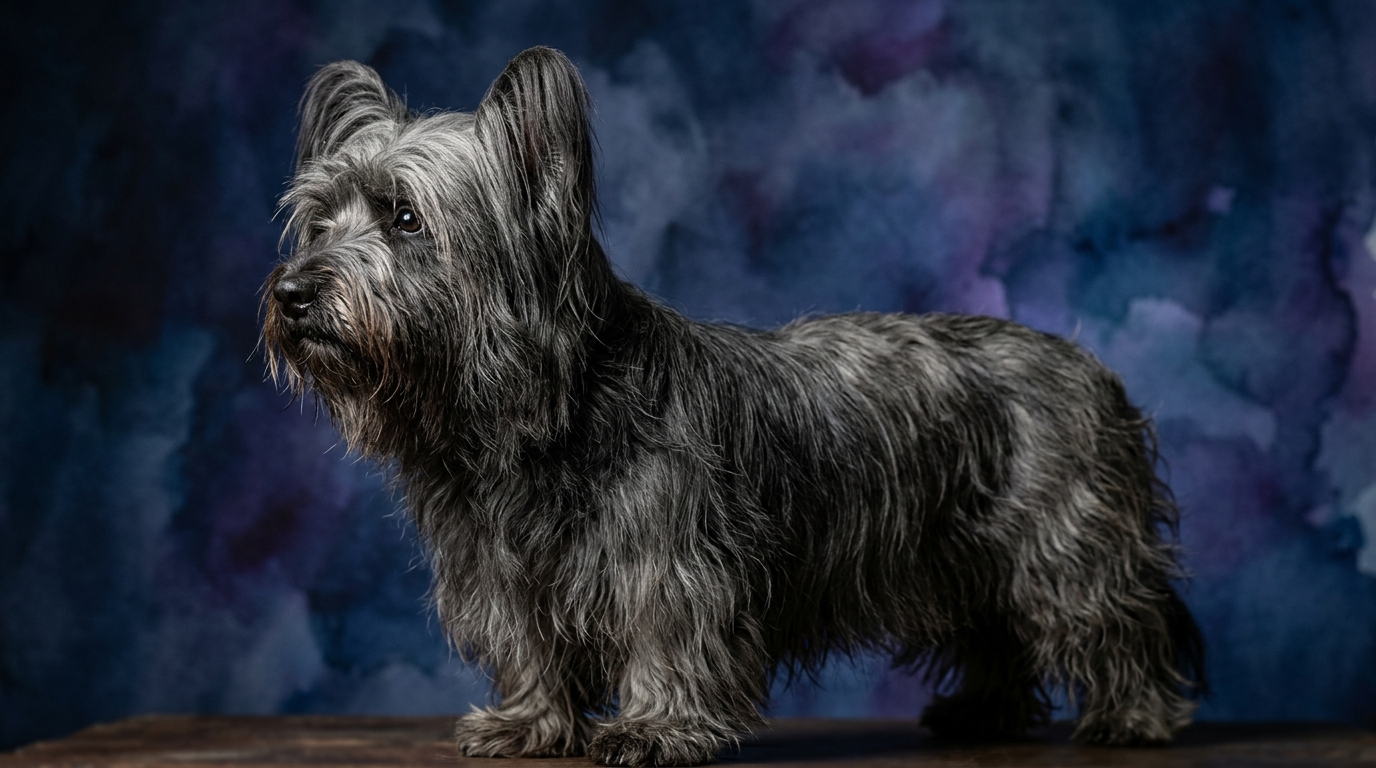
Skye Terrier at a glance
| IQ Rank / Score | 15/25 |
|---|---|
| Trainability | ★★★☆☆ (3/5) |
| Social Intelligence | ★★★☆☆ (3/5) |
| Lifespan | 12-16 years |
| Shedding | Low to moderate |
| Exercise Needs | Moderate (30-45 min/day) |
| Origin | Scotland |
The Skye Terrier's Primary Cognitive Angle: Resolute Independence
The cognitive cornerstone of the Skye Terrier is its resolute independence, a trait honed over centuries of solitary work flushing vermin from rocky burrows in Scotland. Unlike many breeds eager to please, the Skye Terrier approaches challenges and commands with a thoughtful, often self-motivated perspective. Their intelligence isn't about blind obedience; it's about discerning the value of a task, strategizing a solution, and executing it with unwavering determination. This independent streak means they are exceptional problem-solvers when the motivation aligns with their intrinsic drives, whether it's outwitting a squirrel or finding a comfortable spot on the sofa. Their cognitive processes are deeply entwined with their self-reliance, making them thinkers rather than mere followers, and this discerning nature is a hallmark of their unique intellect.
This mental fortitude translates into a dog that, while deeply loyal to its chosen family, is not inherently subservient. They possess a quiet confidence in their own abilities, often preferring to tackle puzzles or new situations on their own terms rather than relying solely on human guidance. Understanding this primary angle is crucial for anyone interacting with a Skye Terrier, as it illuminates why conventional training methods might need adjustment and why patience and mutual respect yield far greater results than forceful directives. Their independence is not stubbornness for its own sake, but rather a profound cognitive characteristic that underscores their self-assured and discerning approach to the world around them.
A Surprising Cognitive Insight: The Legend of Greyfriars Bobby
Perhaps the most profound historical testament to the Skye Terrier's unique cognitive and emotional capacity comes from the legendary tale of Greyfriars Bobby. This Skye Terrier famously guarded his owner’s grave in Greyfriars Kirkyard, Edinburgh, for an astonishing 14 years after his owner's death in 1858. This isn't just a story of loyalty; it’s a remarkable demonstration of deep emotional memory, sustained focus, and unwavering dedication over an incredibly long period. Bobby’s actions highlight a cognitive capacity for profound attachment, a highly developed form of long-term spatial memory (remembering the grave's location), and an ability to process and maintain an emotional bond that transcended the physical presence of his owner.
Scientifically, Bobby’s story provides compelling, albeit anecdotal, evidence of a Skye Terrier's potential for exceptional object constancy and emotional processing. It suggests a dog capable of forming bonds so deep that they influence behavior for over a decade, indicating a sophisticated neural architecture for memory and sentiment. This dedication speaks volumes about their intelligence, showing an ability to maintain complex internal states and routines, adapting his life around a central, deeply meaningful location and memory, a trait that sets them apart and underscores their profound cognitive depth beyond simple problem-solving tasks.
Deconstructing the Skye Terrier's IQ Profile
At The Cosmic Pet's Pet IQ Lab, we assess canine intelligence across multiple dimensions. Here’s how the Skye Terrier measures up:
**Problem-Solving (4/5):** Skye Terriers are highly adept at figuring things out, especially when motivated by instinct or personal gain. Their historical role required independent thought to locate and flush prey from complex environments, making them natural strategists. They will persist with a challenge until a solution is found, demonstrating impressive ingenuity and mental stamina. However, they may choose *not* to solve a problem if they don't see the benefit, reflecting their independent nature.
**Training Speed (3/5):** While intelligent, the Skye Terrier's training speed is often perceived as moderate due to their inherent independence and selective obedience. They certainly have the capacity to learn quickly, but their strong will means they often require consistent, patient, and reward-based methods. They need to understand 'why' they should comply, and once motivated, they can grasp commands and tricks with surprising speed. Their intelligence allows them to understand, but their personality dictates compliance.
**Social Intelligence (3/5):** Skye Terriers are intensely loyal and affectionate with their chosen family, demonstrating deep understanding of their human companions' moods and routines. However, they tend to be reserved, sometimes aloof, with strangers and other animals. Their social intelligence is high within their inner circle, allowing for profound bonds and nuanced communication, but less outwardly expressive or universally friendly than some more gregarious breeds. They read their people exceptionally well.
**Instinctive Drive (5/5):** This is where the Skye Terrier truly shines. Their instinctive drive for hunting, protection, and tenacity is exceptionally strong. Bred to be earth dogs, they possess a formidable prey drive, a keen sense of smell, and an unwavering determination to pursue. This high instinctive drive manifests in their alert nature, territorial instincts, and an almost unbreakable focus when engaged in an activity that taps into their innate purpose. This is a core component of their cognitive makeup.
**Memory (4/5):** As exemplified by Greyfriars Bobby, Skye Terriers possess excellent long-term memory, particularly for people, places, routines, and experiences. They remember kindness, perceived injustices, and the location of favored toys or sleeping spots. This strong memory contributes to their consistent loyalty and their ability to navigate complex environments or recall learned behaviors over extended periods. Their memory for both positive and negative experiences is notably robust.
Optimal Training Strategies for the Discerning Skye Terrier
Training a Skye Terrier requires an understanding of their unique cognitive profile, especially their independence. Forceful or repetitive methods are counterproductive and can lead to resistance. Instead, focus on positive reinforcement, patience, and making training feel like a collaborative problem-solving game. Start early with socialization to help them adapt to novel situations and people, balancing their natural reserve with controlled exposure. Keep training sessions short, engaging, and fun, utilizing their high prey drive with toys or treats as rewards.
Consistency is paramount, as is establishing clear, fair boundaries. Skye Terriers respect leadership that is calm, confident, and understanding of their independent streak. They thrive on mental stimulation, so incorporate puzzle toys and scent games into their daily routine. Harness their problem-solving abilities by allowing them to 'think' through commands, rather than simply drilling them. When they figure out what you want, reward them enthusiastically. This approach not only builds a stronger bond but also taps into their innate intelligence, transforming potential stubbornness into willing participation.
Play & Mental Enrichment for the Clever Skye
To keep a Skye Terrier's sharp mind engaged, incorporate activities that challenge their intellect and satisfy their instinctive drives. Puzzle toys that require manipulation to release treats are excellent, as they cater to their problem-solving skills and persistence. Scent work, such as hide-and-seek with treats or a favorite toy, is highly rewarding, tapping into their powerful sense of smell and historical role. Agility or earth dog trials, while potentially requiring some adaptation to their body structure, can provide physical and mental challenges that satisfy their desire to navigate obstacles and hunt.
Beyond structured activities, simple daily walks become mentally enriching when allowed to explore safe, new scents. Providing a variety of textures and safe chew toys helps satisfy their instinctual need to dig and 'work' with their jaws. Interactive play that simulates hunting, like chasing a lure or fetching a squeaky toy (if they enjoy it), can also be highly stimulating. The key is to offer variety and opportunities for independent thought, ensuring they feel mentally satisfied and less prone to boredom-induced behaviors.
Unique Cognitive and Behavioral Challenges
The Skye Terrier's remarkable intelligence and independence come with specific challenges. Their strong territorial instincts, coupled with their protective nature, can sometimes lead to excessive barking or reserved behavior around strangers if not properly socialized from a young age. Their tenacity means they can be persistent in pursuing what they want, sometimes to the point of perceived stubbornness, requiring owners to be equally consistent and patient in their training. Furthermore, their historical role as hunters imbues them with a significant prey drive, meaning off-leash excursions require careful consideration and secure fencing.
Another cognitive challenge can be their potential for resource guarding, stemming from their self-reliant nature. They may be protective of their food, toys, or favored resting spots, a behavior that needs to be addressed early with careful management and positive reinforcement to prevent escalation. Understanding these nuances of their cognitive profile is essential for preventing behavioral issues and fostering a harmonious relationship, recognizing that their 'challenges' are often simply expressions of their deeply ingrained breed characteristics.
3 At-Home Tests to Measure Your Skye Terrier's IQ
These tests are adapted from peer-reviewed ethology research. No equipment is needed beyond items you have at home. Run each test 5–10 times for reliable results.
The Myth: "The most common myth about Skye Terriers is that they are stubborn and difficult to train, often mistaken for a lack of intelligence or unwillingness to learn."
✅ In reality, Skye Terriers are highly intelligent and capable learners, but they require training methods that respect their independent spirit and motivate them through positive reinforcement and engaging challenges rather than forceful commands. They learn quickly when they understand the purpose and perceive a benefit, demonstrating excellent memory and problem-solving skills once their trust and respect are earned.
Skye Terrier vs. Similar Breeds
🧠 What's Your Dog's IQ Score?
Our full Pet IQ Lab assessment includes 12+ tests across 5 cognitive dimensions, calibrated for Skye Terriers specifically.
Take the Full IQ Test →Frequently Asked Questions
How smart is a Skye Terrier?
Our Pet IQ Lab framework scores cognition across five dimensions (max 25). The Skye Terrier totals 15/25 — above-average for a domestic dog. The full article breaks down each dimension with at-home tests.
Are Skye Terriers easy to train?
Skye Terriers can learn most cues, but expect to repeat lessons and keep sessions short. They score 3/5 on Training Speed in our breed profile.
Are Skye Terriers good with children and other pets?
Skye Terriers can live well with families when socialized early. Their Social Intelligence scores 3/5, so supervise interactions with small children and introduce new pets gradually.
Do Skye Terriers need a lot of mental stimulation?
Skye Terriers benefit from 10-15 minutes of focused enrichment a day: food puzzles, short training drills, or novel toys rotated weekly.
How much exercise does a Skye Terrier need?
Skye Terriers do well with 20-40 minutes of daily walks and play plus a few short training moments.
How good is a Skye Terrier's memory?
Skye Terriers score 3/5 on memory. They remember high-value associations well; less-used cues fade without refresher sessions.
What is the typical lifespan of a Skye Terrier?
Skye Terriers commonly live 12-16 years when kept at a healthy weight.
The Skye Terrier stands as a testament to profound, independent intelligence, combining tenacious problem-solving with a fiercely loyal heart. Understanding their unique cognitive makeup allows us to appreciate these dignified dogs not just for their elegance, but for the sharp, self-reliant minds that define them.