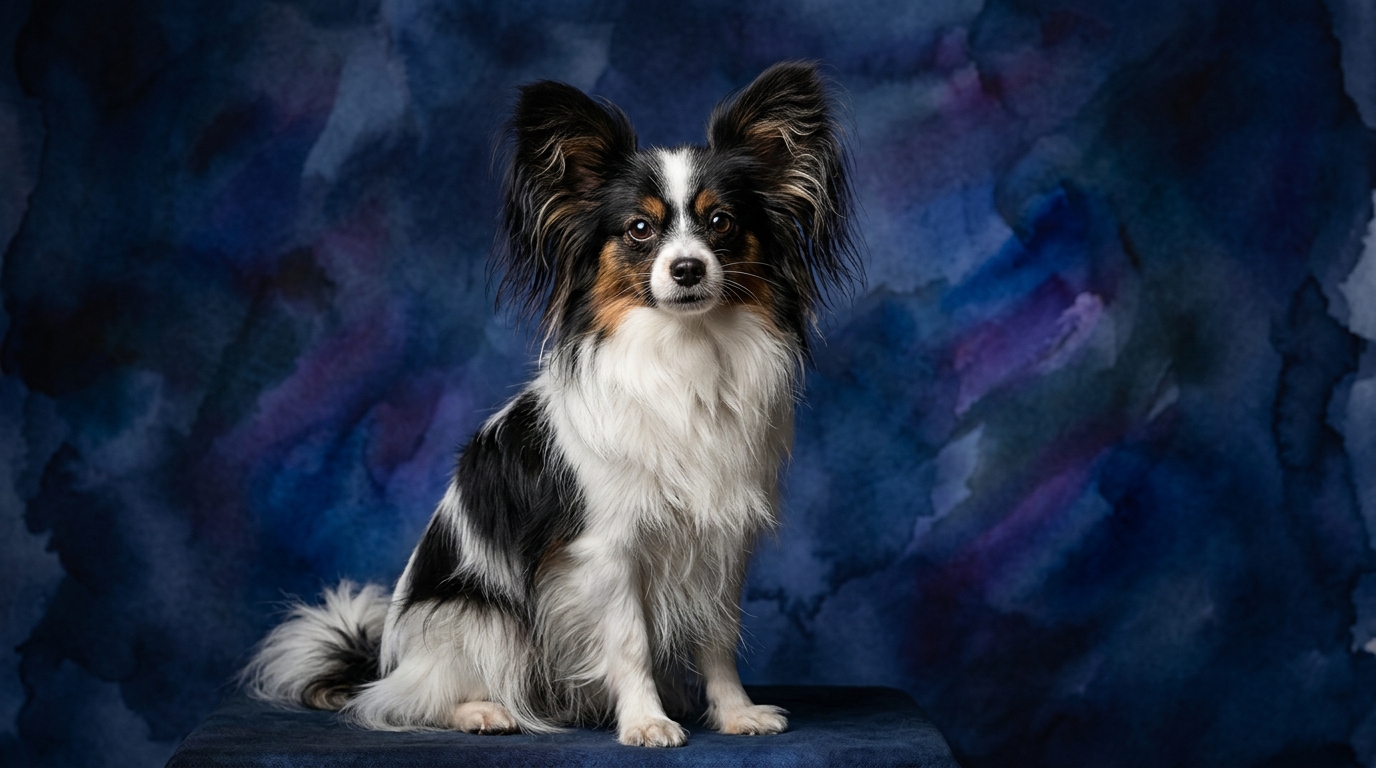

Side-by-Side Cognitive Profiles: Papillon vs. Redbone Coonhound
The Cosmic Pet Pet IQ Lab provides a unique lens through which to examine canine cognition, breaking it down into five crucial dimensions. The Papillon, ranking #8 on Stanley Coren’s list, presents a compelling profile: Problem Solving 5/5, Training Speed 5/5, Social Intelligence 4/5, Instinctive Drive 3/5, and Memory 5/5. This breed exhibits exceptional mental agility and a remarkable capacity for learning and retention, often demonstrating a swift grasp of new concepts and commands.
In stark contrast, the Redbone Coonhound, which is not Coren-ranked, shows a more uniform distribution of cognitive scores: Problem Solving 3/5, Training Speed 3/5, Social Intelligence 3/5, Instinctive Drive 3/5, and Memory 3/5. These scores suggest a cognitive profile that, while not excelling in generalized academic-style tasks, is robustly suited for its specialized role. Their scores indicate a steady, functional intellect, particularly when engaged in tasks aligned with their core purpose.
Where the Papillon Excels Cognitively
The Papillon's cognitive strengths are evident in its exceptional Problem Solving and Training Speed, both scoring a perfect 5/5. This means a Papillon can quickly analyze novel situations and devise effective strategies to achieve desired outcomes, whether it's navigating a complex agility course or figuring out how to open a puzzle toy. Their rapid acquisition of new behaviors makes them highly responsive to training cues, often picking up complex routines after only a few repetitions. This quick learning ability extends beyond basic obedience, making them adept at trick training, canine freestyle, and competitive sports.
Furthermore, their 5/5 Memory score means Papillons retain learned information over extended periods, making them reliable in recalling commands and past experiences. This strong memory, coupled with their 4/5 Social Intelligence, allows them to understand and respond appropriately to human cues and social contexts. They often form strong, nuanced bonds with their handlers, interpreting subtle body language and vocal tones, which further enhances their trainability and adaptability in various social settings. Their cognitive makeup allows for sophisticated interaction and a remarkable ability to integrate into diverse human environments.
Redbone Coonhound's Unique Cognitive Strengths
While the Redbone Coonhound's scores of 3/5 across all categories might seem modest in a general comparison, they represent a highly functional and specialized cognitive toolkit. Their 3/5 Problem Solving isn't about abstract puzzles, but about practical, real-world challenges related to their hunting heritage. This breed excels at meticulously following complex scent trails, navigating varied terrain, and making independent decisions in the field to locate quarry. This form of problem-solving requires sustained focus, environmental awareness, and sequential processing of sensory information, which are hallmarks of their working cognition.
The Redbone's 3/5 Instinctive Drive is a powerful cognitive engine, fueling their unwavering determination to pursue scents. This drive isn't merely physical; it's a profound cognitive commitment that allows them to tune out distractions and maintain a singular focus on their primary task. Their 3/5 Memory, while not geared towards remembering an extensive repertoire of tricks, is acutely attuned to retaining scent patterns, the locations of past finds, and the successful strategies employed during a hunt. This specialized memory is crucial for efficient and effective fieldwork. Their 3/5 Social Intelligence allows for cooperative work with a handler, understanding basic commands within the context of their shared hunting goal, fostering a working partnership built on mutual purpose rather than complex social nuance.
Training Dynamics: Which is Easier to Train?
Based on The Cosmic Pet Pet IQ Lab scores, the Papillon (Training Speed 5/5) is unequivocally easier to train than the Redbone Coonhound (Training Speed 3/5). Papillons exhibit an eager-to-please temperament and a rapid grasp of new commands, often enjoying the mental stimulation that training provides. Their high problem-solving ability means they can quickly generalize learned behaviors to new contexts, making them adaptable and responsive to a wide range of training methodologies, from positive reinforcement to clicker training. They thrive on engagement and praise, making training sessions productive and enjoyable for both dog and handler.
The Redbone Coonhound, conversely, requires a more patient and consistent approach. Their 3/5 Training Speed means they will take longer to acquire new behaviors and may need more repetitions to solidify learning. Their powerful 3/5 Instinctive Drive can be a significant factor; if a compelling scent is present, it can override learned commands, requiring handlers to build strong recall and impulse control from a young age. Training a Redbone often involves leveraging their innate drive, perhaps by incorporating scent work or using high-value, scent-based rewards. While capable of learning, their behavioral patterns are deeply rooted in their breed purpose, demanding a handler who understands how to channel and redirect these strong natural tendencies effectively.
Lifestyle Match: Active vs. Relaxed Owners
For owners seeking a more relaxed lifestyle, the Papillon presents a highly adaptable companion. While they possess energy and enjoy activity, their smaller size and cognitive engagement mean they can thrive with indoor play, puzzle toys, and moderate daily walks. Their 5/5 Problem Solving and Memory make them excellent candidates for mental challenges that don't necessarily require extensive physical exertion, such as learning complex tricks or participating in indoor dog sports. They are content to be close companions, fitting well into various living situations, including apartments, as long as their mental needs are met.
The Redbone Coonhound is decidedly a match for active owners. Their robust physical build and ingrained 3/5 Instinctive Drive demand significant daily exercise and mental stimulation that taps into their scenting abilities. They are not suited for a sedentary lifestyle and will quickly become restless and potentially destructive without an outlet for their energy and natural inclinations. Owners must be prepared for long walks, runs, or hikes, ideally in environments where they can safely explore scents. Engaging them in scent work, tracking, or hunting activities is paramount to their well-being, providing the cognitive and physical challenge their breed purpose dictates. A Redbone thrives with an owner who shares an active, outdoor-oriented lifestyle and understands the profound influence of their specialized drives.
The Verdict
Choose the Papillon if you desire a quick-witted, highly trainable companion that excels in diverse learning tasks and adapts readily to various home environments.
Opt for the Redbone Coonhound if you are an active individual seeking a determined, scent-driven partner for outdoor adventures and specialized working tasks.
🧠 Find Your Pet's IQ Score
Our Pet IQ Lab assessment covers 25+ tests across 5 cognitive dimensions — personalized to your breed.
Take the Full IQ Test →Frequently Asked Questions
Are Papillons prone to barking due to their social intelligence?
Papillons, with their 4/5 social intelligence, can be quite communicative and may use barking to alert their owners or express excitement. While not excessively prone to it, their awareness of their surroundings and desire to interact can lead to vocalizations. Early training focusing on appropriate communication can help manage this behavior effectively.
How does the Redbone Coonhound's 3/5 instinctive drive manifest in daily life?
The Redbone Coonhound's instinctive drive primarily manifests as a powerful urge to follow interesting scents, often leading them to ignore other commands or distractions. In daily life, this means a strong preference for exploring with their nose, potentially pulling on the leash during walks, and requiring secure fencing to prevent them from wandering off on a trail. Engaging this drive positively through scent games can be very rewarding for them.
Can a Redbone Coonhound be a good family pet despite its lower social intelligence score?
Yes, a Redbone Coonhound can be a loyal and affectionate family pet, even with a 3/5 social intelligence score, which indicates functional rather than complex social reasoning. They form strong bonds with their families and are generally good with children when properly socialized. Their devotion often expresses itself through companionship and a desire to be near their people after a day of activity, rather than through intricate social cues.