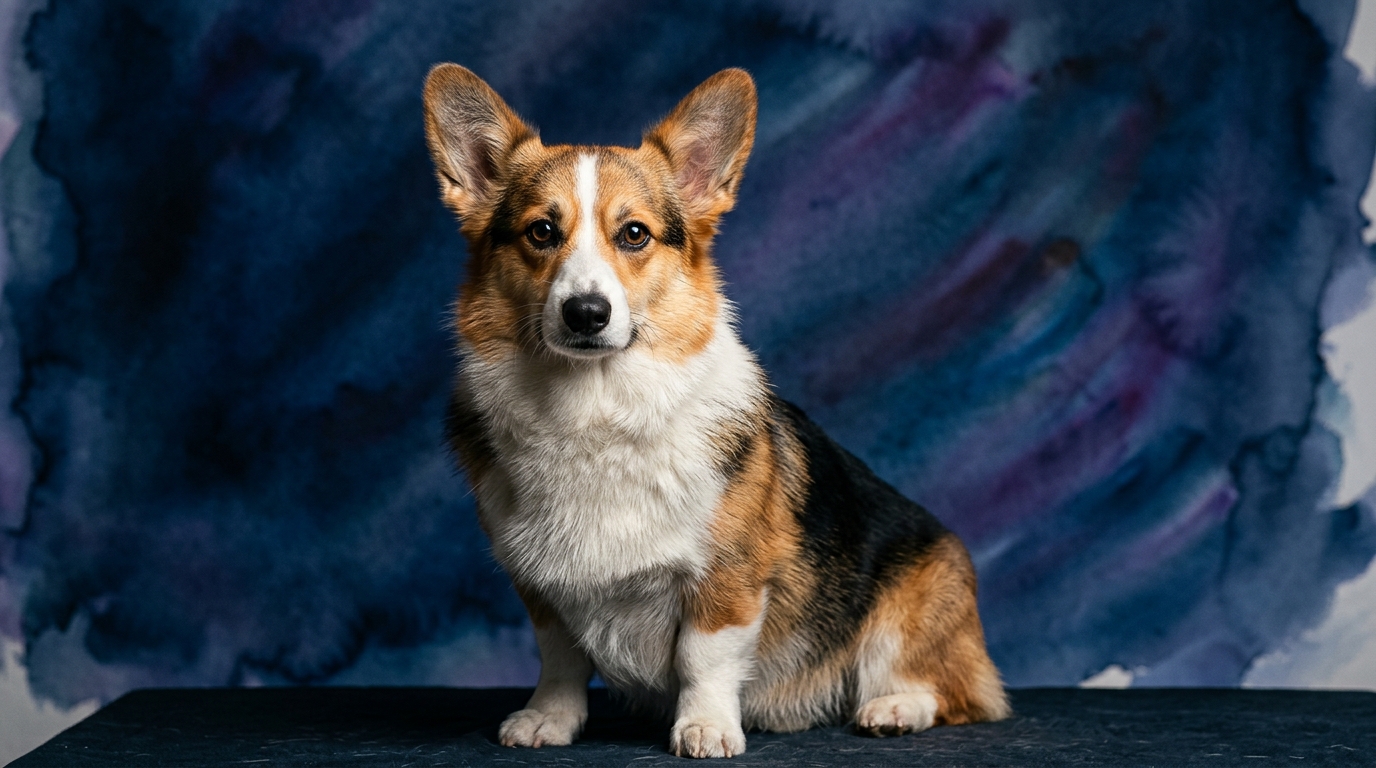

Side-by-Side IQ Profile: Corgi vs. GSP
The Cosmic Pet Pet IQ Lab employs a comprehensive framework to assess canine intelligence across five critical dimensions. For the Pembroke Welsh Corgi, a breed historically tasked with herding cattle, our data reveals a problem-solving score of 4/5, indicating an aptitude for navigating moderately complex situations and adapting strategies. Their training speed is exceptional at 5/5, reflecting a rapid grasp of new commands and routines. Social intelligence stands at 4/5, suggesting a capacity to understand and respond to human cues and social dynamics effectively. An instinctive drive of 5/5 underscores their powerful herding instincts and inherent motivation, while memory at 4/5 means they retain learned information and experiences well.
In contrast, the German Shorthaired Pointer, bred for versatile hunting, presents a distinct cognitive profile. Their problem-solving ability scores a perfect 5/5, demonstrating superior capacity for independent thought and strategic action in complex environmental challenges. Training speed is a robust 4/5, indicating they acquire new skills proficiently, though perhaps not with the instantaneous uptake of the Corgi. Social intelligence matches the Corgi at 4/5, showing an ability to connect and communicate with their human companions. Their instinctive drive is also a formidable 5/5, channeling intense prey drive and focus into their work. Memory parallels the Corgi at 4/5, allowing for efficient recall of hunting patterns and learned behaviors.
Where the Pembroke Welsh Corgi Excels Cognitively
The Corgi's standout cognitive strength lies in their remarkable training speed, scoring a 5/5. This means they are exceptionally quick to pick up new commands, tricks, and routines, making them highly responsive to consistent positive reinforcement. Their ability to rapidly associate verbal cues or hand signals with desired actions is a direct reflection of this cognitive agility. This quick uptake allows Corgi owners to progress through training regimens at an accelerated pace, often mastering foundational obedience within a few sessions, and even moving onto advanced trick training or dog sports like agility with impressive efficiency.
Furthermore, the Corgi's combination of strong social intelligence (4/5) and a potent instinctive drive (5/5), specifically applied to herding, gives them a unique cognitive edge in managing dynamic social groups. While a GSP's drive focuses on pursuit, a Corgi's drive is about control and organization. This translates into a perceptive understanding of group dynamics, whether it's a flock of sheep or a human family, and an innate desire to keep things in order. They can quickly learn household rules and routines, often anticipating their owner's next move or even subtly 'herding' family members where they believe they should be, demonstrating a keen perception of their environment and social roles.
Where the German Shorthaired Pointer Excels Cognitively
The German Shorthaired Pointer's cognitive pinnacle is their exceptional problem-solving ability, rated at 5/5. This isn't just about following instructions; it's about independent thought and strategic improvisation in challenging environments. A GSP can assess a complex scent trail, navigate varied terrain, and make split-second decisions to locate game, often without direct human guidance. This manifests in their capacity to figure out how to open gates, retrieve objects from tricky locations, or devise novel ways to achieve a goal, showcasing a self-reliant and adaptable intellect that thrives on mental challenges.
Their powerful instinctive drive (5/5) combined with their superior problem-solving and solid memory (4/5) creates a dog that is not just driven, but also highly effective and persistent in their pursuits. Where a Corgi might quickly learn a task, a GSP excels at applying that learning creatively and tirelessly in a real-world, often unpredictable, context. This includes remembering complex hunting patterns or extended search grids over vast distances, and applying their problem-solving skills to overcome obstacles encountered along the way, demonstrating a sustained cognitive effort aligned with their physical endurance.
Which is Easier to Train and Why?
Determining which breed is 'easier' to train depends heavily on the owner's goals and training style, but based on our IQ metrics, the Pembroke Welsh Corgi generally offers a quicker initial training experience due to their 5/5 training speed. Corgis absorb new commands and behaviors with remarkable alacrity, often showing understanding after just a few repetitions. This makes foundational obedience, house-training, and learning tricks a relatively swift process. However, their strong instinctive drive, while making them eager workers, can also manifest as stubbornness if they perceive a task as uninteresting or if their herding urges are not adequately channeled. They might try to 'negotiate' or test boundaries, requiring consistent and firm, yet positive, reinforcement to maintain focus.
The German Shorthaired Pointer, with a 4/5 training speed, still learns proficiently, but their training journey often requires more dedication to managing their intense focus and powerful prey drive. GSPs are intelligent and capable of learning complex tasks, but their attention can be easily diverted by environmental stimuli, particularly scents or movement, which their 5/5 instinctive drive compels them to investigate. Training a GSP often involves making the lessons more engaging and physically demanding, transforming commands into a game or a part of their 'work' to maintain their interest. Their high problem-solving capacity means they might also try to find loopholes or alternative solutions if not challenged appropriately, requiring a trainer who is equally clever and consistent.
Cognitive Fit for Active vs. Relaxed Owners
For owners seeking a companion with a vibrant mental presence that complements a moderately active or even a more relaxed lifestyle, the Pembroke Welsh Corgi presents an appealing choice. While they possess a strong instinctive drive and enjoy activities, their cognitive engagement doesn't always necessitate extreme physical exertion. Their high training speed and social intelligence mean they thrive on mental stimulation through puzzle toys, trick training, or participating in dog sports like obedience and rally. A Corgi appreciates a daily walk and playtime, but their cognitive needs can often be met with engaging indoor activities and consistent interaction, making them suitable for owners who enjoy brain games and structured learning without needing to spend hours running trails.
Conversely, the German Shorthaired Pointer is unequivocally suited for highly active owners who can fully engage their profound physical and cognitive needs. Their 5/5 problem-solving and 5/5 instinctive drive are geared towards sustained, independent work in challenging environments. A GSP requires significant daily exercise that often involves running, swimming, or extensive hikes, ideally coupled with opportunities for 'work' like scent games, retrieving, or field trials. Owners who can channel this powerful drive into structured activities, whether hunting, agility, or competitive obedience, will find a GSP to be an exceptionally focused and rewarding partner. Without adequate physical and mental outlets, their cognitive prowess can manifest as restlessness or destructive behaviors, making them less ideal for a predominantly relaxed home environment.
The Verdict
Choose a Pembroke Welsh Corgi if you value rapid learning, a socially perceptive companion, and enjoy channeling a clever mind into structured activities and family interaction without requiring extensive wilderness adventures.
Opt for a German Shorthaired Pointer if you lead an active lifestyle, appreciate an independent problem-solver with immense drive, and can provide consistent opportunities for vigorous physical and mental engagement, particularly in outdoor pursuits.
🧠 Find Your Pet's IQ Score
Our Pet IQ Lab assessment covers 25+ tests across 5 cognitive dimensions — personalized to your breed.
Take the Full IQ Test →Frequently Asked Questions
Do Corgis or GSPs have better memory?
Both the Pembroke Welsh Corgi and the German Shorthaired Pointer score a 4/5 for memory, indicating they both possess a strong capacity to recall learned commands, routines, and experiences. There isn't a significant difference in their memory capabilities based on our assessment.
Which breed is better at problem-solving, Corgi or GSP?
The German Shorthaired Pointer demonstrates superior problem-solving skills with a perfect 5/5 score, compared to the Pembroke Welsh Corgi's 4/5. GSPs are particularly adept at independent thought and strategic improvisation in complex situations, reflecting their hunting heritage.
Are Corgis or GSPs more social?
Both the Pembroke Welsh Corgi and the German Shorthaired Pointer score equally on social intelligence at 4/5. This suggests both breeds are capable of understanding and responding well to human cues and social dynamics, making them perceptive companions.