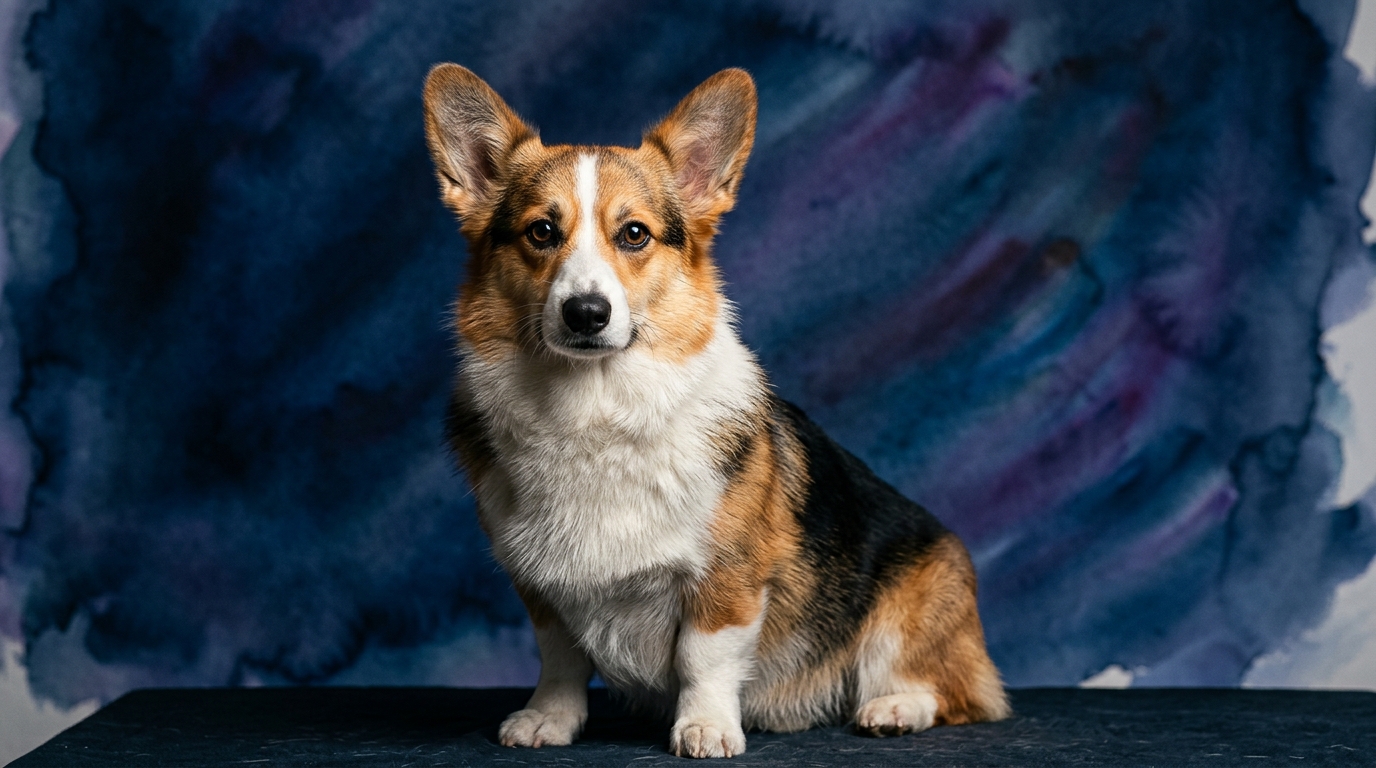
Pembroke Welsh Corgi at a glance
| IQ Rank / Score | #11 |
|---|---|
| Trainability | ★★★★★ (5/5) |
| Social Intelligence | ★★★★☆ (4/5) |
| Lifespan | 12-16 years |
| Shedding | Low to moderate |
| Exercise Needs | High (60+ min/day + training) |
| Origin | Wales |
More Than Just a Fluffy Friend: The Corgi's Ancient Calling
The Pembroke Welsh Corgi, a social media star and canine royalty, has captivated the internet. Yet, beneath their charming exterior lies a mind shaped by centuries of demanding work. To truly appreciate their mental capabilities, we must look beyond their modern image to their storied past in the fields of Wales.
Pembroke Welsh Corgis were cattle herders in medieval Wales — their low stature was a survival adaptation, not a breeding accident. This allowed them to effectively manage animals many times their size by nipping at heels and quickly ducking kicks. This demanding job forged a breed whose mental acuity and quick reactions were paramount for success.
Their intelligence profile reflects this heritage: Problem Solving (4/5), Training Speed (5/5), Social Intelligence (4/5), Instinctive Drive (5/5), and Memory (4/5). These robust scores are genetic echoes of a working legacy.
The Corgi's Mind: A Profile in Canine Cognition
Let's break down what these scores mean for the Corgi's everyday interactions and learning capacity. Their high Problem Solving aptitude (4/5) reveals a dog that actively strategizes, navigating obstacles or figuring out how to get to a coveted toy. This skill was vital for outsmarting stubborn livestock and adapting to unpredictable farm environments.
The perfect 5/5 in Training Speed highlights their exceptional capacity to grasp new commands quickly. Owners often find Corgis eager learners, soaking up lessons with remarkable efficiency, making them invaluable on the farm. This quick uptake also contributes to their reputation as delightful companions.
Social Intelligence at 4/5 shows strong ability to interpret human cues and adapt to social situations, making them well-adjusted family members. Their 5/5 Instinctive Drive is a clear nod to their herding roots; many Corgis will exhibit chasing behaviors. A Memory score of 4/5 means they retain lessons, reinforcing consistent training.
Obedience and Acuity: Stanley Coren's Rankings Explained
Dr. Stanley Coren's respected ranking places the Pembroke Welsh Corgi at #11 out of 138 breeds for obedience and working intelligence. This signifies a Corgi typically understands a new command in fewer than 5 repetitions and obeys the first command 95% of the time or better, placing them firmly in the top tier of canine learners.
Such a high ranking speaks volumes about their cognitive processing speed and willingness to engage. For an owner, this translates into a dog receptive to training and often enjoying the process. Their sharp focus and desire to please make them excellent candidates for advanced obedience, agility, or competitive herding trials.
Decoding Corgi Instincts: The Low-Profile Herder
The Corgi's primary intelligence angle — that of a low-profile herder — is perhaps their most defining cognitive characteristic. This wasn't brute force. Instead, their strategic approach involved quick bursts of speed, precise nipping at cattle heels, and an uncanny ability to duck kicks. This demanded a brain that could process information, make split-second decisions, and execute complex movements simultaneously.
Imagine the mental gymnastics: assessing herd movement, identifying a straggler, calculating the approach, executing the nip, then instantly judging reaction to avoid injury. This required fast situational judgment, exceptional spatial awareness, and an understanding of cause and effect. This tactical brilliance, woven into their genetics, influences their playful antics and problem-solving skills today.
3 At-Home Tests to Measure Your Pembroke Welsh Corgi's IQ
These tests are adapted from peer-reviewed ethology research. No equipment is needed beyond items you have at home. Run each test 5–10 times for reliable results.
The Myth: "Corgis are just cute internet dogs with no real working intelligence"
✅ While their endearing looks have undoubtedly made them internet sensations, the Pembroke Welsh Corgi possesses a profound working intelligence rooted in centuries of herding cattle. Their history as adept, low-profile herders demonstrates a sharp, problem-solving mind, far beyond just being a decorative pet.
Pembroke Welsh Corgi vs. Similar Breeds
🧠 What's Your Dog's IQ Score?
Our full Pet IQ Lab assessment includes 12+ tests across 5 cognitive dimensions, calibrated for Pembroke Welsh Corgis specifically.
Take the Full IQ Test →Frequently Asked Questions
How smart is a Pembroke Welsh Corgi?
Our Pet IQ Lab framework scores cognition across five dimensions (max 25). The Pembroke Welsh Corgi totals 22/25 — exceptionally high for a domestic dog. The full article breaks down each dimension with at-home tests.
Are Pembroke Welsh Corgis easy to train?
Pembroke Welsh Corgis learn new cues very quickly — often in 5-15 repetitions. They score 5/5 on Training Speed in our breed profile.
Are Pembroke Welsh Corgis good with children and other pets?
Yes — their Social Intelligence rates 4/5 in our Pet IQ Lab framework. With early socialization and supervised play, most Pembroke Welsh Corgis integrate well into families with respectful children and other pets.
Do Pembroke Welsh Corgis need a lot of mental stimulation?
Absolutely. With Problem Solving 4/5 and Instinctive Drive 5/5, Pembroke Welsh Corgis need daily mental work — puzzle feeders, scent games, training sessions, or nose-work — to avoid boredom.
How much exercise does a Pembroke Welsh Corgi need?
Pembroke Welsh Corgis need active engagement. Plan for 45-60 minutes of exercise and training per day, plus mental stimulation.
How good is a Pembroke Welsh Corgi's memory?
Pembroke Welsh Corgis score 4/5 on memory. They remember routines, hiding spots, and learned cues for months, sometimes years.
What is the typical lifespan of a Pembroke Welsh Corgi?
Pembroke Welsh Corgis commonly live 12-16 years when kept at a healthy weight.
The Pembroke Welsh Corgi is a vibrant testament to the fact that size belies intellect. Their cleverness, rooted in centuries of demanding herding work, makes them far more than just a charming face. Appreciate the sharp, adaptable mind behind those perky ears, and you’ll unlock a deeper connection with these remarkable canine companions.