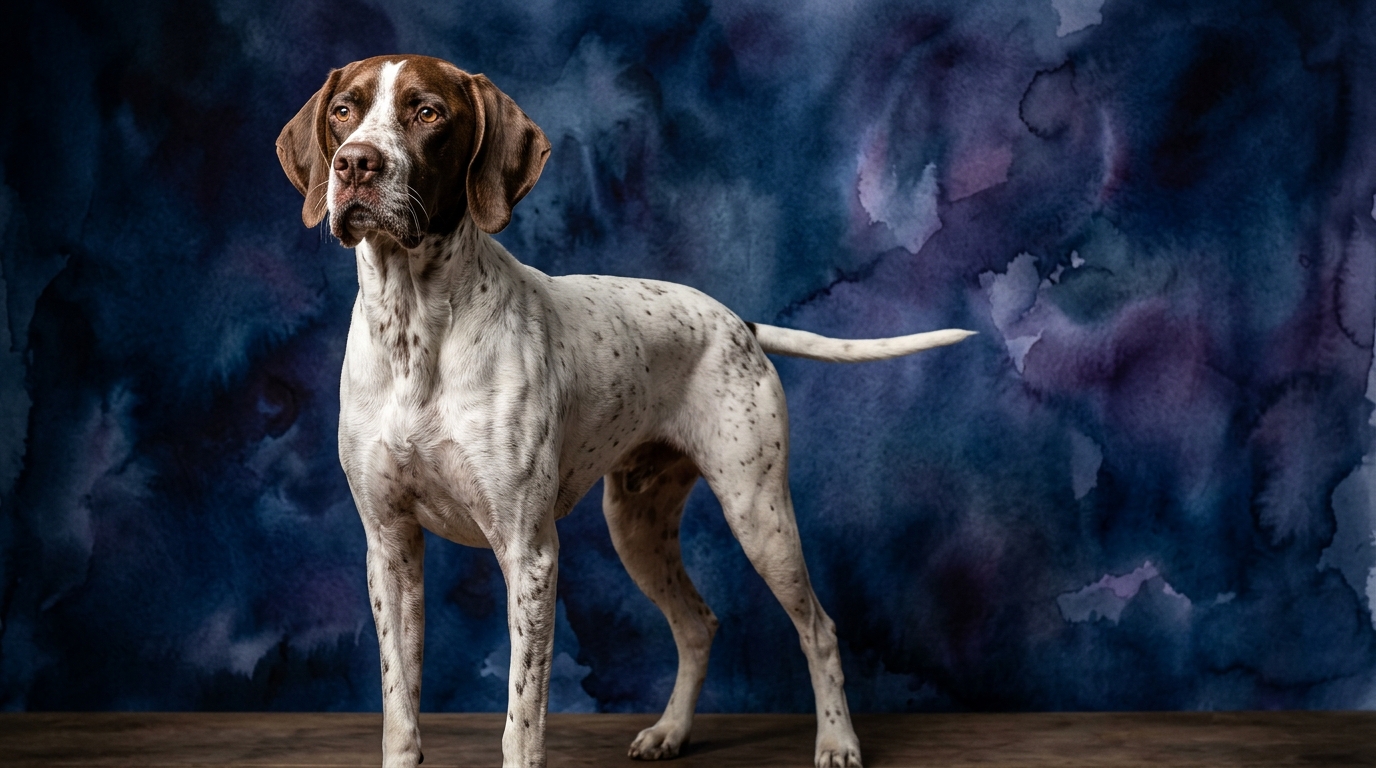
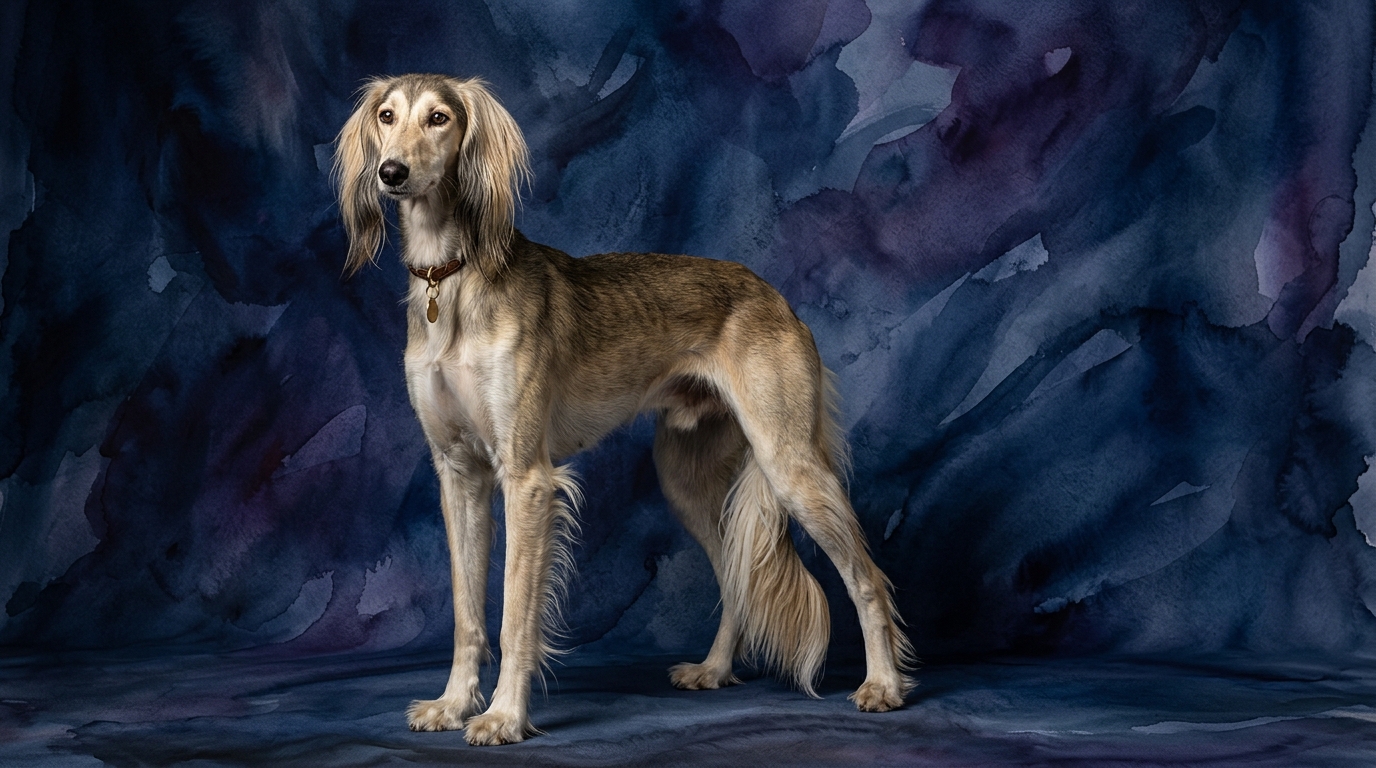
Side-by-Side Cognitive Profiles: Pointer vs. Saluki
Originating as gun dogs, Pointers were selectively bred for finding and indicating game birds. Their problem-solving (3/5) is geared towards practical application in the field, such as navigating varied terrain to locate scent sources and understanding complex commands to work collaboratively with a hunter. Their training speed (3/5) reflects a biddable nature, learning new tasks at a steady pace, particularly when these tasks align with their desire to work alongside their human. Social intelligence (3/5) in Pointers manifests as an amiable disposition, a capacity to read human intent, and a desire to engage with their family. Their instinctive drive (3/5) is a powerful, scent-driven urge to range and point, a deep-seated behavioral pattern. Memory (3/5) supports their ability to recall hunting locations, learned routes, and an extensive repertoire of commands essential for their work.
As ancient sighthounds, Salukis were developed to hunt gazelle and other fast-moving prey across vast, open landscapes. Their problem-solving (3/5) is characterized by rapid, independent decision-making, particularly in judging distances, calculating intercepts, and navigating obstacles at high speeds during a chase. Training speed (3/5) in Salukis is often influenced by their independent streak; while capable of learning quickly, their compliance is frequently tied to personal motivation rather than an inherent desire to please. Their social intelligence (3/5) is expressed through deep loyalty to their chosen family, often reserved or aloof with strangers, and a capacity to understand subtle household dynamics without necessarily participating overtly. Instinctive drive (3/5) for Salukis is an intense, visually triggered prey drive, an insatiable urge to run and pursue anything that moves swiftly. Memory (3/5) in a Saluki is strong for familiar people, routines, and the layout of their environment, but may be selectively applied to commands when a compelling visual stimulus ignites their chase instinct.
Where the Pointer Excels Cognitively
The Pointer's cognitive strengths shine particularly in cooperative tasks and sustained engagement with a human partner. Their problem-solving, while rated identically, is more often applied to understanding and executing complex sequences of commands from a handler, demonstrating a greater inclination towards collaborative mental effort. This breed excels at processing and responding to verbal and hand signals in dynamic environments, a critical aspect of their original purpose. Their social intelligence, in contrast to the Saluki's more reserved nature, typically translates into a more overtly eager and consistently engaged demeanor with a broader circle of people, reflecting a higher degree of openness to external direction and social interaction. Furthermore, a Pointer's memory is often more consistently harnessed for recalling and applying learned commands across various settings, driven by their inherent desire to work and please, making their cognitive output more predictable in structured training scenarios. They are less likely to 'forget' a command due to distraction, instead maintaining focus on the task at hand under direction.
Where the Saluki Demonstrates Cognitive Prowess
The Saluki's cognitive advantages are rooted in their profound independence and specialized hunting heritage. Their problem-solving, though numerically similar, is acutely tuned for autonomous decision-making in high-stakes, fast-paced scenarios. They exhibit exceptional spatial reasoning and rapid processing of visual information, allowing them to instantly assess a chase situation, calculate trajectories, and navigate complex terrain at speed without human intervention. This split-second, independent problem-solving is a hallmark of their mental prowess. Their instinctive drive is not just strong; it's a finely honed cognitive apparatus for pursuit, where visual cues trigger an immediate and overwhelming mental focus on the target, demonstrating an unparalleled single-mindedness in the act of the chase. This intense, visually-driven focus allows for a form of reactive intelligence that Pointers, bred for scent work and human partnership, do not typically exhibit to the same degree. Additionally, a Saluki's memory, particularly for the layout of vast landscapes and the nuances of their hunting grounds, is remarkable, allowing them to operate effectively over large areas with a self-directed navigation system.
Ease of Training: Behavioral Differences Unpacked
When considering ease of training, the Pointer generally presents a more straightforward path for the average owner. Their training speed (3/5) is consistently applied due to their innate biddability and desire to work in tandem with their human. Pointers thrive on positive reinforcement and clear directives, eager to understand what is expected of them and to perform tasks that involve collaboration. Their social intelligence and cooperative nature mean they are typically more attuned to human cues and more invested in receiving approval, making them responsive to traditional training methods. They are less prone to 'selective hearing' because their primary motivation is often tied to engaging with their handler and fulfilling a shared purpose. In contrast, the Saluki's training speed (3/5) is often conditional. While capable of learning quickly, their independent problem-solving and intense visual prey drive mean their compliance can be highly situational. A Saluki might master a command perfectly in a quiet living room, but if an enticing visual stimulus (like a cat darting across the yard) appears, their instinctive drive can override learned behaviors. Their social intelligence often translates into a deep, but less outwardly demonstrative, bond, and they may choose not to engage in repetitive or seemingly pointless tasks if their motivation isn't piqued. Training a Saluki requires immense patience, creativity in finding their specific motivators, and an understanding that their profound independence is not defiance, but a fundamental aspect of their cognitive makeup.
Active vs. Relaxed Owners: Matching Cognitive Needs
Neither the Pointer nor the Saluki are suitable for relaxed owners, as both possess significant energy levels and inherent drives that demand active engagement. The Pointer, with its sporting heritage, thrives with owners who can provide ample physical exercise and mental stimulation that often involves collaborative activities. They are ideal companions for active individuals or families who enjoy long hikes, running, or participating in dog sports like agility, obedience, or field trials. Pointers need structured outlets for their energy and cognitive abilities, benefiting from consistent training sessions and activities that allow them to use their scenting and pointing instincts in a controlled manner. Their desire for partnership means they enjoy being included in an owner's active lifestyle. The Saluki, on the other hand, requires a different kind of active owner. While also needing substantial exercise, their need is primarily for opportunities to run at full speed in a safe, securely fenced environment. They are not typically suited for long, structured jogging sessions on a leash, but rather for bursts of intense, free running. Owners who appreciate an independent companion and can provide access to large, enclosed spaces where their Saluki can stretch its legs and indulge its chase instinct are best suited. Their active needs are less about constant engagement in human-directed tasks and more about fulfilling their innate drive to run. Therefore, both demand active owners, but the nature of that activity differs significantly: collaborative and structured for the Pointer, independent and free-form for the Saluki.
The Verdict
When considering a Pointer, envision a partnership built on shared activities and eager cooperation; they are ideal for owners seeking an engaged, biddable companion for field work, dog sports, or an active family life, thriving on consistent training and intellectual engagement.
Conversely, choose a Saluki if you appreciate an independent, elegant companion with a profound need for speed and a unique, deep bond, understanding that their distinct motivations require ample space for vigorous running and a patient, nuanced approach to training.
🧠 Find Your Pet's IQ Score
Our Pet IQ Lab assessment covers 25+ tests across 5 cognitive dimensions — personalized to your breed.
Take the Full IQ Test →Frequently Asked Questions
Are Pointers prone to separation anxiety?
Pointers, due to their social intelligence and desire for companionship, can develop separation anxiety if left alone for extended periods without adequate stimulation or training. Gradual acclimatization and mental enrichment are key.
Do Salukis make good watchdogs?
Salukis are generally not suited as watchdogs. While they may bark at strangers approaching the home, their reserved nature means they are more likely to observe than to actively guard or confront.
How much exercise does a Pointer need daily?
A Pointer typically requires at least 60-90 minutes of vigorous exercise daily, ideally broken into multiple sessions that include running, brisk walks, and mental games to keep them physically and mentally satisfied.