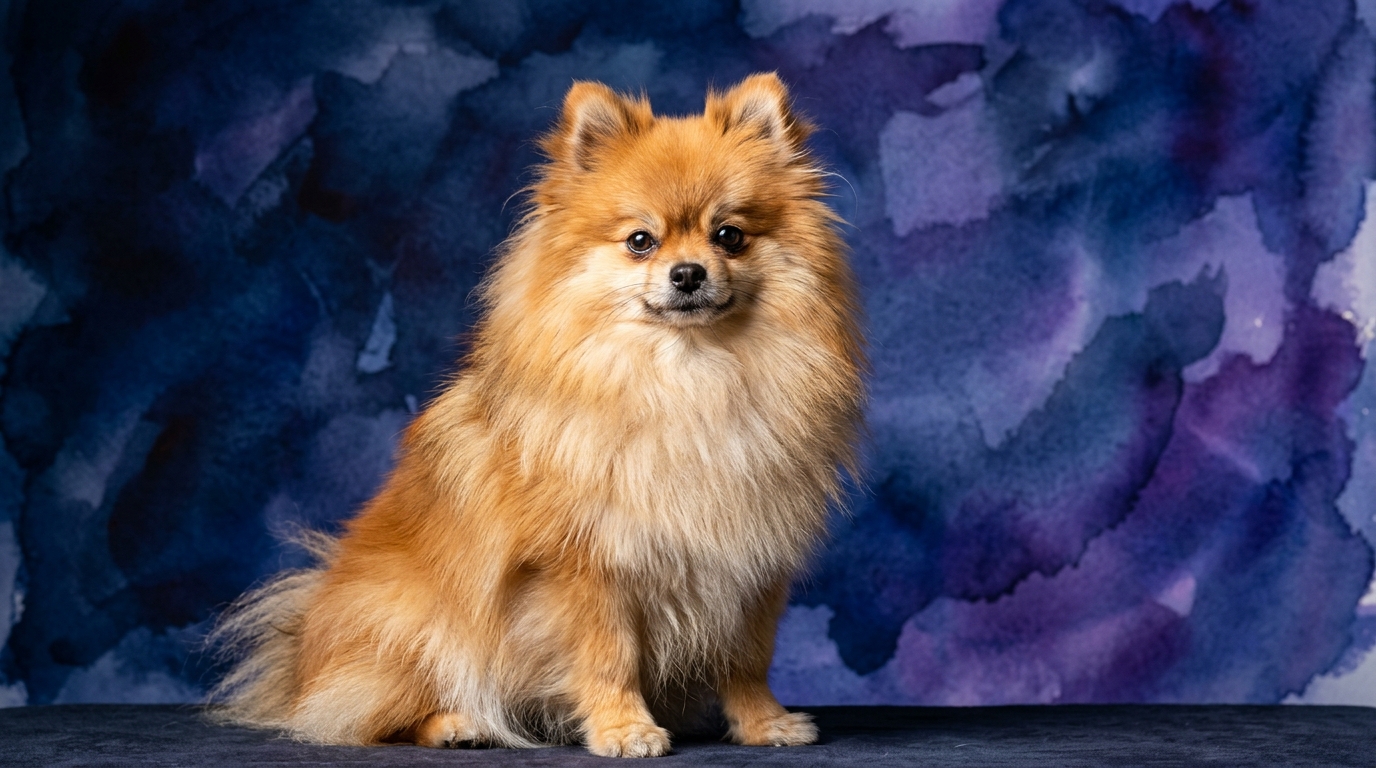

Side-by-Side IQ Profile: Pomeranian vs. Bloodhound
The Pomeranian, a member of the Toy group, holds an impressive Coren rank of #23, indicating a strong general capacity for learning and adaptation. Its cognitive profile shows robust scores across several dimensions: Problem Solving at 4/5, suggesting a readiness to figure out novel situations; Training Speed at 4/5, pointing to a quick grasp of new commands and routines; and Social Intelligence also at 4/5, highlighting an aptitude for understanding human cues and social dynamics. Its Instinctive Drive is a moderate 3/5, meaning while it possesses inherent breed traits, they are generally manageable and less overwhelming than in some working breeds. Finally, its Memory is rated 4/5, enabling it to retain learned behaviors and experiences effectively over time.
In stark contrast, the Bloodhound, a renowned member of the Hound group, sits at a Coren rank of #74. Its cognitive strengths are highly specialized and intense. This breed excels with a perfect 5/5 in Problem Solving, particularly when it pertains to its primary function, and an equally perfect 5/5 in Instinctive Drive, which is almost exclusively centered around its unparalleled olfactory prowess. Its Memory is also exceptional at 5/5, crucial for tracking complex scent trails over vast distances and durations. However, these specialized strengths come with trade-offs in other areas: its Training Speed is a notably low 1/5, reflecting a profound independence, and its Social Intelligence is rated 2/5, indicating a less primary focus on human social cues compared to its drive to follow scent.
Where the Pomeranian Wins Cognitively
The Pomeranian's cognitive profile showcases several distinct advantages, particularly in areas valued by companion animal owners. Its Training Speed, at 4/5, far surpasses the Bloodhound's 1/5, meaning a Pomeranian typically learns new commands and house rules with remarkable efficiency. This rapid acquisition of knowledge is often coupled with an eager-to-please temperament, making structured training sessions more productive and less challenging. Furthermore, the Pomeranian's Social Intelligence, also rated 4/5, allows it to finely tune into human emotions and intentions, fostering a strong, responsive bond.
This capacity for social understanding translates into a dog that is often more attuned to family dynamics, capable of subtle communication, and generally more adaptable to varied social environments. Its moderate Instinctive Drive (3/5) also means its natural urges, while present, are less likely to override direct human instruction or social cues, making it a more consistently cooperative partner in daily life. A Pomeranian's problem-solving skills (4/5) are readily applied to mastering new tricks or navigating household challenges, often with an engaging curiosity.
Where the Bloodhound Wins Cognitively
The Bloodhound's cognitive strengths are nothing short of legendary, though they manifest in a profoundly different manner than the Pomeranian's. Its perfect 5/5 in Problem Solving is unparalleled, but it is a problem-solving ability deeply integrated with its primary function: scent detection. This breed can analyze, interpret, and follow a complex, often faint, scent trail for miles, distinguishing it from countless other environmental odors—a cognitive feat requiring immense focus and analytical power. This is directly fueled by its equally perfect 5/5 Instinctive Drive, an unwavering compulsion to track that overrides almost all other stimuli.
Coupled with a 5/5 Memory, the Bloodhound can recall and piece together scent information from hours or even days prior, building a comprehensive 'scent map' in its mind. This specialized intelligence isn't about learning typical obedience commands, but about mastering an incredibly complex, real-world skill with unparalleled dedication and precision, making it an apex canine in its specific domain. Their problem-solving isn't about pleasing; it's about persistent, methodical deduction through scent.
Which is Easier to Train and Why?
When assessing ease of training, the Pomeranian clearly holds the advantage, primarily due to its 4/5 Training Speed and 4/5 Social Intelligence. Pomeranians typically exhibit a strong desire to engage with their human companions and find satisfaction in performing requested actions. Their relatively moderate Instinctive Drive (3/5) means they are less likely to be overwhelmingly distracted by environmental stimuli, allowing them to maintain focus during training sessions. A Pomeranian often thrives on positive reinforcement, quickly connecting a command with a desired action and the subsequent reward, making for a generally straightforward training experience.
In contrast, the Bloodhound’s 1/5 Training Speed is a direct reflection of its profound independence and singular focus. While capable of understanding, a Bloodhound's overwhelming 5/5 Instinctive Drive, particularly for scent, means it prioritizes following a trail above almost all else. Its lower 2/5 Social Intelligence suggests less inherent motivation to please or respond to human social cues when its nose is engaged. Training a Bloodhound requires immense patience, consistency, and an understanding that you are often competing with an ancient, powerful drive rather than simply teaching a new behavior. Their intelligence is not about compliance, but about tenacious pursuit of a goal they set for themselves.
Which Suits Active Owners vs. Relaxed Owners?
The choice between a Pomeranian and a Bloodhound also hinges significantly on an owner's lifestyle and activity level. A Pomeranian, while enjoying active play and walks, typically adapts well to a more relaxed home environment. Its moderate instinctive drives and strong social intelligence make it content with being a companion, often thriving on indoor games, short walks, and ample cuddle time. They require mental stimulation, but it can often be satisfied through interactive toys, learning tricks, or simply engaging with their family. This adaptability makes them suitable for owners who might prefer a calmer pace of life, or those living in smaller spaces where intense physical exertion isn't always feasible.
The Bloodhound, however, demands an exceptionally active and dedicated owner. Its profound 5/5 Instinctive Drive and 5/5 Problem Solving, channeled through its scenting ability, mean it requires extensive opportunities for mental and physical exertion centered around its natural talents. Daily, long walks or runs are insufficient; a Bloodhound thrives when given actual 'work'—scent games, tracking exercises, or even participation in search and rescue. Owners must be prepared for a dog that will incessantly follow its nose, requiring secure containment and a commitment to channeling its powerful drives productively. This breed is unequivocally for the active, outdoor-oriented, and highly engaged owner who understands and respects its specialized needs.
The Verdict
Choose a Pomeranian if you seek a highly trainable, socially astute companion that thrives on interaction and adapts well to various home environments, offering bright companionship with manageable exercise needs.
Choose a Bloodhound if you are an exceptionally active, dedicated owner prepared to channel a powerful, specialized scent drive, valuing a dog with unparalleled problem-solving and memory for tracking, even if it means a significant training challenge.
🧠 Find Your Pet's IQ Score
Our Pet IQ Lab assessment covers 25+ tests across 5 cognitive dimensions — personalized to your breed.
Take the Full IQ Test →Frequently Asked Questions
Is the Bloodhound's lower Coren rank an indicator of generally lower intelligence?
Not necessarily. The Coren rank measures general obedience intelligence. The Bloodhound's lower rank (74) reflects its independence and difficulty in training for general commands, not a lack of cognitive power, which it demonstrates profoundly in its specialized scent work.
Can a Pomeranian be trained for complex tasks like agility or advanced obedience?
Absolutely. With a Problem Solving score of 4/5 and Training Speed of 4/5, Pomeranians are quite capable of excelling in complex tasks like agility, advanced obedience, and even trick training, enjoying the mental stimulation and social interaction.
Why is the Bloodhound's social intelligence rated low despite being generally gentle?
The 2/5 Social Intelligence score indicates that while Bloodhounds are typically gentle and tolerant, their primary focus is often on their olfactory world rather than subtle human social cues or a strong desire for human validation in the same way a companion breed might.