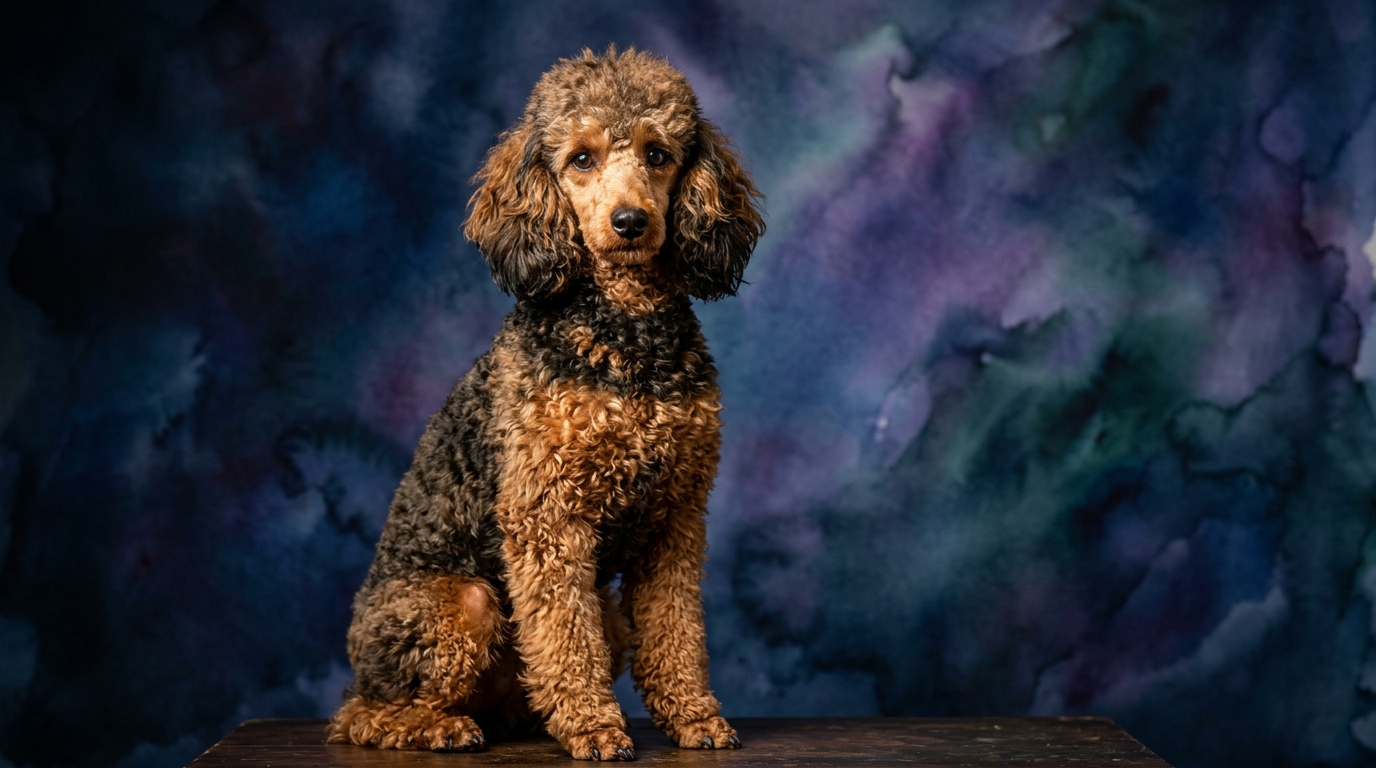
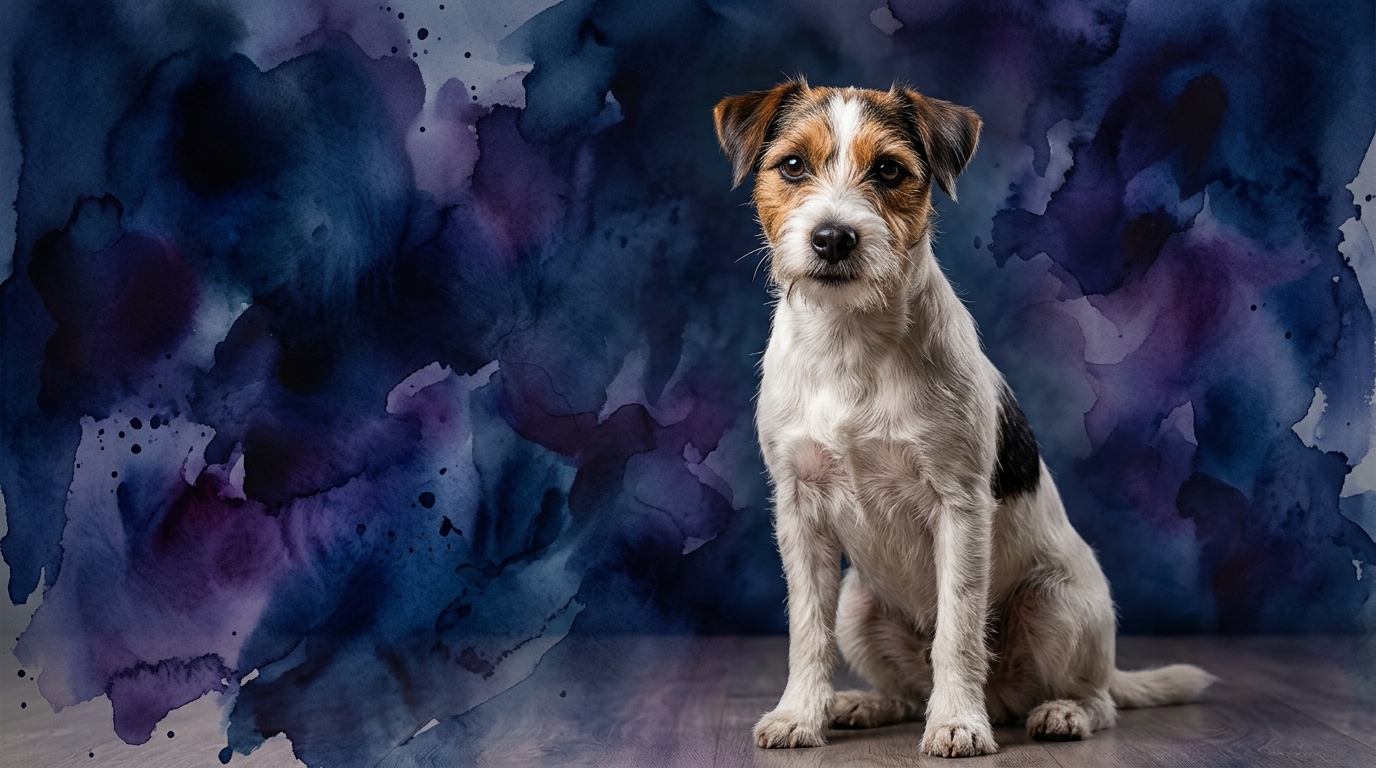
Side-by-Side IQ Profile: Poodle (Standard) vs. Parson Russell Terrier
The Cosmic Pet Pet IQ Lab provides a standardized framework to understand canine cognitive abilities, illuminating the distinct profiles of these two breeds. The Poodle (Standard), a member of the Non-Sporting group, consistently demonstrates exceptional cognitive prowess across multiple dimensions. Its Problem Solving score of 5/5 indicates an impressive capacity for abstract thought, understanding complex sequences, and independently navigating novel challenges. This is complemented by a Training Speed of 5/5, meaning Poodles grasp new commands and concepts with minimal repetition, often generalizing learned behaviors to new contexts quickly. Their Social Intelligence, also rated 5/5, points to a profound ability to interpret human emotions, social cues, and adapt their behavior accordingly, fostering deep interspecies communication. A robust Memory score of 5/5 ensures long-term retention of learned skills and routines, while their Instinctive Drive, at 4/5, is present but highly adaptable, often channeled into cooperative tasks or performance sports.
In contrast, the Parson Russell Terrier, a vibrant member of the Terrier group, presents a profile shaped by its working heritage, emphasizing practical application over abstract generalization. With a Problem Solving score of 3/5, these terriers are adept at specific, task-oriented challenges, such as locating hidden objects or navigating obstacles to reach a target, but may show less inclination for purely abstract puzzles. Their Training Speed of 3/5 suggests they learn steadily and effectively with consistent, engaging methods, though they may require more repetition and motivation than the Poodle. The Parson Russell Terrier's Social Intelligence, also at 3/5, indicates clear communication within their social circle, but perhaps less subtlety in interpreting complex human emotional states, tending towards more direct interactions. Their Memory score of 3/5 means they retain practical information and routines well, particularly those linked to their drives. Most notably, their Instinctive Drive, also 3/5, is strongly focused on prey drive and independent pursuit, a defining characteristic that influences many aspects of their cognitive expression.
Where Poodle (Standard) Wins Cognitively
The Poodle (Standard) demonstrates cognitive superiority primarily in areas requiring abstract reasoning, rapid acquisition of complex behaviors, and nuanced social understanding. Their 5/5 Problem Solving manifests in an ability to not just solve a puzzle, but to understand the underlying principle, allowing them to apply that learning to entirely new situations. For instance, a Poodle might quickly learn to open various types of latches after mastering one, demonstrating a conceptual grasp rather than mere rote memorization.
Furthermore, the Poodle's exceptional Training Speed and Memory (both 5/5) allow them to excel in disciplines demanding extensive repertoires of commands and intricate sequences, such as competitive obedience, agility, or service dog work. They can link multiple cues together seamlessly, often anticipating the next step in a routine. Their 5/5 Social Intelligence gives them a remarkable capacity to attune to their owner's moods and intentions, making them highly responsive partners in tasks that require close cooperation and subtle communication.
Where Parson Russell Terrier Wins Cognitively
While the Parson Russell Terrier's IQ scores may be lower across the board, their cognitive strengths are uniquely tailored to their historical role and specific drives. Their 3/5 Problem Solving, combined with a strong 3/5 Instinctive Drive, makes them incredibly effective at persistent, goal-oriented tasks, particularly those involving scent work or pursuit. A Parson Russell Terrier excels at figuring out how to get to a perceived 'prey' item, whether it's burrowing under a fence or maneuvering through dense brush, demonstrating a practical, tenacious form of problem-solving.
The Parson Russell Terrier's cognitive 'wins' are often tied to their independent spirit and unwavering focus when engaged in a task that resonates with their instincts. Their 3/5 Memory, though not as expansive as the Poodle's, is highly effective for retaining information relevant to their pursuits, such as the location of a favorite digging spot or the scent trail of a small animal. Their determination to achieve a specific objective, even when faced with obstacles, highlights a cognitive resilience and a focused application of their intelligence that is distinct from the Poodle's more generalized adaptability.
Which is Easier to Train and Why
Based on their IQ profiles, the Poodle (Standard) is demonstrably easier to train than the Parson Russell Terrier, primarily due to their superior Training Speed (5/5 vs. 3/5) and Problem Solving (5/5 vs. 3/5). Poodles show a strong eagerness to please and possess a natural inclination to cooperate, absorbing new commands with very few repetitions. They are often quick to generalize learned behaviors, meaning a command taught in one environment is readily understood and performed in another. Their high social intelligence also contributes to their trainability, as they are adept at reading and responding to human cues, making communication during training sessions highly efficient.
The Parson Russell Terrier, while certainly trainable, requires a different approach and more consistent engagement. Their 3/5 Training Speed means they will take more repetitions to solidify new commands. Their independent nature, fueled by their instinctive drive, can sometimes translate into a perceived stubbornness; they are less inherently driven to please and more driven by their own objectives. Training a Parson Russell Terrier often necessitates making sessions highly rewarding, varied, and directly relevant to their interests, leveraging their tenacity rather than fighting against it. They thrive with owners who understand their terrier mindset and can make training feel like a game or a challenging hunt.
Which Suits Active Owners vs. Relaxed Owners
The Poodle (Standard) is a remarkably adaptable breed that can thrive with both active and moderately relaxed owners, provided their mental stimulation needs are met. While they enjoy physical activity, their high Problem Solving and Social Intelligence mean they also require consistent mental engagement through training, puzzles, or interactive games. A Poodle can be content with a relaxed owner who prioritizes daily walks and regular brain games, but will equally excel with an active owner who involves them in dog sports like agility, obedience, or even dock diving, harnessing their versatile cognitive abilities. Their adaptable instinctive drive (4/5) allows them to channel their energy into various cooperative activities.
The Parson Russell Terrier, with its focused Instinctive Drive (3/5) and practical problem-solving, is unequivocally better suited for active owners. These terriers possess an innate drive to explore, chase, and 'work,' requiring substantial physical exercise and mental engagement directly related to their instincts. A relaxed owner who cannot provide outlets for their energy and drive will likely find a Parson Russell Terrier to be a challenging companion, potentially leading to undesirable behaviors like excessive digging, barking, or independent 'hunting' expeditions. They thrive with owners who enjoy hiking, earthdog trials, barn hunt, or other activities that allow them to utilize their natural instincts in a structured, appropriate manner.
The Verdict
Choose the Poodle (Standard) if you seek a highly adaptable, rapidly learning companion eager for complex training and nuanced social interaction, fitting into various lifestyles with sufficient mental engagement. Their cognitive flexibility makes them excellent partners for advanced dog sports or service work.
Opt for the Parson Russell Terrier if you are an active owner who appreciates a tenacious, independent spirit and can provide consistent outlets for their strong instinctive drives and practical problem-solving skills. They are ideal for those who enjoy structured 'work' and outdoor adventures.
🧠 Find Your Pet's IQ Score
Our Pet IQ Lab assessment covers 25+ tests across 5 cognitive dimensions — personalized to your breed.
Take the Full IQ Test →Frequently Asked Questions
Do Poodles (Standard) require a lot of mental stimulation?
Yes, Poodles (Standard) possess a 5/5 Problem Solving and 5/5 Training Speed, indicating a significant need for mental engagement. Without consistent mental challenges, they can become bored, potentially leading to undesirable behaviors; daily training, puzzle toys, and interactive games are crucial.
Are Parson Russell Terriers difficult to train due to their independence?
Parson Russell Terriers are not 'difficult' but require a specific training approach due to their 3/5 Training Speed and strong instinctive drive. Their independence means training must be engaging, consistent, and highly rewarding, often leveraging their natural drive rather than relying solely on eagerness to please.
Which breed is better for a first-time dog owner?
A Poodle (Standard) is generally more forgiving for a first-time owner due to their high trainability (5/5 Training Speed) and social intelligence (5/5), making them responsive and adaptable. A Parson Russell Terrier's robust instinctive drive and independent nature (3/5 Instinctive Drive) typically require an owner with prior experience understanding and managing terrier specific traits.