
Side-by-Side Cognitive Profiles: Decoding Identical Scores
While both the Portuguese Water Dog and the Komondor register identical scores of 3/5 across all five dimensions of our Pet IQ Lab assessment, this apparent equality belies fascinating differences in their cognitive application. These scores indicate a solid, functional intellect, capable of learning and adapting, but the 'how' and 'why' of their mental processes diverge significantly, shaped by centuries of distinct working roles. A 3/5 in problem-solving suggests they can find solutions to moderately complex challenges, but their approach to those solutions differs, one often seeking human collaboration, the other preferring autonomy.
For the **Portuguese Water Dog**, a 3/5 in Problem Solving reflects their capacity to adapt to varied tasks, from retrieving fishing nets to acting as boat companions. They are adept at figuring out new commands and navigating novel environments, often looking to their human partners for guidance and approval in these processes. Their Training Speed at 3/5 indicates a steady learning pace; they absorb commands and routines consistently, driven by a desire to engage and cooperate. Social Intelligence, also 3/5, manifests as a keen attentiveness to human cues and moods, forming strong, responsive bonds, though they can be discerning about who they extend their full trust to. Their Instinctive Drive at 3/5 is channeled into their historical roles—retrieving, herding fish, and water work—showing a robust but generally manageable innate motivation. Finally, a Memory score of 3/5 means they retain commands, learned behaviors, and past experiences reliably, enabling consistent performance over time.
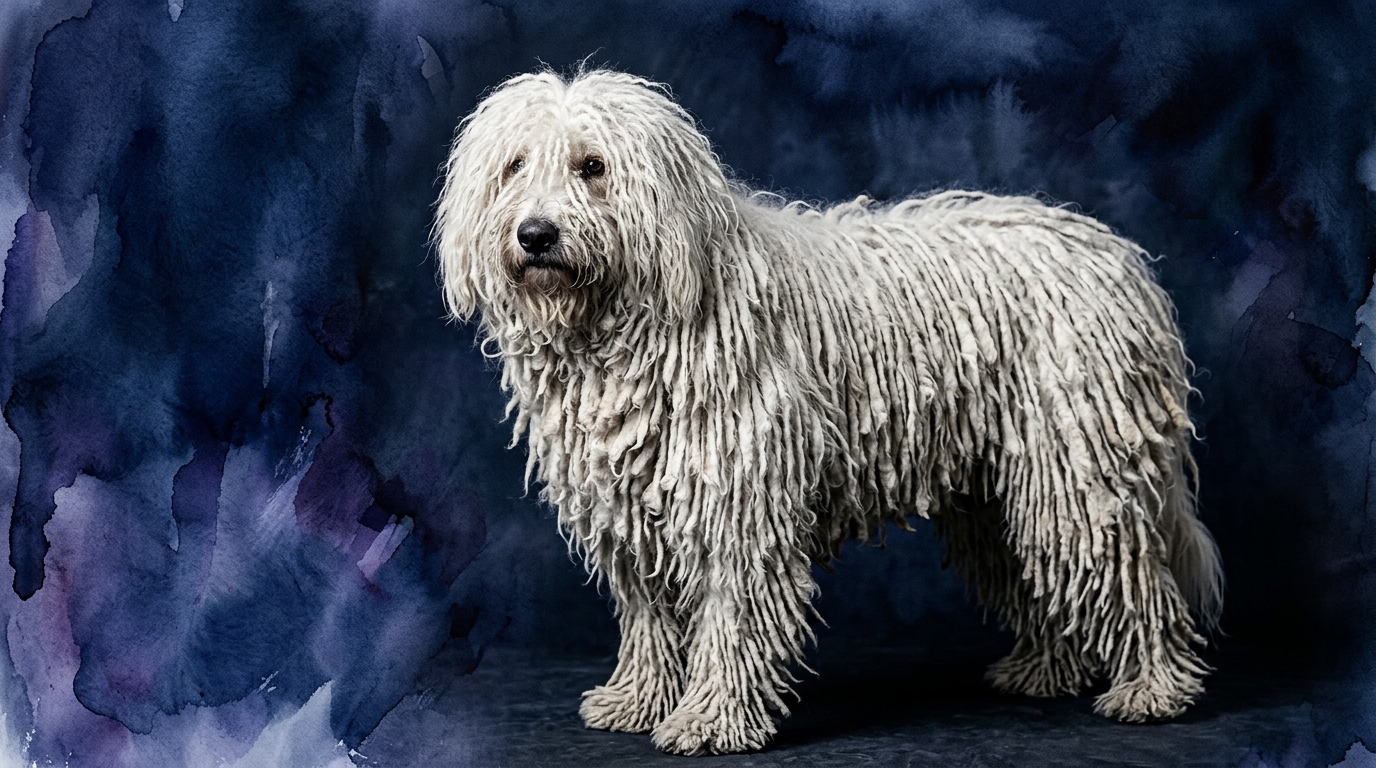
The **Komondor's** 3/5 in Problem Solving, however, speaks to a different kind of ingenuity. Their historical role as a livestock guardian demanded independent decision-making and the ability to assess and neutralize threats without human intervention. This problem-solving often involves observation and autonomous judgment rather than seeking direct human input. Their Training Speed, also 3/5, means they learn, but often require patience and a clear understanding of the 'why' behind a command; rote repetition without perceived purpose can be met with stubbornness. A 3/5 in Social Intelligence is focused intensely on their 'flock'—their family—displaying deep loyalty and protectiveness, while being naturally reserved and wary of strangers. Their Instinctive Drive, rated 3/5, is powerfully geared towards guarding, territory protection, and vigilance, a deeply ingrained motivation that defines their character. A Memory score of 3/5 ensures they remember perceived threats, established routines, and the layout of their protected domain, crucial for their guardian duties.
Where the Portuguese Water Dog Excels Cognitively
The Portuguese Water Dog's cognitive strengths shine particularly in scenarios demanding active cooperation and versatile engagement with humans. Their historical role as an all-around boat dog, assisting fishermen with retrieving lost gear, herding fish into nets, and relaying messages between boats, fostered a mind that thrives on diverse, human-directed tasks. This breed excels at understanding complex sequences of commands and adapting quickly to changes in their working environment, often anticipating their handler's next move. Their problem-solving, while rated 3/5, is characterized by a collaborative spirit; they are more inclined to work *with* their owner to achieve a goal, making them exceptionally responsive in activities like agility, obedience, and water work where joint effort is paramount.
Furthermore, their social intelligence, also a 3/5, is geared towards finely tuned responsiveness to human communication, both verbal and non-verbal. They pick up on subtle cues, making them highly attuned companions and effective partners in dynamic situations. This allows them to seamlessly integrate into various family activities and learn new routines with relative ease, seeking to understand what their human wants and how they can contribute. Their memory reliably stores these human-centric interactions and learned behaviors, allowing for consistent performance and a deep understanding of their family's expectations and routines.
Where the Komondor Holds a Cognitive Edge
The Komondor's cognitive prowess is distinctly tailored to its ancient purpose: the autonomous protection of livestock. Their intellect, while sharing the 3/5 problem-solving score, is uniquely honed for independent decision-making and vigilance in unsupervised environments. A Komondor's strength lies in its ability to observe, assess, and react to potential threats without needing direct commands. They are masters of their territory, possessing an exceptional spatial memory and an instinctive understanding of boundaries and intruder detection. This independent problem-solving doesn't necessarily involve solving puzzles for a human, but rather involves strategic thinking in a guardian context: how to deter a predator, how to position themselves for optimal surveillance, or when to intervene.
Their social intelligence, also 3/5, is profoundly focused on their immediate 'flock' and the discernment of outsiders. This manifests as an innate ability to distinguish between familiar, benign elements and potential dangers, often processing complex environmental information to make critical judgments. They possess a long-term memory for perceived threats and routines related to guarding, ensuring consistent vigilance over extended periods. This breed's instinctive drive, a powerful 3/5, is deeply rooted in protection, making them unwavering in their commitment to their family and territory. Their cognitive strengths are less about performing tricks on command and more about a profound, self-directed competence in their sentinel role.
Training Dynamics: Cooperation vs. Conviction
When it comes to training, the practical differences between these two breeds become quite apparent, despite their identical 3/5 training speed scores. The Portuguese Water Dog, with its history of working closely alongside humans, generally presents as the more straightforward student. Their inherent eagerness to participate and their desire for human interaction mean they are often motivated by praise, play, and the sheer joy of working together. They tend to be more forgiving of handler errors and are typically more responsive to repetitive drills and positive reinforcement techniques, quickly associating commands with desired outcomes. Their problem-solving orientation leans towards understanding what their human wants and finding ways to deliver it, making them adept at various dog sports and cooperative tasks.
The Komondor, on the other hand, requires a different approach. While they are capable learners (3/5 training speed), their independent guardian nature means they often need to be convinced that a command is logical and beneficial. They are not inherently driven to please humans in the same way a PWD might be. Training a Komondor demands immense patience, consistency, and a deep understanding of their psyche. They respond best to clear, firm, and fair leadership, and once they respect their owner and understand the 'why' behind a command, they will comply. However, if a Komondor perceives a command as unnecessary or illogical, their strong-willed nature can lead to resistance. Their problem-solving is about self-preservation and protection, not necessarily about conforming to human whims, so training often involves leveraging their natural instincts rather than overriding them.
Matching Breeds to Lifestyles: Active vs. Relaxed Owners
The energy levels and mental stimulation requirements of these two breeds dictate vastly different owner profiles. The Portuguese Water Dog is an ideal companion for active owners who thrive on outdoor adventures and enjoy engaging their dog in various activities. Their 3/5 instinctive drive and problem-solving abilities mean they need consistent mental and physical exercise. They are happiest when involved in family life, participating in hikes, swimming, dog sports, or even just long, engaging walks. Owners who enjoy teaching new tricks, exploring new places, and having a constant, interactive companion will find the PWD a rewarding fit. Their cooperative nature makes them excellent partners for those seeking to build a strong working relationship through shared activities.
The Komondor, conversely, suits a more specific type of owner—one who values an independent guardian and understands the unique demands of such a breed. While they are not necessarily 'relaxed' in the sense of being sedentary, their activity is often characterized by patrolling, observing, and maintaining vigilance within their territory. They do not require the same level of constant human-directed activity as a PWD. Owners should be confident, experienced with large, strong-willed breeds, and capable of providing consistent structure and early, thorough socialization. While they appreciate a secure yard to patrol, they are not typically suited for owners seeking a dog for competitive dog sports or extensive off-leash adventures in public spaces. Their 3/5 instinctive drive is focused on protection, making them excellent, watchful companions for those seeking a dedicated, independent guardian.
The Verdict
Choose the Portuguese Water Dog if you are an active individual or family seeking a cooperative, versatile companion for sports, outdoor adventures, and consistent interactive engagement.
Opt for the Komondor if you are an experienced, confident owner who values an independent, vigilant guardian and can provide early socialization, consistent guidance, and a secure environment for their protective nature.
🧠 Find Your Pet's IQ Score
Our Pet IQ Lab assessment covers 25+ tests across 5 cognitive dimensions — personalized to your breed.
Take the Full IQ Test →Frequently Asked Questions
Do identical IQ scores mean the Portuguese Water Dog and Komondor are equally easy to train?
No, identical IQ scores of 3/5 in training speed indicate they both have a solid capacity to learn, but their motivations and approaches to learning differ significantly. The PWD's cooperative nature makes it generally more eager to please and easier to train for diverse tasks, while the Komondor's independence requires more patience and a focus on convincing the dog of a command's logic.
How does 'problem solving' differ between these two breeds with the same 3/5 score?
For the Portuguese Water Dog, problem-solving often involves figuring out how to achieve a goal in collaboration with their human, such as learning a new multi-step command. For the Komondor, problem-solving is typically autonomous, focused on assessing threats and making independent decisions to protect its territory or 'flock' without direct human intervention.
Which breed would be better for a first-time dog owner interested in a working breed?
The Portuguese Water Dog is generally a better choice for a first-time owner interested in a working breed, provided they are committed to providing ample exercise and mental stimulation. Their cooperative nature and responsiveness make them more forgiving and adaptable to various training methods, while the Komondor's strong independence and guarding instincts require more experienced handling.