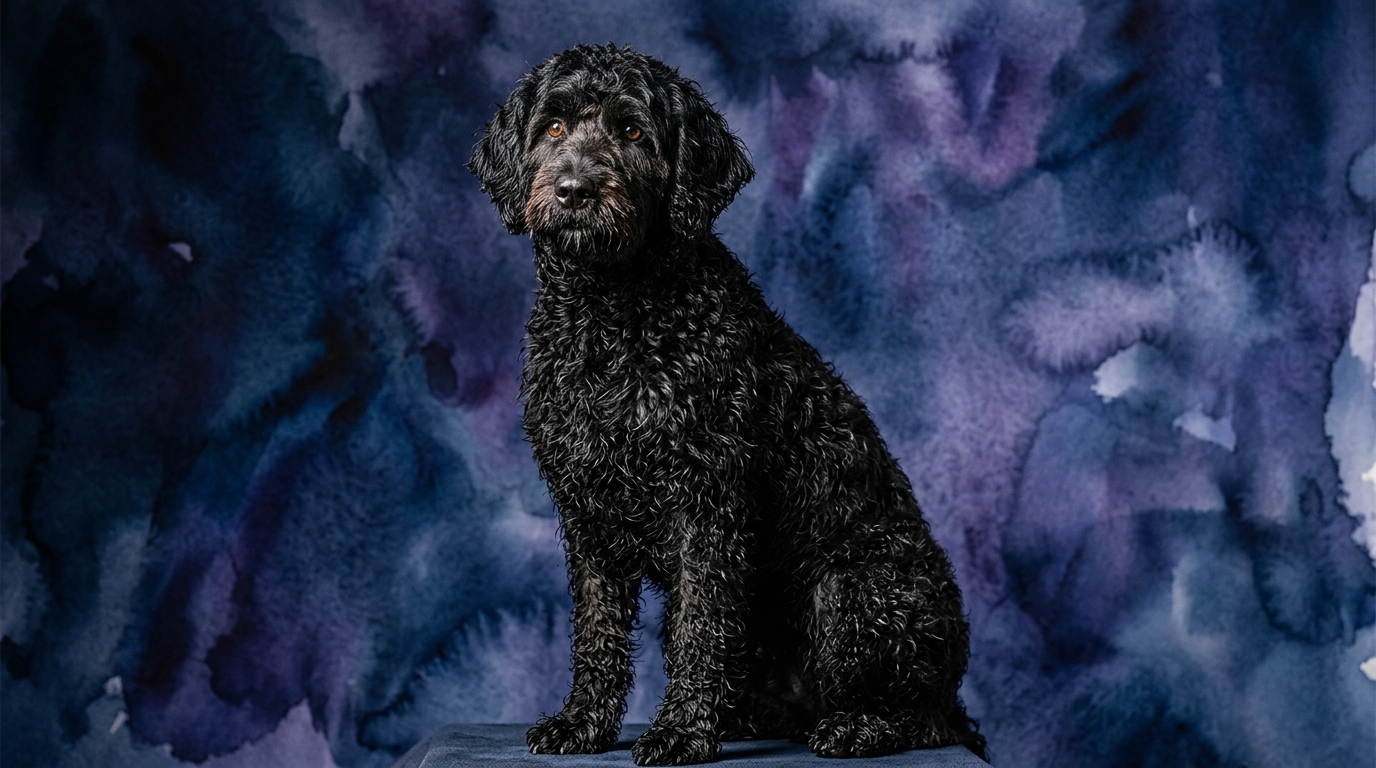
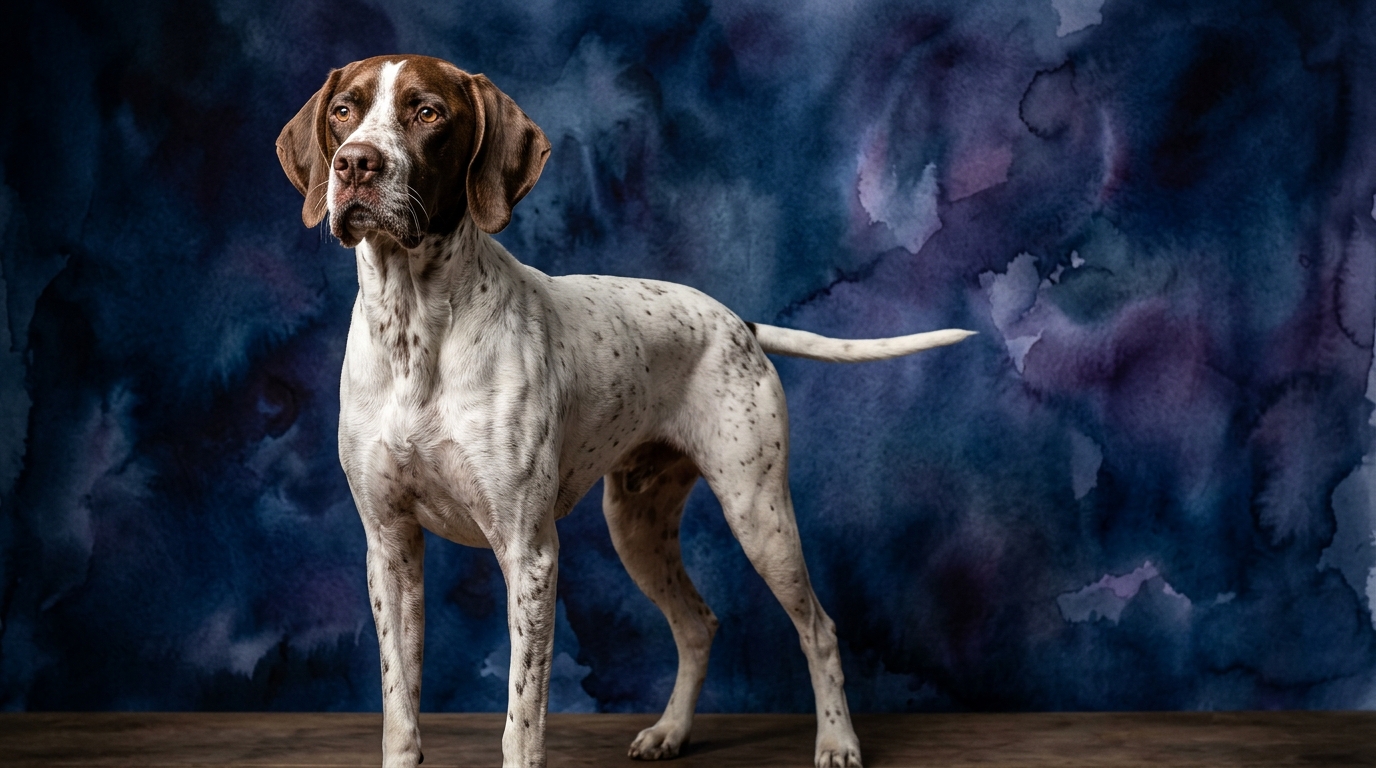
Side-by-Side IQ Profile: PWD vs. Pointer
The Portuguese Water Dog (PWD), a robust breed from the Working Group, presents a balanced cognitive profile across The Cosmic Pet Pet IQ Lab's five dimensions. Their Problem Solving (3/5) aptitude often shines in practical, physical challenges, historically involving retrieving lost tackle or navigating boat decks. Today, this translates to adeptness at puzzle toys or learning complex sequences, with an approach that is often hands-on and exploratory, driven by curiosity. Their Training Speed (3/5) indicates they absorb new commands at a moderate pace, though their independent spirit means consistency and engaging methods are crucial; they learn well through positive reinforcement and enjoy the process, but can become bored with rote repetition, sometimes leading them to find 'loopholes' in commands. Social Intelligence (3/5) in PWDs manifests as a keen observation of human moods and intentions within their family unit, forming strong bonds and seeking active participation in household activities. Their Instinctive Drive (3/5) is rooted in their water dog heritage, manifesting as a persistent desire to retrieve, swim, and be involved in tasks alongside their humans. Finally, their Memory (3/5) allows them to recall complex sequences of actions, commands, and routines over long periods, especially when associated with positive experiences or practical purposes.
The Pointer, a dedicated breed from the Sporting Group, shares the exact same 3/5 rating across all cognitive dimensions, yet its intellectual expression is distinctly tailored to its hunting heritage. Their Problem Solving (3/5) acumen is finely tuned for efficiently locating game, involving complex scent discrimination, navigating varied terrain, and adapting search patterns. In a domestic setting, this translates to excellent navigation skills or strategizing to access interesting smells, with solutions often direct and goal-oriented. Training Speed (3/5) for Pointers can be notably efficient, especially when training aligns with their innate drives; they are generally eager to please their handler, and their focus in a working context allows for rapid acquisition of specific tasks, though managing their strong instinctive urges requires consistent direction. Their Social Intelligence (3/5) is typically handler-centric, forming deep bonds with their primary human partner, particularly in a working relationship, making them highly attuned to their handler's cues and expectations. The Pointer's Instinctive Drive (3/5) is powerfully directed towards hunting, scenting, and pointing game, manifesting as tireless energy and intense focus on smells. Their Memory (3/5) is reliable, particularly for scent trails, terrain features, and learned hunting patterns, aiding them in navigating vast areas and recalling where game might be found.
Where the Portuguese Water Dog Wins Cognitively
The Portuguese Water Dog often demonstrates a more versatile and adaptive problem-solving approach, particularly in novel situations not directly tied to a singular, ingrained task. Their 3/5 in problem-solving might manifest as greater ingenuity in manipulating objects or understanding multi-step puzzles that require more than just instinctual drive. For instance, a PWD might more readily figure out how to open a complex latch or retrieve an item from an unusual, inaccessible spot by employing various strategies beyond brute force or scent-following. This adaptability extends to their learning, where they often grasp the 'why' behind a command, enabling them to generalize learned behaviors to new contexts with greater ease.
Furthermore, the PWD's social intelligence, also rated 3/5, often leans towards a broader understanding of family dynamics and human emotional nuances. While Pointers are handler-focused, PWDs can be more attuned to the varied personalities and interactions within a multi-person household, potentially making them more adaptable to diverse social cues from different family members. This adaptability allows them to integrate smoothly into varied social settings, interpreting a wider range of human expressions and intentions, which can make them more intuitive companions in complex social environments.
Where the Pointer Wins Cognitively
The Pointer's 3/5 in instinctive drive, coupled with their problem-solving at the same rating, gives them an edge in sustained, focused tasks requiring intense sensory input and endurance. Their cognitive strength lies in their ability to process vast amounts of olfactory information, categorize it, and make rapid, accurate decisions in the field. This specific type of problem-solving—identifying, tracking, and pointing game—is where their intellect truly shines, requiring immense concentration and a keen understanding of their environment. Their unwavering focus on a task, driven by their powerful instincts, allows them to excel in specialized roles requiring consistent application of their sensory and problem-solving skills.
Moreover, the Pointer's memory, also 3/5, often excels in spatial recall and pattern recognition related to their working environment. While PWDs remember routines, Pointers demonstrate superior recall for terrain, scent distribution, and the most efficient routes to cover ground. This cognitive advantage allows them to operate effectively over large areas, remembering where they've searched and where potential game might still be found. Their training speed, when aligned with their natural drives, can be remarkably efficient for specific, repetitive tasks essential to their function, showcasing a highly specialized form of intelligence geared towards their historical purpose.
Which Is Easier to Train and Why
Despite identical 3/5 scores in Training Speed, the practical experience of training these breeds can differ significantly. The Pointer, with its strong handler focus and intense instinctive drive towards a specific purpose, can be remarkably easy to train for tasks related to its heritage. Their eagerness to please a primary handler and their drive to work make them highly responsive to clear, consistent commands, especially in a structured, goal-oriented training environment. They thrive on repetitive drills that channel their natural instincts, quickly mastering tasks like 'stay,' 'come,' and 'retrieve' in a hunting context. However, managing their high prey drive and boundless energy requires firm, consistent leadership to prevent them from becoming overly distracted by external stimuli, particularly in less structured environments.
The Portuguese Water Dog, while equally capable of learning, often requires a more creative and varied training approach. Their 3/5 in problem-solving and social intelligence means they are quick to understand what is being asked but might also test boundaries or find alternative ways to achieve a goal if bored. They excel with positive reinforcement, puzzle-based training, and activities that challenge both their minds and bodies, such as agility or obedience sports. Their independence means trainers need to be engaging and prevent monotony, as a PWD might simply disengage if the task isn't stimulating enough. While they might not be as unilaterally 'eager to please' for every single command as a Pointer, their social intelligence allows them to form a deep understanding with their trainer, making them responsive to nuanced cues over time, requiring a more collaborative training dynamic.
Which Suits Active Owners vs. Relaxed Owners
Neither the Portuguese Water Dog nor the Pointer is suitable for a truly 'relaxed' owner in the sense of minimal daily activity. Both breeds possess a 3/5 instinctive drive and require substantial physical and mental engagement. However, the *type* of activity they thrive on differs. The Portuguese Water Dog thrives with active owners who enjoy diverse activities and can provide consistent mental stimulation. These dogs need more than just a walk; they excel in activities like swimming, dock diving, agility, obedience, and interactive puzzle games. Owners who appreciate a dog that is an active participant in family life, enjoys learning new tricks, and can handle a dog with a playful, sometimes boisterous, personality will find a PWD rewarding. Their need for varied engagement means they suit owners who are willing to explore different types of exercise and training.
The Pointer is best suited for highly active owners who can provide outlets for their intense physical energy and strong hunting instincts. This means long runs, extensive hikes, field work, or participation in dog sports like lure coursing or competitive obedience. Owners who understand and appreciate a dog's natural drive to range, scent, and work will find the Pointer an unparalleled companion. While affectionate at home, their primary satisfaction comes from engaging in strenuous, purposeful activity, making them ideal for individuals or families with an active, outdoor-centric lifestyle, potentially involving hunting or competitive field trials. A Pointer's need for specific, intense activity might be less adaptable to varied forms of exercise compared to a PWD, but more focused on stamina and scent work and covering ground.
The Verdict
Opt for the Portuguese Water Dog if you seek a versatile, engaging companion who thrives on intellectual challenges, enjoys varied physical activities (especially water-based ones), and values a deep, interactive bond within a family setting.
Select the Pointer if your lifestyle involves extensive outdoor activity, particularly long runs or field work, and you appreciate a dedicated, focused partner eager to channel its strong hunting instincts into purposeful endeavors.
🧠 Find Your Pet's IQ Score
Our Pet IQ Lab assessment covers 25+ tests across 5 cognitive dimensions — personalized to your breed.
Take the Full IQ Test →Frequently Asked Questions
Do Portuguese Water Dogs and Pointers have similar energy levels?
While both breeds are active, their energy expression differs. PWDs need varied mental and physical engagement, often enjoying water and interactive play, while Pointers require intense, focused bursts of physical activity, often involving scent work and covering large distances.
Are PWDs or Pointers better for families with children?
Both can be good family dogs with proper socialization and training. PWDs often integrate well into family dynamics due to their social intelligence, while Pointers can be gentle but their high prey drive means supervision is essential, especially with smaller children or pets.
How do their grooming needs compare?
PWDs have a non-shedding, single coat requiring regular grooming (clipping, brushing) to prevent matting. Pointers have a short, dense coat that sheds minimally and requires less intensive grooming, typically just occasional brushing.