
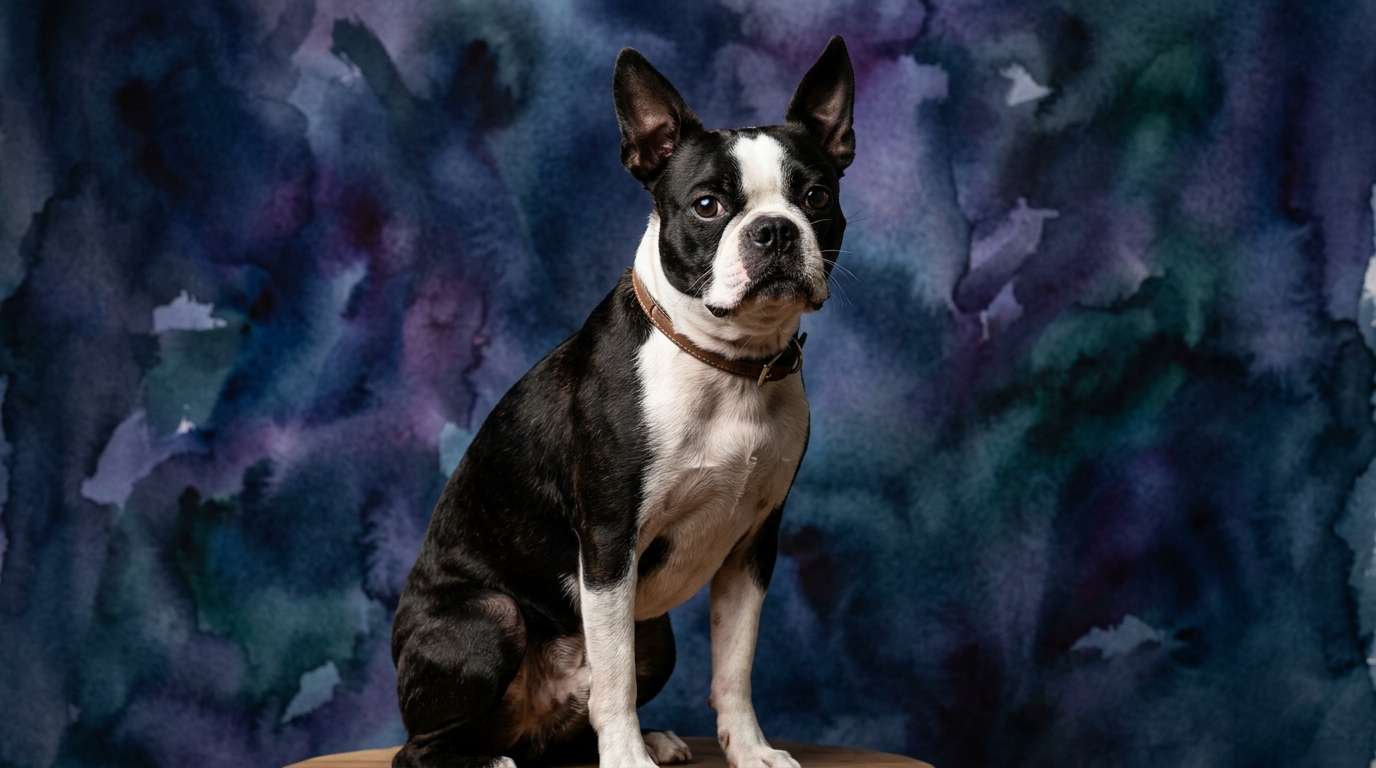
Side-by-Side IQ Profile: Pug vs. Boston Terrier
At The Cosmic Pet Pet IQ Lab, we evaluate canine intelligence across five key dimensions, providing a granular understanding of each breed's cognitive strengths. Let's break down the mental blueprints of the Pug and the Boston Terrier.
The Pug (Coren rank #57), a Toy breed, exhibits a unique intelligence profile tailored for companionship. Their Problem Solving is rated 2/5, indicating a preference for human assistance over independent strategizing. Training Speed is also 2/5, meaning they require patience and consistent, positive reinforcement to grasp new commands. However, their Social Intelligence is a perfect 5/5, showcasing an exceptional capacity for understanding human emotions and cues. Instinctive Drive stands at 2/5, reflecting their low inclination for traditional working tasks. Memory is moderate at 3/5, allowing them to recall routines and familiar faces.
The Boston Terrier (Coren rank #54), from the Non-Sporting group, presents a slightly different cognitive makeup. Their Problem Solving ability is 3/5, suggesting a moderate capacity for independent thought when faced with environmental puzzles. Training Speed is rated 3/5, indicating they generally pick up commands more readily than Pugs. Social Intelligence is strong at 4/5, demonstrating a solid understanding of human intentions and emotional states. Like the Pug, their Instinctive Drive is 2/5, prioritizing companionship over task-oriented behaviors. Their Memory is also moderate at 3/5, enabling them to retain learned behaviors and patterns effectively.
Where the Pug Wins Cognitively
The Pug's standout cognitive strength lies unequivocally in its social intelligence, scoring a perfect 5/5. This breed possesses an extraordinary ability to interpret human emotions, body language, and subtle social cues, making them unparalleled emotional support companions. While a Boston Terrier might understand you're upset, a Pug seems to internalize and reflect that emotion, seeking to soothe or engage in a way that feels deeply empathetic. Their entire cognitive framework appears oriented towards fostering profound human-animal bonds, allowing them to anticipate needs and offer comfort with a remarkable degree of attunement. This superior social processing means they excel in situations requiring emotional sensitivity and reciprocal interaction, appearing to know exactly what their human is feeling before a word is spoken.
Where the Boston Terrier Wins Cognitively
The Boston Terrier demonstrates a clear cognitive advantage in problem-solving and training speed, both scoring 3/5 compared to the Pug’s 2/5. This means a Boston Terrier is more inclined to independently assess a novel situation and attempt to find a solution, even if it’s a simple one like figuring out how to retrieve a toy stuck under furniture. Their slightly higher training speed indicates a quicker grasp of new commands and a more direct response to cues, requiring fewer repetitions to solidify a behavior. This isn't to say they are master strategists, but their cognitive approach to environmental challenges involves a greater degree of independent engagement and learning through interaction with their surroundings, rather than solely relying on human intervention.
Which is Easier to Train and Why
When it comes to ease of training, the Boston Terrier generally holds an advantage due to its higher training speed and problem-solving scores. Their eagerness to please, coupled with a moderate capacity for independent thought, means they grasp new concepts and commands more readily. A Boston Terrier is more likely to engage with training as a game or a collaborative effort, responding well to varied methods and enjoying the mental stimulation. Pugs, with their lower training speed and problem-solving scores, require more patience, repetition, and a consistent, reward-based approach. Their training can be perceived as more challenging because their primary motivation is comfort and social connection rather than task completion, meaning trainers need to be highly adept at making training sessions enjoyable and relevant to the Pug's social drive. For example, teaching a Boston Terrier 'stay' might take fewer sessions because they process the command and its reward more directly, whereas a Pug might need more context and motivation, linking 'stay' to receiving a favorite treat while you remain nearby.
Which Suits Active Owners vs. Relaxed Owners
For owners who prefer a moderately active lifestyle, the Boston Terrier is a better fit. While not requiring extreme endurance, their slightly higher problem-solving and training speed indicate a greater capacity for engaging in activities that involve mental stimulation and moderate physical exertion, such as obedience classes, agility lite, or interactive puzzle toys. They enjoy structured playtime and can keep pace with owners who like regular, brisk walks or short hikes. Conversely, the Pug is an ideal companion for relaxed owners. Their lower instinctive drive and preference for social bonding over physical tasks mean they are perfectly content with shorter, leisurely strolls and ample cuddle time on the sofa. An owner seeking a dog whose primary joy is close physical proximity and emotional connection, rather than extensive exercise or complex mental challenges, will find the Pug’s temperament and cognitive profile align perfectly with a more laid-back routine.
The Verdict
Choose a Pug if your priority is an unparalleled emotional companion who excels at social bonding and seeks deep emotional attunement, thriving in a relaxed, comfort-focused home environment.
Opt for a Boston Terrier if you desire a spirited companion with a moderate capacity for learning and problem-solving, suitable for owners who enjoy engaging in structured play and moderate activity.
🧠 Find Your Pet's IQ Score
Our Pet IQ Lab assessment covers 25+ tests across 5 cognitive dimensions — personalized to your breed.
Take the Full IQ Test →Frequently Asked Questions
Are Pugs stubborn during training?
Pugs can appear stubborn due to their lower training speed and strong preference for comfort over compliance, often requiring highly motivating rewards and patient, consistent methods. Their social intelligence means they respond best when training feels like a positive interaction rather than a demand.
Can a Boston Terrier live in an apartment?
Yes, Boston Terriers are well-suited for apartment living due to their compact size and moderate exercise needs, as long as they receive regular walks and mental stimulation. Their adaptable nature and social intelligence allow them to thrive in smaller spaces with attentive owners.
Which breed is better with children?
Both breeds can be excellent with children, but the Pug's exceptional social intelligence often makes them particularly gentle and tolerant, especially with respectful children. The Boston Terrier's playful energy also makes them a good match, though their occasional exuberance might require more supervision with very young children.