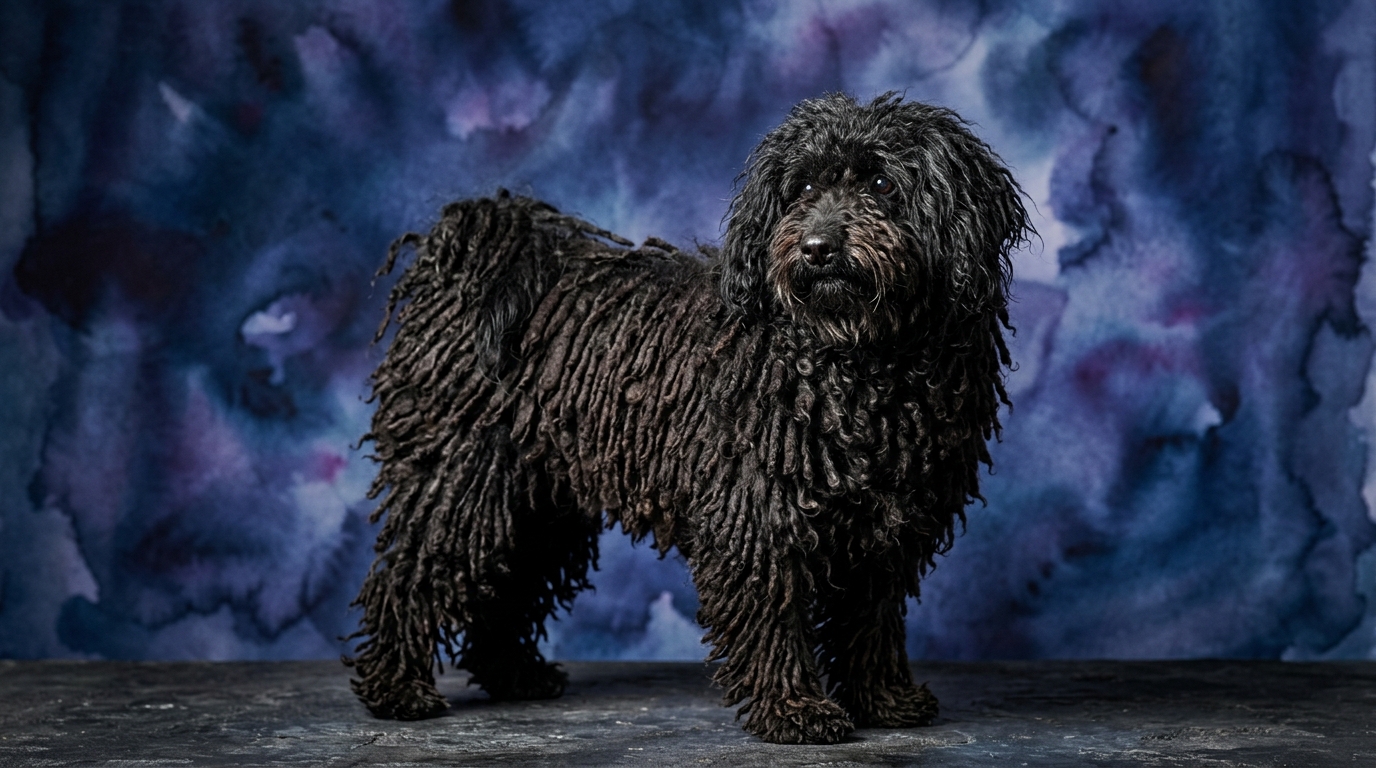
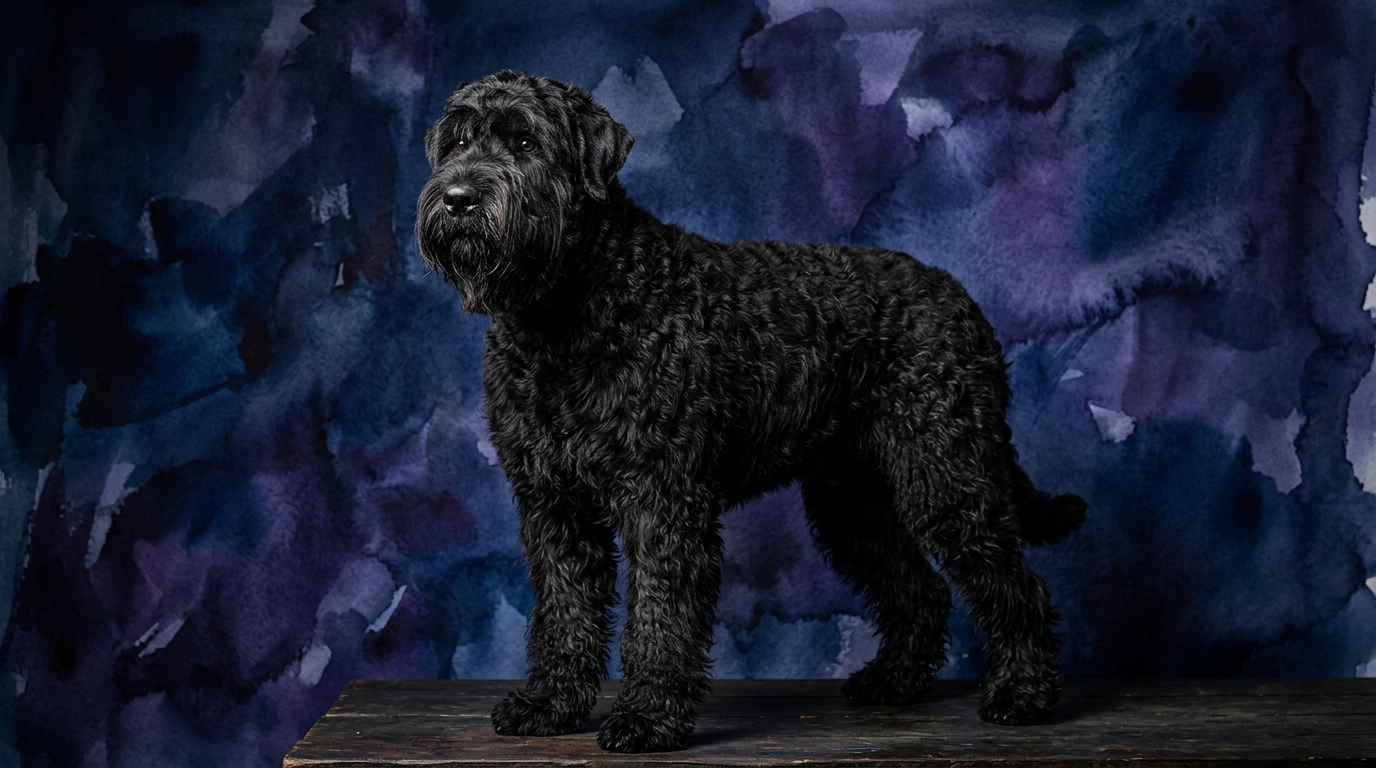
Side-by-Side Cognitive Profile: Puli vs. Black Russian Terrier
At The Cosmic Pet Pet IQ Lab, we delve beyond superficial observations to measure canine intellect across five critical dimensions. For the Puli, a Herding Group member ranked #25 by Coren, and the Black Russian Terrier (BRT), a powerful Working Group breed, their scores reveal distinct mental architectures.
The Puli exhibits a Problem Solving score of 4/5, indicating a strong capacity for independent thought and devising clever solutions to environmental challenges. Their herding roots demanded quick decisions in dynamic situations, fostering mental agility to adapt and think on their feet rather than just relying on learned commands. Their Training Speed also rates 4/5; Pulis typically grasp new commands and routines with impressive swiftness, often requiring fewer repetitions to solidify a behavior due to their sharp memory and eagerness to engage. Social Intelligence for the Puli is 3/5; while affectionate with family, they can be reserved or discerning with strangers, focusing their social acumen on understanding core pack dynamics. Their Instinctive Drive, at 3/5, is rooted in herding, manifesting as a desire to gather, control, and protect their family unit, informing their watchful and territorial nature. Finally, Puli Memory is a robust 4/5, allowing them to retain learned behaviors, routines, and experiences over long periods, contributing significantly to their training efficiency and consistency.
In contrast, the Black Russian Terrier, while not Coren-ranked, presents a different cognitive blueprint. Their Problem Solving score is 3/5; BRTs demonstrate a solid, practical approach, often relying on strength and determination to overcome obstacles, with solutions tending to be direct and persistent. Training Speed for the BRT is also 3/5; they are capable learners, absorbing training with consistency, but may require more repetition and patience to ingrain complex commands. Their progress is steady, and once learned, a lesson is deeply embedded due to their tenacity. Social Intelligence for the BRT is 3/5, similar to the Puli; they are deeply loyal and protective of their loved ones but maintain a watchful and often aloof demeanor towards strangers, acutely tuned to discerning threats. The BRT's Instinctive Drive, rated 3/5, is profoundly tied to its origins as a military working dog, centered on protection and territorial defense, manifesting as a strong inclination to survey surroundings and patrol boundaries. Their Memory score is 3/5; BRTs possess reliable recall, sufficient for retaining a wide array of commands and recognizing familiar people and situations, contributing to consistency in established routines.
Where the Puli's Cognition Excels
The Puli's cognitive strengths distinctly shine in areas demanding agility of thought and rapid adaptation. With a 4/5 in Problem Solving, they often display a more inventive and flexible approach to novel situations. Imagine a Puli quickly figuring out how to open a child-proof gate by observing its mechanism, or cleverly maneuvering around an obstacle course with minimal instruction, anticipating the next move. Their Herding Group heritage instilled a need for autonomous decision-making in dynamic environments, which translates into a dog that can assess and react to changing circumstances with impressive mental speed.
Furthermore, their 4/5 in Training Speed means they often connect cause and effect faster than the BRT. A Puli might learn a complex multi-step command sequence, like 'find the ball and bring it to your bed,' in significantly fewer sessions, demonstrating an efficient neurological pathway for absorbing and executing new information. This quick uptake is a clear advantage for owners interested in advanced obedience or canine sports where rapid learning is key. Their superior memory (4/5) reinforces this, ensuring that once a lesson is learned, it sticks, making for a consistent and reliable companion over time.
Where the Black Russian Terrier's Cognition Excels
The Black Russian Terrier's cognitive advantages, while perhaps less about rapid invention, are deeply rooted in their steadfastness and purpose-driven nature. While their Problem Solving is rated 3/5, their solutions are often characterized by a determined persistence that can outlast more agile thinkers. Consider a BRT faced with a sturdy barrier; rather than seeking a clever workaround, they might methodically test its weak points, pushing or nudging until a path is cleared, demonstrating a resilience in their approach.
Their strength lies in their unwavering focus on their primary objective, often protection. This translates into a highly dependable and predictable response in situations demanding vigilance and territorial awareness. While their Training Speed is 3/5, once a command is ingrained, it is often executed with an unshakeable resolve. This tenacity means that while they might take longer to learn, the learned behavior is deeply integrated into their operational framework. For tasks requiring consistent, unwavering adherence to a learned protocol, such as guard duties or complex protection work, their methodical learning and robust memory (3/5) ensure reliability. Their social intelligence, while not broadly expansive, is acutely tuned to discerning threats and maintaining the safety of their family unit, making them unparalleled in their specific niche of protective acumen.
Ease of Training: Puli vs. Black Russian Terrier
Based on our Pet IQ Lab scores, the Puli is generally considered easier to train due to its higher scores in both Problem Solving (4/5) and Training Speed (4/5). Pulis tend to grasp new concepts and commands with fewer repetitions, often displaying an eagerness to learn and participate in training sessions. Their cognitive flexibility allows them to understand complex sequences more readily and adapt to different training methodologies. For instance, if a Puli is struggling with a particular command, an owner might find it easier to adjust their approach, and the Puli would likely adapt to the new teaching method quickly.
In contrast, the Black Russian Terrier, with scores of 3/5 in both Problem Solving and Training Speed, requires a more patient, consistent, and structured training approach. While equally capable of learning, they may need more repetition to solidify new behaviors and might not respond as quickly to varied training techniques. Their inherent determination means that once they understand a command, they perform it reliably, but the initial learning phase demands more steadfast commitment from the trainer. The Puli's quicker mental processing makes them more forgiving of minor inconsistencies in early training, whereas the BRT thrives on predictable routines and clear expectations.
Matching Breeds to Lifestyles: Active vs. Calm Owners
The Puli, with its heritage as an active herding dog, naturally suits active owners who can provide ample mental and physical stimulation. Their quick intellect and desire to work mean they thrive on engaging activities like agility, obedience trials, or even complex puzzle toys that challenge their problem-solving skills. An owner who enjoys daily vigorous walks, interactive play, and consistent training will find the Puli a deeply rewarding companion, as their cognitive and physical needs align perfectly with an active lifestyle. They need an outlet for their sharp minds and energetic bodies to prevent boredom-induced behaviors.
The Black Russian Terrier, while certainly requiring exercise and mental engagement, can also suit owners who appreciate a more deliberate pace, provided they understand the need for firm, consistent leadership and early socialization. Their powerful build and protective instincts mean their 'activity' often leans towards structured walks, patrolling their territory, and training focused on discipline and control rather than high-speed agility. They are not necessarily a breed for 'relaxed' owners in terms of effort, but rather owners who are calm, confident, and consistent in their approach, providing a stable environment. While they enjoy activity, their cognitive makeup suggests they are less about constant high-energy tasks and more about purposeful engagement and maintaining order within their perceived domain.
The Verdict
Choose the Puli if you seek a quick-witted, adaptable companion eager for varied mental challenges and enjoy engaging in diverse training activities that leverage their rapid learning and strong memory.
Choose the Black Russian Terrier if you value unwavering loyalty, steadfast protection, and are prepared for a consistent, patient training journey with a powerful dog whose cognitive strengths lie in determined execution and territorial vigilance.
🧠 Find Your Pet's IQ Score
Our Pet IQ Lab assessment covers 25+ tests across 5 cognitive dimensions — personalized to your breed.
Take the Full IQ Test →Frequently Asked Questions
Do Pulis and Black Russian Terriers require similar amounts of exercise?
While both breeds benefit from regular exercise, their needs differ in quality. Pulis often need more mentally stimulating and varied activities to satisfy their herding instincts and quick minds, while BRTs benefit from structured, purposeful exercise that reinforces their protective nature and physical strength.
How do their social intelligence scores impact their interactions with children or other pets?
Both breeds score 3/5 in social intelligence, meaning they are generally good with their immediate family but can be reserved with strangers. With proper socialization from a young age, both can coexist well with children and other pets within their established family unit, though their protective instincts necessitate careful introductions and supervision.
Is the Coren ranking significant when comparing these two breeds?
Stanley Coren's ranking primarily assesses 'working and obedience intelligence,' focusing on how quickly a dog learns commands. The Puli's rank of #25 reflects its faster training speed, whereas the BRT, not being Coren-ranked, implies it might fall outside the top tier for rapid obedience learning, aligning with its 3/5 training speed score.