
Side-by-Side Cognitive Profiles
The Rottweiler, a member of the Working Group and ranked #9 in Coren's hierarchy, exhibits a robust and versatile cognitive toolkit. Their Problem Solving is rated an exceptional 5/5, indicating a capacity for understanding complex sequences, strategizing, and adapting to novel challenges beyond simple rote learning. Training Speed stands at 4/5, signifying a rapid uptake of new commands and concepts, though consistent reinforcement ensures mastery. Social Intelligence, at 4/5, highlights their aptitude for interpreting human cues, forming deep bonds, and understanding social structures within a household. An Instinctive Drive of 5/5 underscores their powerful genetic predisposition for guarding, protection, and focused work, providing strong motivation for purposeful tasks. Finally, their Memory, also 5/5, allows them to retain extensive training, recall past experiences, and recognize individuals over long periods, contributing to their reliability.
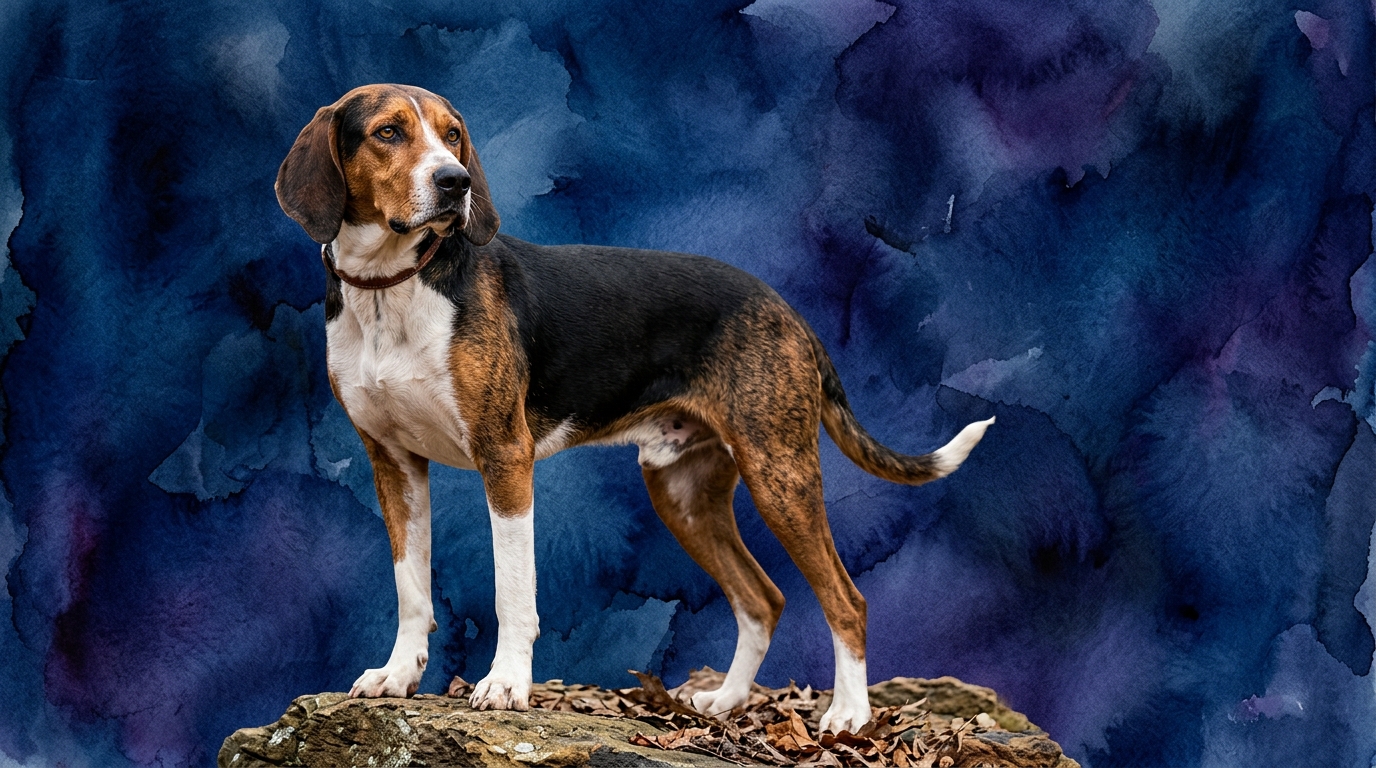
In contrast, the Treeing Walker Coonhound, a Hound Group member not listed in Coren's rankings, possesses a distinct set of cognitive strengths tailored to their specialized role. Their Problem Solving is rated 3/5, suggesting practical thinking primarily focused on navigating and interpreting their environment through scent, rather than abstract conceptual tasks. Training Speed also sits at 3/5, meaning they learn at a moderate pace, often requiring more repetition and patience due to their independent nature and powerful distractions from scent. Social Intelligence, at 3/5, indicates they are generally friendly but may prioritize their olfactory world over constant human interaction. Their Instinctive Drive, 3/5, is intensely focused on tracking and treeing quarry, a singular, potent motivation that can override other impulses. Memory, 3/5, is competent for remembering trails and specific hunting scenarios but might be less adept at retaining a broad repertoire of complex, arbitrary commands compared to the Rottweiler.
Where the Rottweiler Excels Cognitively
The Rottweiler's cognitive strengths lie in their ability to process and act upon complex, multi-layered information, particularly when directed by a human. Their 5/5 Problem Solving score means they can quickly grasp the logic behind tasks like opening latches, navigating obstacle courses, or even distinguishing between different objects based on subtle cues. This capacity for strategic thought allows them to excel in advanced obedience, protection work, and service roles where understanding nuanced commands and making appropriate decisions is paramount. They don't just follow instructions; they often understand the *intent* behind them.
Their superior Memory (5/5) allows for a vast repertoire of learned behaviors and experiences to be stored and retrieved efficiently. A Rottweiler can remember intricate training sequences, the specific routines of their household, and the faces of friends and strangers for years. This robust memory, combined with their 4/5 Social Intelligence, makes them highly responsive to verbal and non-verbal cues, enabling them to anticipate owner's needs or react appropriately to changes in their environment. Their 5/5 Instinctive Drive, channeled effectively through training, provides an unwavering focus for guarding or protective duties, where their analytical capabilities and memory allow them to assess threats and respond with measured precision rather than indiscriminate action.
Where the Treeing Walker Coonhound Shines Cognitively
While the Treeing Walker Coonhound's overall IQ scores appear lower in a generalized context, their cognitive profile represents a masterclass in specialized intelligence. Their 3/5 Problem Solving, though not geared for abstract puzzles, is exceptionally refined for unraveling the intricate puzzle of a scent trail. They excel at discriminating between faint odors, following complex paths over varied terrain, and making independent decisions about the most efficient route to their quarry. This involves a sophisticated form of spatial reasoning and sensory analysis that is unparalleled in many other breeds.
The Coonhound's 3/5 Instinctive Drive is not broad but incredibly deep and powerful within its specific domain: scent tracking. This drive fuels an almost obsessive focus on their primary task, allowing them to work tirelessly for hours, ignoring distractions that would derail less specialized breeds. Their Memory (3/5) is particularly potent for recalling the layout of hunting grounds, the characteristic scents of different animals, and the successful strategies used in past hunts. They might not remember a dozen complex commands as readily as a Rottweiler, but they can recall the precise location of a squirrel's scent from yesterday, demonstrating a different, yet equally impressive, form of cognitive retention tuned to their purpose.
Training Dynamics: Rottweiler vs. Treeing Walker Coonhound
Training a Rottweiler is generally a more straightforward endeavor due to their higher scores in Training Speed (4/5), Problem Solving (5/5), and Social Intelligence (4/5). They are eager to engage with their handlers, quickly understanding what is expected of them and deriving satisfaction from performing tasks correctly. Their strong memory means commands, once learned, are retained effectively, building a reliable foundation for advanced training. Rottweilers thrive on structure and consistency, responding well to positive reinforcement and clear communication, making them capable of mastering a wide array of commands and specialized skills with dedicated effort.
Conversely, training a Treeing Walker Coonhound requires a different approach, often characterized by more patience and understanding of their inherent drives. Their 3/5 Training Speed suggests they may take longer to grasp concepts that don't directly align with their natural instincts, and their powerful scent drive can be a significant distraction. While they are capable of learning, their independent problem-solving (3/5), which prioritizes following a scent, means they might not always be as inclined to defer to human commands once a compelling trail is detected. Owners must be prepared for consistent, engaging training methods that either incorporate scent work or are compelling enough to momentarily override their primary instinct, often requiring more creative strategies and a longer commitment to achieve desired obedience levels. Their 3/5 memory for non-instinctive tasks means reinforcement needs to be ongoing.
Matching Breeds to Lifestyles: Active vs. Relaxed Owners
For active owners seeking a canine partner for structured activities, the Rottweiler is an excellent match. Their need for purposeful work, combined with their high Problem Solving (5/5) and Instinctive Drive (5/5), means they thrive on consistent mental and physical challenges. Owners who enjoy dog sports like obedience, agility, protection work, or even just complex puzzle toys and extensive training sessions will find the Rottweiler a willing and capable participant. They require significant daily engagement that goes beyond simple walks, demanding an owner who is active in directing their energies and providing outlets for their cognitive capabilities. While they can be calm indoors, this tranquility is often a result of having their substantial mental and physical needs met through structured activity.
The Treeing Walker Coonhound also requires an active owner, but one whose definition of 'active' aligns with their breed-specific needs. Their powerful Instinctive Drive (3/5) for scent work means they need vast opportunities for off-leash exploration in secure areas where they can follow trails and engage their olfactory senses. Owners who enjoy long hikes, hunting, or providing large, securely fenced yards where a dog can 'work' a scent will find them rewarding companions. They are less suited for owners who prefer sedentary lifestyles or limited outdoor access, as their unmet drive can lead to restlessness, vocalizations, or destructive behaviors. While affectionate, their independent nature means they might not be constantly seeking human interaction in the same way a Rottweiler might, preferring to engage with their environment through their nose. Neither breed is truly suited for a 'relaxed' owner who expects a low-maintenance companion; rather, they suit different *types* of active engagement.
The Verdict
Choose a Rottweiler if you seek a highly trainable, protective companion capable of complex tasks and deep social bonds, and are willing to invest in consistent, structured training and mental stimulation.
Opt for a Treeing Walker Coonhound if you embrace their independent, scent-driven nature, offering vast outdoor exploration, understanding their specialized instincts, and prioritizing physical endurance over strict obedience.
🧠 Find Your Pet's IQ Score
Our Pet IQ Lab assessment covers 25+ tests across 5 cognitive dimensions — personalized to your breed.
Take the Full IQ Test →Frequently Asked Questions
Are Treeing Walker Coonhounds difficult to live with as pets?
They require significant exercise and can be vocal, but with proper outlets for their energy and scent drive, they are affectionate companions. Their independent nature means they might not always seek human direction, preferring to follow a compelling scent.
Can a Rottweiler be a good family dog?
Absolutely, with proper socialization and training from a young age, Rottweilers form strong bonds with their family, often displaying a protective yet gentle demeanor towards children. Their social intelligence helps them integrate well into family dynamics.
How much daily exercise do these breeds typically need?
Rottweilers need at least 1-2 hours of structured exercise and mental engagement daily to thrive, while Treeing Walker Coonhounds typically require 1.5-2+ hours of vigorous activity, ideally involving off-leash exploration and scent work, to prevent restlessness.