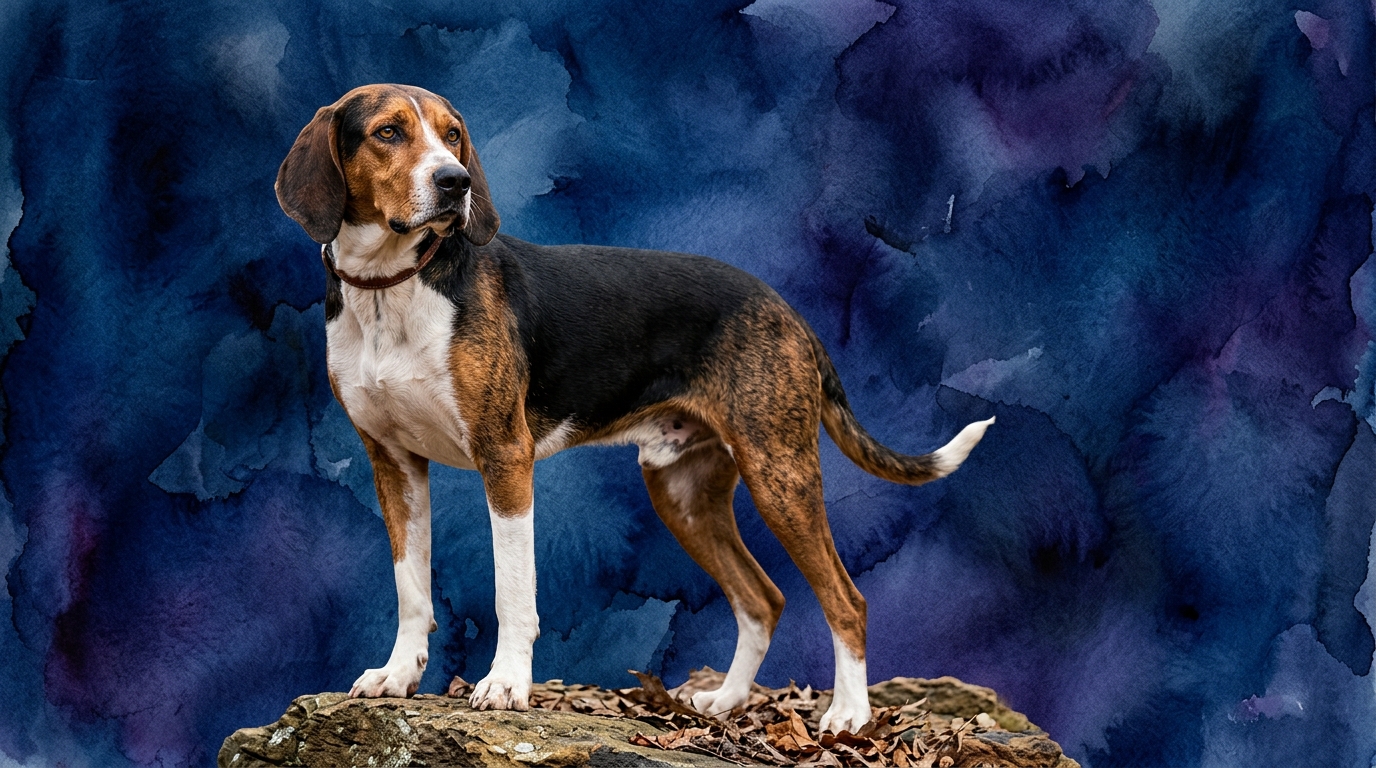
Treeing Walker Coonhound at a glance
| IQ Rank / Score | 16/25 |
|---|---|
| Trainability | ★★★☆☆ (3/5) |
| Social Intelligence | ★★★☆☆ (3/5) |
| Lifespan | 10-12 years |
| Shedding | Moderate to high |
| Exercise Needs | High (60+ min/day + training) |
| Origin | USA |
Welcome to the World of the Treeing Walker Coonhound Mind
The Treeing Walker Coonhound, a proud American native, embodies the essence of the hound group: determination, stamina, and an olfactory system that borders on the miraculous. Their intelligence isn't measured by typical obedience metrics, but rather by their extraordinary ability to interpret, follow, and react to a world invisible to humans – the world of scent. This large, energetic dog's cognitive strengths are deeply rooted in its ancestral purpose: tracking game through diverse terrains and signaling its location with a distinctive, purposeful bark. Understanding a Treeing Walker's intelligence means appreciating their unique priorities and how their brain processes information.
Unlike breeds developed for herding or complex trick learning, the Treeing Walker's genius lies in its relentless focus, intricate sensory processing, and adaptive problem-solving skills, all directed towards a singular, instinctual goal. They are masters of their domain, showcasing a form of intelligence that is both ancient and highly specialized, requiring a different lens through which to be truly appreciated. Their independence often belies a deeply intelligent mind, constantly at work deciphering the complex tapestry of scents around them.
The Olfactory Alchemist: Unpacking Their Primary Intelligence Angle
The primary angle for the Treeing Walker Coonhound's intelligence is best described as Olfactory-Driven Persistent Problem-Solving. Their cognition is uniquely optimized for complex scent discrimination and trail following, requiring sustained focus and adaptive strategy in dynamic environments, often overriding other stimuli. This isn't merely a strong sense of smell; it's a specialized brain architecture dedicated to processing, interpreting, and relentlessly pursuing olfactory data as a primary mode of interaction with their world. They are highly adept at constructing a mental map solely from scent information, navigating complex terrains, and making real-time decisions based on subtle changes in odor intensity and direction. This cognitive specialization means their problem-solving is often a relentless, single-minded pursuit of a scent-based goal, rather than a generalized, abstract approach.
For a Treeing Walker, every scent molecule is a piece of a larger puzzle, a clue leading them closer to their objective. Their minds are constantly analyzing, prioritizing, and filtering through a cacophony of odors to isolate and follow a specific trail, even one hours old. This requires incredible cognitive stamina, memory, and a sophisticated internal GPS system powered by their nose. When faced with a lost trail, they don't give up; they engage in adaptive strategies, circling, casting, and re-evaluating until the path forward is clear again. This is pure, unadulterated cognitive dedication.
Beyond the Bark: A Surprising Glimpse into Coonhound Cognition
A truly surprising scientific and historical fact about the Treeing Walker Coonhound's cognition lies in their distinct “chop” bark. This isn't merely a loud vocalization but a highly specialized cognitive communication signal, deeply ingrained yet refined through generations of selective breeding and cooperative hunting. Unlike a general alarm or the prolonged, mournful “bay” of some other hounds, the Treeing Walker’s “chop” is a sharp, rhythmic, often rapid series of barks that precisely indicates to hunters that game – typically a raccoon or opossum – has been successfully cornered and “treed.” This intricate vocalization is a direct cognitive output, signalling a specific outcome of their hunt. It demonstrates a sophisticated interspecies communication developed for a specific purpose within a shared goal.
The ability to produce such a specific, context-dependent vocal signal speaks volumes about their cognitive processing. It suggests not just an instinct to vocalize, but an evolved understanding of cause and effect (treeing the game) and its direct translation into a human-comprehensible message. This requires a complex integration of sensory input, spatial awareness, and an inherited communicative syntax, showcasing a truly specialized form of intelligence that transcends basic animal sounds.
Treeing Walker Coonhound IQ Scores Explained
At The Cosmic Pet's Pet IQ Lab, we evaluate breed intelligence across five key dimensions. Here's how the Treeing Walker Coonhound scores, offering insight into their unique cognitive strengths and areas that require understanding and tailored approaches:
Problem Solving (4/5): When it comes to scent-related puzzles, the Treeing Walker Coonhound is a master. Their ability to track, decipher complex scent trails, and overcome obstacles in pursuit of a goal is outstanding. However, their problem-solving tends to be highly specialized; they may not excel at abstract, non-olfactory challenges with the same agility as some other breeds, as their primary cognitive focus is so profoundly scent-driven.
Training Speed (3/5): Treeing Walkers are intelligent and capable of learning, but their strong independent nature and intense focus on scent can make traditional obedience training a nuanced endeavor. They learn best with positive reinforcement, consistency, and when training leverages their natural drives rather than attempting to suppress them entirely. Distractions, especially compelling scents, can significantly impact their responsiveness.
Social Intelligence (3/5): These hounds are generally friendly, affectionate, and good-natured with both people and other dogs. However, their social intelligence is often secondary to their instinctive drive. While they enjoy companionship, their primary focus in many situations will be on external stimuli (like a scent) rather than intently observing and responding to subtle human social cues or commands when a trail is present. They are not aloof, but their world is often scent-first, human-second.
Instinctive Drive (5/5): This is the defining characteristic of the Treeing Walker Coonhound. Their instinctive drive for tracking, trailing, and treeing is virtually unmatched. This powerful urge governs much of their behavior and cognitive processes, making them relentless in their pursuit of a scent. This score reflects their extraordinary stamina, single-minded focus, and genetic predisposition for their specialized hunting role.
Memory (4/5): Treeing Walker Coonhounds possess excellent memory, particularly regarding scent trails, past successful hunts, and the layout of familiar territories. They can remember complex routes and the location of specific game or resources. This strong memory is crucial for efficient hunting, allowing them to recall where trails were picked up, where game was treed, or to revisit productive areas, demonstrating a robust cognitive mapping ability.
3 At-Home Tests to Measure Your Treeing Walker Coonhound's IQ
These tests are adapted from peer-reviewed ethology research. No equipment is needed beyond items you have at home. Run each test 5–10 times for reliable results.
The Myth: "Treeing Walker Coonhounds are stubborn and difficult to train."
✅ Treeing Walker Coonhounds are highly intelligent, but their cognitive specialization means they are not eager to please in the same way as a herding dog. Their 'stubbornness' is typically a manifestation of their powerful instinctive drive. They are very trainable, but require patient, consistent, and positive reinforcement methods that understand and leverage their motivations, especially their love of scent work, rather than attempting to fight their innate nature.
Treeing Walker Coonhound vs. Similar Breeds
🧠 What's Your Dog's IQ Score?
Our full Pet IQ Lab assessment includes 12+ tests across 5 cognitive dimensions, calibrated for Treeing Walker Coonhounds specifically.
Take the Full IQ Test →Frequently Asked Questions
How smart is a Treeing Walker Coonhound?
Our Pet IQ Lab framework scores cognition across five dimensions (max 25). The Treeing Walker Coonhound totals 16/25 — high for a domestic dog. The full article breaks down each dimension with at-home tests.
Are Treeing Walker Coonhounds easy to train?
Treeing Walker Coonhounds can learn most cues, but expect to repeat lessons and keep sessions short. They score 3/5 on Training Speed in our breed profile.
Are Treeing Walker Coonhounds good with children and other pets?
Treeing Walker Coonhounds can live well with families when socialized early. Their Social Intelligence scores 3/5, so supervise interactions with small children and introduce new pets gradually.
Do Treeing Walker Coonhounds need a lot of mental stimulation?
Absolutely. With Problem Solving 3/5 and Instinctive Drive 5/5, Treeing Walker Coonhounds need daily mental work — puzzle feeders, scent games, training sessions, or nose-work — to avoid boredom.
How much exercise does a Treeing Walker Coonhound need?
Treeing Walker Coonhounds need active engagement. Plan for 45-60 minutes of exercise and training per day, plus mental stimulation.
How good is a Treeing Walker Coonhound's memory?
Treeing Walker Coonhounds score 2/5 on memory. They remember high-value associations well; less-used cues fade without refresher sessions.
What is the typical lifespan of a Treeing Walker Coonhound?
Typical lifespan is 10-12 years for a large dog like the Treeing Walker Coonhound.
The Treeing Walker Coonhound's intelligence is a testament to natural selection, perfectly honed for a specific, demanding purpose. By understanding their unique cognitive architecture, owners can foster a deeper bond and truly unleash the potential of these remarkable, scent-driven dogs.