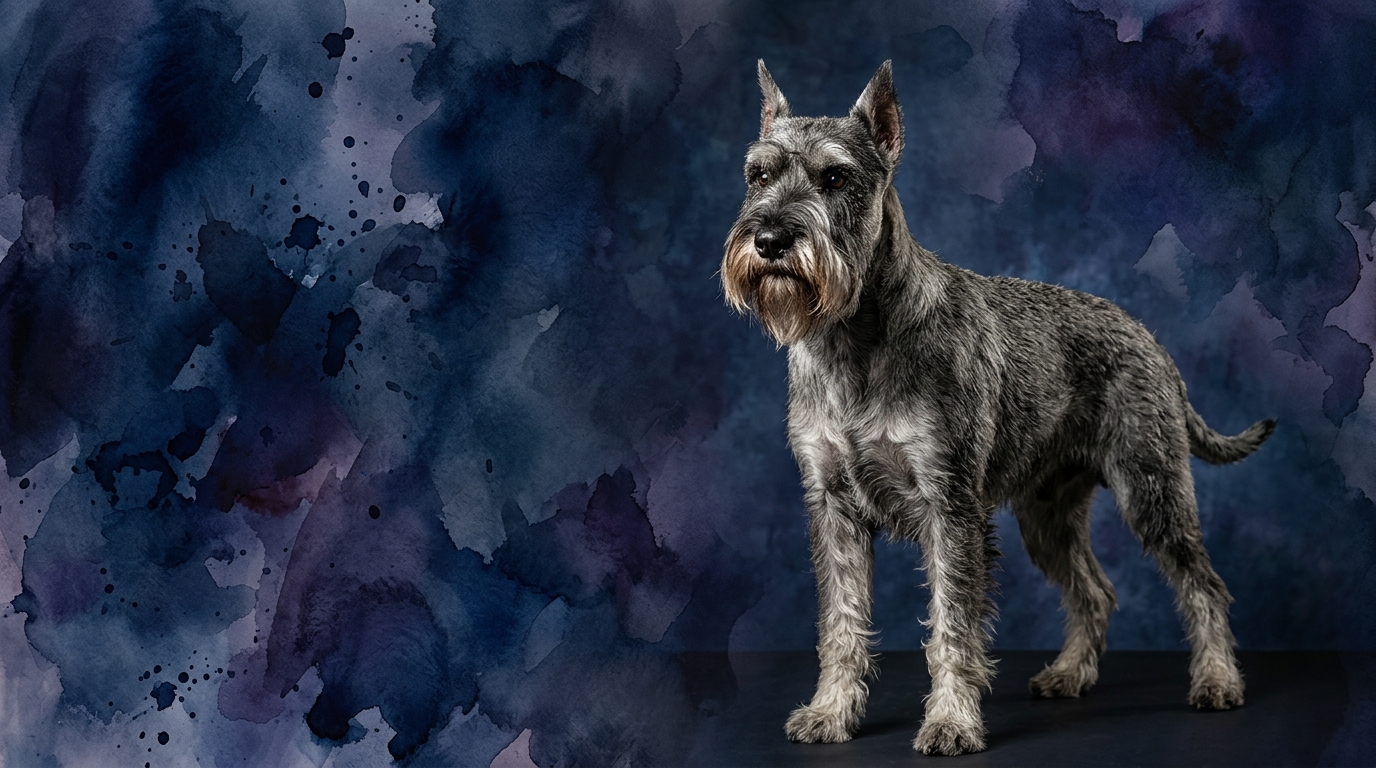

Side-by-Side Cognitive Profile: Standard Schnauzer vs. Russian Toy
The Standard Schnauzer, a member of the Working Group and ranked #22 by Coren, presents a profile marked by considerable mental agility. Its problem-solving capacity registers at a notable 4/5, indicating a strong ability to navigate complex situations and devise solutions. Training speed also scores 4/5, suggesting a quick grasp of new commands and routines. Social intelligence stands at 3/5, reflecting a competent understanding of family dynamics but often a reserved approach to strangers. An instinctive drive of 3/5 points to a purposeful, moderate drive often expressed as alertness and a desire for engagement. Finally, memory is a strong suit at 4/5, enabling robust retention of learned behaviors and experiences.
In contrast, the Russian Toy, a charming member of the Toy Group, is not included in the Coren ranking, yet possesses its own distinct cognitive strengths. Across all five dimensions—problem solving, training speed, social intelligence, instinctive drive, and memory—the Russian Toy consistently scores 3/5. This suggests a balanced, moderate cognitive aptitude; they are capable of learning, understanding social cues within their close circle, and remembering routines, but perhaps without the same intensity or speed seen in some working breeds. Their mental attributes align well with their role as a devoted companion.
Comparing these profiles reveals a clear distinction in cognitive emphasis. The Standard Schnauzer shows a pronounced inclination towards complex cognitive tasks and rapid learning, driven by its heritage. The Russian Toy, while equally capable of learning and bonding, operates with a more uniform, moderate mental energy across the board, which often translates into a highly adaptable and focused companionship.
Where the Standard Schnauzer Shows Cognitive Advantage
The Standard Schnauzer clearly excels in areas demanding higher cognitive effort and retention. Its 4/5 score in problem solving signifies a breed adept at independent thought and strategizing. Owners frequently observe Schnauzers figuring out how to open gates, retrieve out-of-reach items, or even manipulate situations to their advantage, showcasing a mental resourcefulness that goes beyond simple learned responses. This capacity for complex thought makes them excellent candidates for advanced obedience, agility, and scent work, where independent decision-making within a structured framework is valued.
Furthermore, the Schnauzer's 4/5 training speed is a significant asset. They absorb new commands and multi-step routines with remarkable efficiency, often requiring fewer repetitions than many other breeds. This rapid acquisition of knowledge means that training sessions can progress quickly, building upon foundational skills to tackle more intricate tasks. This quick uptake is further bolstered by their 4/5 memory, ensuring that once a lesson is learned, it is retained over the long term, allowing for a cumulative and progressive training journey. Their ability to recall past experiences and learned solutions contributes to their overall adaptability and reliability in various scenarios.
Unique Cognitive Strengths of the Russian Toy
While the Russian Toy's scores are consistently 3/5, these moderate ratings coalesce into a unique cognitive profile perfectly suited for its companion role, particularly in areas where subtle attunement and manageable drives are paramount. Their 3/5 social intelligence, for example, is often highly focused on their immediate human family. This means they are particularly adept at reading the nuances of their owner's moods and intentions, fostering an incredibly strong and sensitive bond. Their social understanding, while perhaps not broadly applied to many strangers, is intensely directed towards their inner circle, making them profoundly empathetic companions.
The Russian Toy's 3/5 instinctive drive, while not translating to complex working tasks, is ideal for a small companion. This moderate drive manifests as a keen awareness of their environment and a desire for close proximity to their loved ones, without the overwhelming need for constant, intense physical or mental outlets. They are alert and make excellent, if tiny, watchdogs, signaling the presence of newcomers with enthusiasm. This 'just right' level of drive means they are generally less prone to destructive behaviors born from unfulfilled working instincts, making them delightful household members.
Their 3/5 problem-solving ability, though not as complex as a Schnauzer's, is practical and effective for their daily lives. They are clever enough to figure out how to get their favorite toy from under the couch or how to solicit attention from their owner, demonstrating resourceful thinking within their personal sphere. This balance ensures they are engaging without being overly demanding or prone to 'outsmarting' their human companions in challenging ways.
Ease of Training: Standard Schnauzer vs. Russian Toy
When considering ease of training, the Standard Schnauzer's 4/5 training speed and 4/5 memory present a compelling case for rapid skill acquisition. They are quick to understand and retain commands, often thriving on the mental challenge that structured training provides. Their background as working dogs means they naturally seek purpose and engagement, making them highly receptive to consistent, stimulating instruction. However, their 4/5 problem-solving and independent nature can also mean they are prone to finding their own solutions or testing boundaries if training isn't consistent, engaging, and varied. An owner must match their quick wit and provide ample mental stimulation to prevent boredom-driven behaviors and ensure compliance.
The Russian Toy, with its 3/5 training speed and 3/5 memory, learns at a steady, reliable pace. While they may require more repetitions than a Schnauzer to solidify new commands, their eagerness to please their beloved owner serves as a powerful motivator. They are generally less prone to independent 'scheming' or pushing boundaries, making them straightforward to train with patience and positive reinforcement. Their moderate instinctive drive means they are typically less distracted by external stimuli, allowing for focused training sessions. For owners who value consistency and a gentle approach, the Russian Toy is an amenable student, excelling in basic obedience and trick training that strengthens the human-animal bond.
Matching Breeds to Owner Lifestyles: Active vs. Relaxed
The Standard Schnauzer is an ideal match for active owners who relish mental engagement and a shared sense of purpose. Their 4/5 problem-solving and 3/5 instinctive drive necessitate a lifestyle rich in mental and physical stimulation. They thrive in homes where they can participate in activities that challenge their intellect, such as advanced obedience, agility, hiking, or even canine jobs like scent work. A relaxed or sedentary owner might find the Schnauzer's abundant mental energy leads to boredom, which can manifest as unwanted behaviors. They require daily opportunities to think, learn, and expend their focused energy, making them excellent companions for adventurous and dedicated individuals.
The Russian Toy, conversely, is remarkably adaptable and can suit a range of owner lifestyles, though they particularly shine with companion-oriented or moderately active individuals. Their consistent 3/5 scores across all cognitive dimensions mean they appreciate mental stimulation but do not demand the same intensity or volume as a working breed. They are content with daily walks, indoor play sessions with puzzle toys, and extensive lap time. Their moderate drive makes them well-suited for apartment living and less demanding routines, provided they receive consistent affection and engagement. While they enjoy outdoor adventures, their primary needs revolve around companionship and comfort, making them a flexible choice for both relaxed and moderately active households.
The Verdict
For owners seeking a mentally agile companion eager for structured training, problem-solving challenges, and an active lifestyle, the Standard Schnauzer offers a rewarding partnership.
For individuals desiring a devoted companion who thrives on close connection and consistent, positive guidance, the Russian Toy provides a charming and adaptable presence.
🧠 Find Your Pet's IQ Score
Our Pet IQ Lab assessment covers 25+ tests across 5 cognitive dimensions — personalized to your breed.
Take the Full IQ Test →Frequently Asked Questions
Is a Standard Schnauzer a good first dog?
Their impressive cognitive abilities and drive for engagement mean they thrive with an owner who understands consistent training and mental stimulation. While manageable for first-time owners willing to commit, their quick wit and independence require dedication and a proactive approach to prevent boredom.
How much exercise does a Russian Toy need?
Russian Toys have moderate exercise needs, with daily walks and indoor play typically sufficient to keep them content. Their smaller size and moderate instinctive drive mean they don't require extensive outdoor adventures, but they do enjoy mental engagement through games and training sessions.
Are Russian Toys good with children?
Their social intelligence (3/5) means they can bond closely with family members. However, due to their delicate build, they are generally better suited to homes with older, respectful children who understand how to interact gently with a small dog and respect its space.