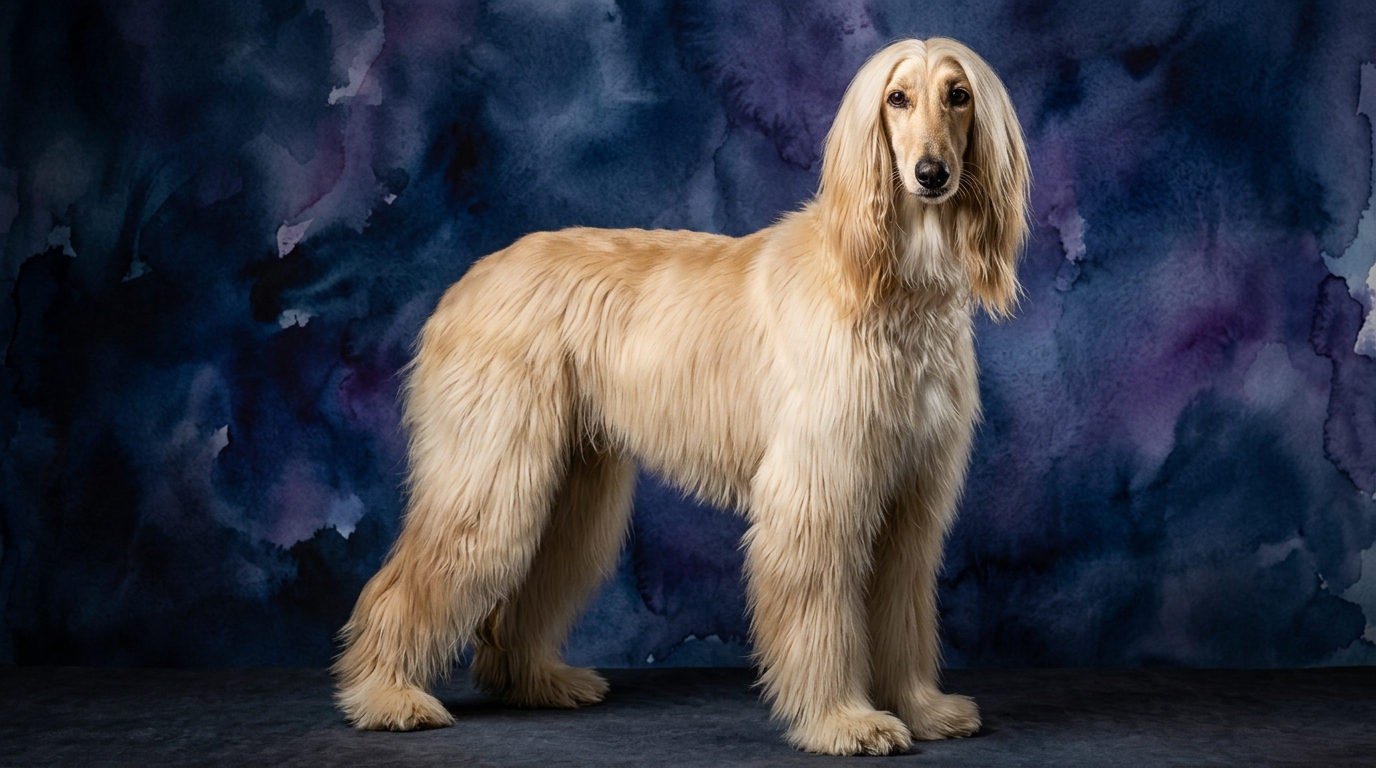

Side-by-Side Cognitive Profiles
The Afghan Hound, a majestic Sighthound, presents a unique cognitive profile. Their Problem Solving ability, rated at 4/5, indicates a capacity for navigating complex environments and overcoming physical obstacles with independent thought, often in pursuit of their goals. However, their Training Speed is notably low at 1/5, reflecting a strong independent spirit and a preference for making their own decisions rather than readily complying with human commands. Social Intelligence stands at 2/5, suggesting a reserved nature, less inclined towards overt collaboration or constant human interaction. Their Instinctive Drive, a powerful 5/5, highlights an intense internal motivation, particularly for chasing and observing moving objects, deeply rooted in their sighthound heritage. Memory, at 3/5, is solid and functional, allowing them to recall learned patterns and locations effectively.
In contrast, the Rat Terrier, a lively member of the Terrier group, exhibits a more balanced and interactive cognitive makeup. Their Problem Solving score of 3/5 indicates practical intelligence, enabling them to figure out everyday challenges and puzzles efficiently. Training Speed is a moderate 3/5, signifying a willingness to learn and a responsiveness to consistent guidance, making them generally more amenable to structured lessons. Social Intelligence also rates 3/5, pointing to a balanced capacity for interacting with both humans and other animals, capable of forming strong bonds and understanding social cues. Their Instinctive Drive, also 3/5, reflects a moderate internal motivation, often channeled towards scent work, digging, and the energetic pursuit of small prey, characteristic of their terrier background. Memory, similar to the Afghan Hound, is 3/5, providing a reliable foundation for retaining information and routines.
Where the Afghan Hound Cognitively Shines
The Afghan Hound truly excels in domains demanding autonomous decision-making and an unwavering focus on intrinsic motivations. Their superior Problem Solving (4/5) allows them to independently assess and navigate intricate physical spaces, often leveraging their exceptional visual acuity and athletic prowess to achieve an objective, such as finding the optimal path during a chase. This isn't about solving human-designed puzzles for praise, but rather efficiently overcoming environmental challenges relevant to their innate drives. Furthermore, their Instinctive Drive (5/5) is an unparalleled cognitive strength, enabling sustained, high-intensity focus on specific tasks, particularly those involving movement and pursuit. This translates to an impressive ability to track and react to stimuli at great distances, a nuanced form of intelligence vital to their original purpose. This deep-seated drive means they are highly motivated by opportunities that tap into their natural sighthound behaviors, demonstrating a profound, specialized cognitive capacity.
Where the Rat Terrier Cognitively Excels
The Rat Terrier's cognitive strengths lie in their adaptability, biddability, and balanced social engagement. Their higher Training Speed (3/5 compared to the Afghan Hound's 1/5) signifies a greater openness to learning and performing human-directed tasks. This isn't merely about speed, but about a cognitive inclination to engage with and respond to handler cues, making them more receptive to various forms of instruction. Their Social Intelligence (3/5 versus 2/5) further enhances this, allowing them to better interpret and respond to human body language and vocal tones, fostering a more collaborative learning environment. This social acumen means they are often more attuned to the nuances of group dynamics and human expectations. While their Problem Solving (3/5) is slightly lower than the Afghan Hound's, it's a practical, applied intelligence that thrives in interactive scenarios, making them adept at figuring out interactive games or learning complex trick sequences when motivated by their owner's presence and rewards.
Trainability: A Clear Distinction
Without question, the Rat Terrier is generally easier to train for obedience and structured activities, primarily due to their higher Training Speed (3/5) and Social Intelligence (3/5). Rat Terriers possess a cognitive framework that leans towards engagement and responsiveness; they are often eager to please and find satisfaction in cooperative tasks with their handlers. Their moderate instinctive drive means they can focus on a task without being overwhelmingly distracted by environmental stimuli, allowing for more consistent learning. In contrast, the Afghan Hound's extremely low Training Speed (1/5) is not a lack of intelligence, but rather a profound manifestation of their independent thought process and strong self-will. They are not naturally inclined to follow commands simply because they are given; instead, they weigh the perceived value of a command against their own strong internal motivations. Training an Afghan Hound requires immense patience, creativity, and a deep understanding of what truly motivates them, often involving making the desired action intrinsically rewarding and tapping into their chase drive rather than relying on rote repetition or constant praise. Their lower social intelligence means they are less motivated by human approval alone, necessitating a different pedagogical approach.
Matching Breeds to Lifestyles: Active vs. Relaxed Owners
The choice between these breeds significantly depends on an owner's lifestyle and their definition of 'active' or 'relaxed.' An Afghan Hound, with its powerful Instinctive Drive (5/5) and a history as a sighthound, requires significant outlets for running and chasing. This means 'active' owners for an Afghan Hound are those who can provide access to large, securely fenced areas where the dog can gallop freely, or who are committed to activities like lure coursing. Their independence means they don't necessarily need constant human interaction during these bursts of activity, making them suitable for owners who appreciate a dog that can entertain itself within appropriate boundaries. A 'relaxed' owner, in this context, would struggle to meet the Afghan Hound's profound need for physical exertion, leading to potential behavioral issues. Conversely, the Rat Terrier, with its balanced Instinctive Drive (3/5) and higher Trainability (3/5), suits a broader range of 'active' owners who enjoy interactive play, structured training sessions, and dog sports like agility or earthdog trials. Their energy is often channeled into more focused, human-involved activities rather than independent, wide-ranging sprints. For a 'relaxed' owner, a Rat Terrier might still require daily walks and mental engagement to prevent boredom, but they are generally more adaptable to a less intense physical regimen than an Afghan Hound, provided they receive consistent mental stimulation through training and puzzle toys.
The Verdict
Choose the Afghan Hound if you are an experienced owner who deeply appreciates an independent, visually driven companion and can provide ample, secure space for their powerful chase instincts to flourish, valuing their unique, sometimes aloof, partnership over eager compliance.
Opt for the Rat Terrier if you seek an adaptable, biddable companion eager for interactive training, social engagement, and a variety of activities, thriving on a collaborative bond and consistent mental stimulation.
🧠 Find Your Pet's IQ Score
Our Pet IQ Lab assessment covers 25+ tests across 5 cognitive dimensions — personalized to your breed.
Take the Full IQ Test →Frequently Asked Questions
Are Afghan Hounds difficult to train for basic obedience?
Afghan Hounds present a unique training challenge due to their exceptionally low training speed and high independence. They are not difficult because they lack intelligence, but because they are less motivated by human approval and prefer to make their own decisions. Success requires patience, creative motivation, and understanding their sighthound instincts.
Do Rat Terriers require significant mental stimulation?
Yes, Rat Terriers thrive on mental engagement. Their moderate problem-solving and instinctive drive mean they benefit greatly from puzzle toys, consistent training, and interactive games. Without adequate mental outlets, they can become bored and potentially develop undesirable behaviors, channeling their terrier energy destructively.
Which breed is better suited for a first-time dog owner?
For a first-time dog owner, the Rat Terrier is generally a more suitable choice. Their higher training speed and social intelligence make them more responsive to traditional training methods and easier to integrate into a family lifestyle. The Afghan Hound's profound independence and specific cognitive needs typically require an owner with prior dog experience and a deep understanding of sighthound behavior.