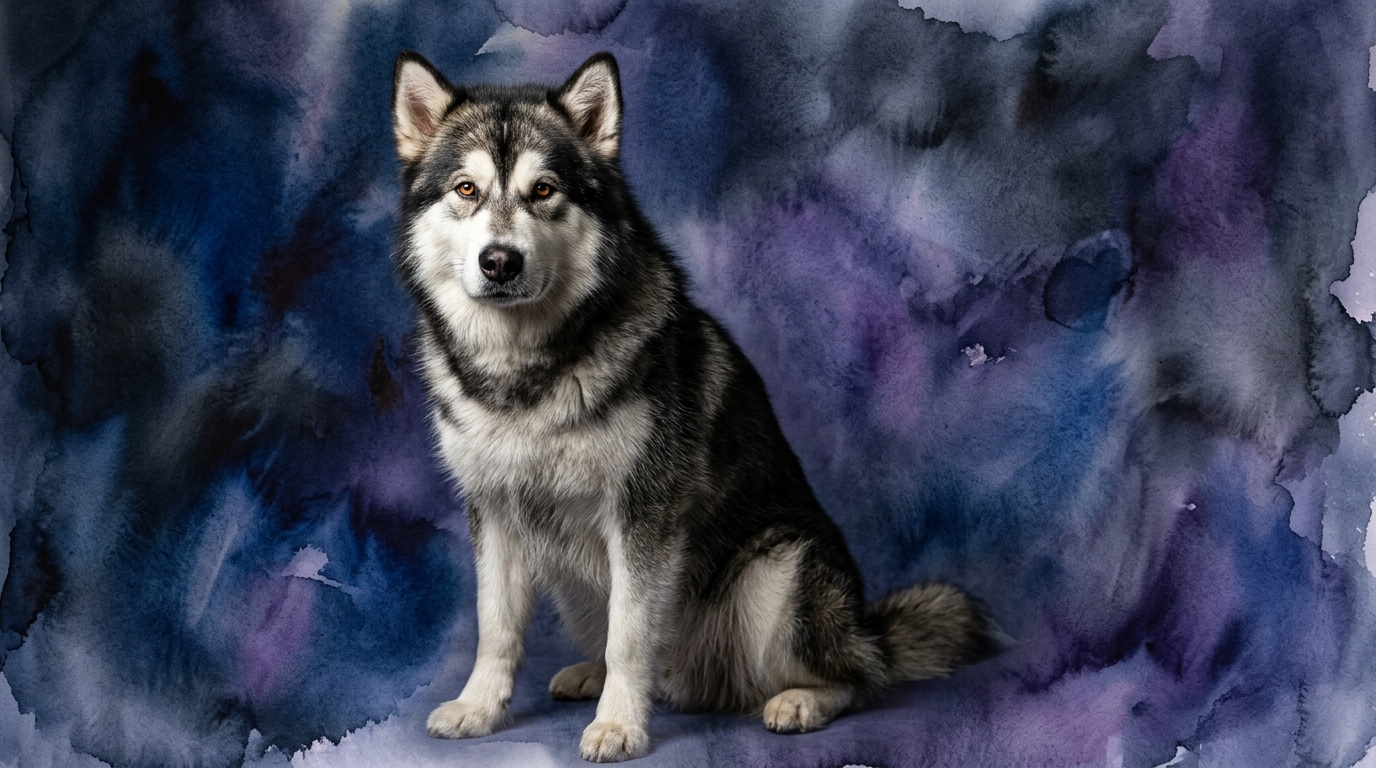

The Cognitive Landscape: Alaskan Malamute vs. English Setter IQ Profile
The Alaskan Malamute, a working breed ranked #50 by Coren, demonstrates a formidable cognitive makeup suited for harsh environments and demanding tasks. Its Problem Solving score of 4/5 reflects an independent mind adept at navigating complex challenges and finding solutions autonomously, essential for survival in its native habitat. Training Speed is rated 2/5, indicating a strong-willed nature that requires patience and motivation rather than simple compliance. Social Intelligence stands at 3/5, suggesting a capacity for pack dynamics but not an overwhelming desire to please. An Instinctive Drive of 5/5 highlights their profound urge for sustained physical work, pulling, and exploring, while their Memory of 4/5 enables them to recall intricate routes and learned tasks over long periods.
In contrast, the English Setter, a sporting breed ranking #37 by Coren, presents a cognitive profile finely tuned for cooperative hunting and companionship. Its Problem Solving also scores 4/5, but this intelligence is often applied in collaboration with a handler, strategizing to locate and point game. Training Speed is a higher 4/5, signaling a more biddable and responsive learner, eager to grasp commands and execute them with precision. Social Intelligence matches the Malamute at 3/5, indicating a sociable nature that thrives on partnership. The Instinctive Drive is 3/5, focused on scenting and retrieving rather than raw power, and their Memory of 4/5 is excellent for retaining complex sequences of commands and tracking information in the field.
Where the Alaskan Malamute Excels Cognitively
The Alaskan Malamute's most pronounced cognitive strength lies in its exceptional Instinctive Drive (5/5), which isn't merely a physical attribute but a deeply ingrained mental fortitude. This drive fuels their capacity for sustained, goal-oriented work, making them unparalleled in tasks requiring endurance and determination. Their problem-solving (4/5) often manifests as practical intelligence, enabling them to make independent decisions when navigating challenging terrain, identifying safe paths, or even devising strategies to overcome obstacles encountered during a long trek. This self-reliance is a critical cognitive asset in scenarios where immediate human guidance might be absent or insufficient.
Furthermore, their memory (4/5) is particularly robust for spatial recall and remembering sequences of tasks vital for their working roles. A Malamute can remember complex routes through varied landscapes, adapting their approach based on past experiences or environmental changes. This breed's cognitive prowess shines in situations demanding resilience, autonomous decision-making, and an unwavering commitment to a task, whether it's pulling a heavy load or exploring vast distances. Their cognitive makeup emphasizes survivalist intelligence, making them adept at processing and responding to environmental cues with minimal prompting.
Where the English Setter Shows its Cognitive Edge
The English Setter’s primary cognitive advantage is its superior Training Speed (4/5), which, when coupled with its Problem Solving (4/5), makes it exceptionally adept at learning and applying complex instructions. This breed excels at interpreting nuanced handler cues and rapidly integrating new information into its behavioral repertoire, a crucial skill for the intricate demands of bird hunting. Their problem-solving is often directed towards collaborative tasks, such as figuring out the optimal way to quarter a field for scent or how to best position themselves to point game effectively, always in concert with their human partner.
Their social intelligence (3/5), combined with a strong desire to cooperate, allows them to form a tight working partnership, understanding and anticipating their handler's intentions. This makes them highly responsive and precise in their actions. The English Setter’s memory (4/5) is vital for retaining a vast array of commands, scent locations, and field conditions, enabling them to perform consistently and reliably. Their cognitive strengths lie in their capacity for nuanced communication, rapid skill acquisition, and a partnership-oriented approach to problem-solving, making them highly capable in structured, collaborative activities.
Trainability: A Tale of Two Temperaments
When it comes to trainability, the English Setter generally offers a smoother journey for most owners. Their Training Speed of 4/5 signifies a greater eagerness to please and a quicker understanding of what is being asked. Setters respond well to positive reinforcement, consistency, and a calm, encouraging approach. Their instinctive drive (3/5), while present for scenting and pointing, is typically more manageable and can be channeled effectively into structured training exercises, making them highly adaptable to various dog sports and obedience work. They thrive on interaction and view training as a cooperative venture.
The Alaskan Malamute, with a Training Speed of 2/5 and a powerful Instinctive Drive of 5/5, presents a different training dynamic. They are not unintelligent, but their independent nature means they often need to understand the 'why' behind a command and may prioritize their own instincts or perceived agenda over immediate compliance. Training a Malamute requires immense patience, creativity, and a deep understanding of their motivations. A trainer must make tasks engaging and relevant to their natural drives, often framing training as a collaborative problem-solving exercise rather than a series of directives to be followed. Building a strong, respectful bond is paramount to success.
Matching Minds to Lifestyles: Active vs. Engaged Owners
The Alaskan Malamute is best suited for highly active owners who embrace a lifestyle of adventure and purpose. Their profound Instinctive Drive (5/5) means they require significant physical exertion and mental engagement, making them ideal companions for those who enjoy activities like long-distance hiking, sledding, canicross, or skijoring. An owner must appreciate their independent problem-solving (4/5) and be prepared to provide consistent, firm yet fair leadership, understanding that a Malamute is a thinking partner, not merely a follower. They thrive when given a 'job' that satisfies their inherent drive and resilience.
The English Setter, while certainly active, appeals to owners seeking an engaged companion for varied activities without the extreme endurance demands of a Malamute. Their sporting background means they need regular exercise, such as extended walks, runs, or opportunities for off-leash exploration in safe areas. Their higher Training Speed (4/5) and cooperative nature make them excellent candidates for dog sports like agility, obedience, or scent work, which provide both physical and mental stimulation. Owners who enjoy interactive training, companionship, and can engage their natural birding instincts in a controlled manner will find a Setter to be a rewarding partner.
The Verdict: Choosing Your Canine Companion
The Verdict
Choose the Alaskan Malamute if you seek an independent, resilient partner for demanding outdoor adventures and appreciate a dog that thinks for itself, provided you can commit to consistent, bond-based training and ample exercise.
Opt for the English Setter if you desire a cooperative, responsive companion for various activities, valuing quick learning and a strong partnership in training, especially if you can engage their natural sporting drives and provide regular, interactive engagement.
🧠 Find Your Pet's IQ Score
Our Pet IQ Lab assessment covers 25+ tests across 5 cognitive dimensions — personalized to your breed.
Take the Full IQ Test →Frequently Asked Questions
Are Alaskan Malamutes harder to train than English Setters?
Yes, generally. Malamutes have a lower training speed score (2/5) and a very high instinctive drive (5/5), meaning they often prioritize their own agenda or natural urges over human commands, requiring more patience and creative motivation. English Setters, with a 4/5 training speed, are typically more eager to please and quicker to pick up new tasks.
Do both breeds have similar problem-solving abilities?
Both breeds score 4/5 in problem-solving, but they apply this intelligence differently. Malamutes often use it for independent navigation and survival in challenging environments, while English Setters apply it to strategic tasks like locating game or interpreting complex handler cues in a cooperative setting.
Which breed is better for a family with other pets?
This depends heavily on individual temperament and early socialization, but the Alaskan Malamute's high instinctive drive (5/5) can sometimes manifest as a strong prey drive, requiring careful management around smaller pets. English Setters, with a lower instinctive drive (3/5) and more cooperative nature, might generally adapt more smoothly to multi-pet households with proper introductions.