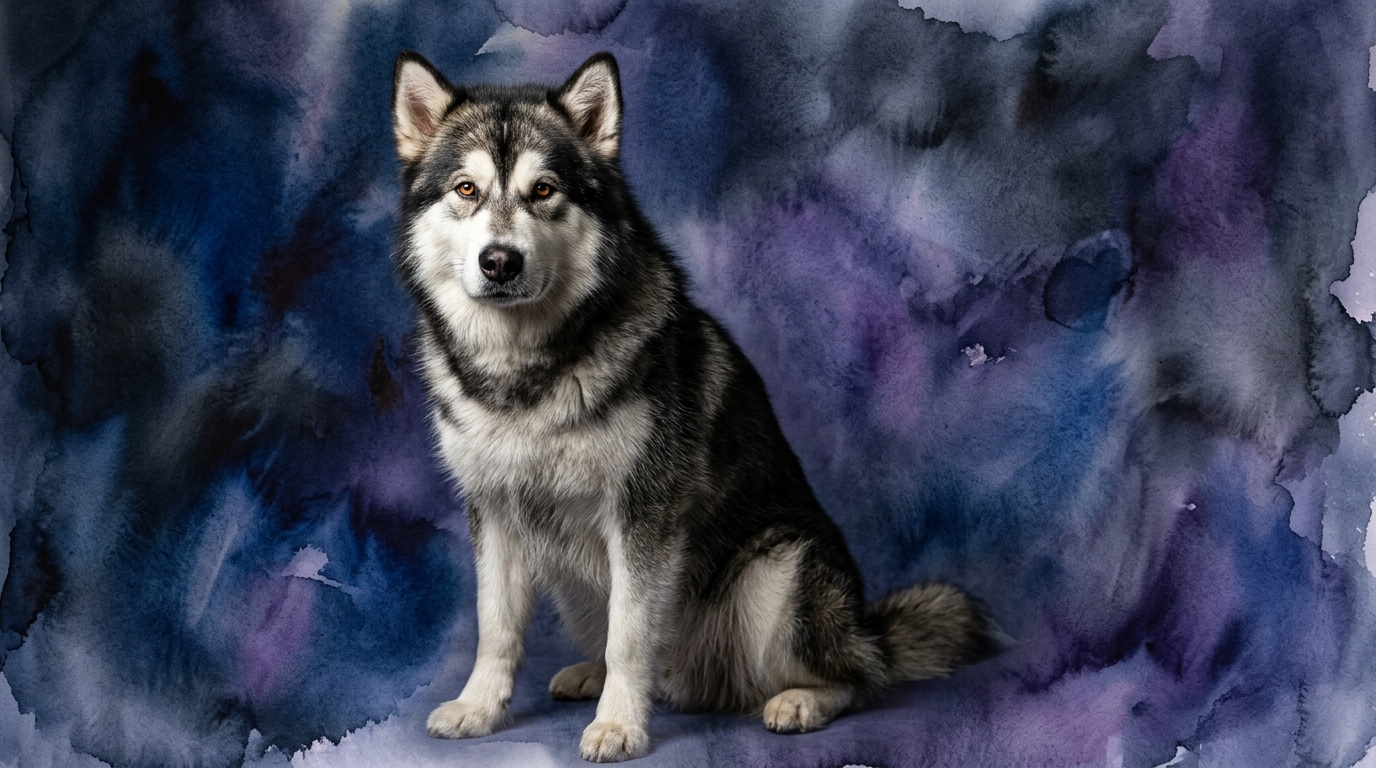
Alaskan Malamute at a glance
| IQ Rank / Score | #50 |
|---|---|
| Trainability | ★★☆☆☆ (2/5) |
| Social Intelligence | ★★★☆☆ (3/5) |
| Lifespan | 10-12 years |
| Shedding | Moderate to high |
| Exercise Needs | High (60+ min/day + training) |
| Origin | Alaska (USA) |
The Ancient Roots of Malamute Minds
Originating from the unforgiving landscapes of Alaska, the Alaskan Malamute's cognitive abilities are deeply rooted in their historical purpose. These weren't merely pets; they were essential partners for Inuit tribes, bred to haul heavy freight across vast, treacherous terrains. This demanding role necessitated a particular kind of intellect: one focused on endurance, pack cohesion, and autonomous problem-solving. Unlike breeds designed for speed or intricate handler-directed tasks, Malamutes needed to make critical decisions without constant human guidance, often navigating complex routes and adapting to sudden environmental shifts.
This independent decision-making intelligence is a hallmark of their lineage. Remarkably, genetic tests show that the Malamute is one of the oldest Arctic sled dog breeds, having diverged from wolves over 4,000 years ago — making them one of the most ancient domesticated dogs. This profound history underscores why their mental faculties developed to prioritize self-reliance and group strategy over immediate compliance. Their intelligence, therefore, isn't just about 'smartness' in a conventional sense, but a finely tuned adaptation for extreme environments and collaborative survival.
When evaluating a Malamute's cognitive profile, it's crucial to consider this heritage. Their capacity for route-finding, understanding terrain, and making judgments for the good of the pack reflects a deep, intuitive intelligence. This manifests as a strong memory for paths, an innate ability to assess situations, and a drive to complete tasks, even if it means approaching them in a uniquely Malamute fashion.
Beyond Obedience: Understanding Malamute Cognition
Stanley Coren's obedience ranking places the Alaskan Malamute at #50 out of 138 breeds, a position that might initially surprise some given their profound problem-solving abilities. However, this ranking primarily measures a dog's willingness to learn and execute human commands rapidly, which doesn't fully encapsulate the Malamute's unique cognitive strengths. Their historical role demanded independence, not strict subservience, leading to a cognitive profile that values self-sufficiency over immediate compliance.
Let's break down the Malamute's intelligence profile, as assessed by our Pet IQ Lab: Problem Solving: 4/5, Training Speed: 2/5, Social Intelligence: 3/5, Instinctive Drive: 5/5, and Memory: 4/5. Their high problem-solving score reflects their natural aptitude for navigating obstacles and finding creative solutions, a trait vital for their ancestors who had to overcome physical challenges on the trail. This also contributes to their considerable ingenuity when trying to achieve a desired outcome, whether it's opening a pantry or finding a new way out of the yard.
Their training speed of 2/5 isn't an indicator of an inability to learn; rather, it speaks to their independent nature. Malamutes learn quickly, but often decide *when* and *if* they will perform a task, especially if they don't see immediate purpose or benefit. Social intelligence at 3/5 highlights their capacity for complex pack dynamics, both with other dogs and their human family, yet it's often expressed through subtle cues rather than overt people-pleasing. Their instinctive drive of 5/5 is profoundly strong, encompassing their desire to pull, roam, and explore, which are deeply embedded ancestral traits. Finally, their memory at 4/5 is a significant asset, allowing them to remember routes, previous solutions to problems, and routines with remarkable accuracy.
Decoding Independent Decision-Making
The core of the Alaskan Malamute's intelligence lies in their capacity for independent decision-making. This isn't stubbornness, but a deeply ingrained trait from their working heritage where critical choices, like choosing the safest path over an icy stretch or rationing energy, could mean the difference between survival and failure. For a modern Malamute, this means they often assess situations and decide on a course of action based on their own judgment, which may not always align with their owner's immediate wishes. They are thinkers, not just doers.
This independence means a Malamute might not always respond to a command immediately, especially if they are engaged in something else or if they perceive their chosen action to be more logical or rewarding. They can be incredibly persistent in pursuing their goals, whether it’s digging under a fence or figuring out how to access a prized toy. Understanding this aspect of their cognition is key to building a successful relationship; it requires consistent, positive reinforcement training that focuses on motivation and mutual respect, rather than forceful compliance.
In daily life, this independent thought manifests in various ways: a Malamute might take a slightly different, perhaps more efficient, route on a familiar walk, or strategically 'herd' their human towards a desired destination like the treat cupboard. They often display impressive problem-solving when faced with barriers or puzzles, demonstrating a cognitive flexibility that prioritizes reaching their objective. Recognizing and appreciating this unique mental framework allows owners to tap into the Malamute’s full potential, engaging them in activities that challenge their intellect rather than just their obedience.
3 At-Home Tests to Measure Your Alaskan Malamute's IQ
These tests are adapted from peer-reviewed ethology research. No equipment is needed beyond items you have at home. Run each test 5–10 times for reliable results.
The Myth: "Malamutes and Huskies are the same breed with the same intelligence profile."
✅ While both are iconic arctic breeds, Alaskan Malamutes and Siberian Huskies are distinct, developed for different purposes that shaped their intelligence. Malamutes were bred for hauling heavy freight over long distances, requiring robust strength and, critically, independent decision-making and route-finding when handlers couldn't guide them. Huskies, conversely, were developed for speed and endurance with lighter loads, making them generally more handler-focused and responsive to direct commands. Their physical builds and cognitive priorities are subtly but significantly different.
Alaskan Malamute vs. Similar Breeds
🧠 What's Your Dog's IQ Score?
Our full Pet IQ Lab assessment includes 12+ tests across 5 cognitive dimensions, calibrated for Alaskan Malamutes specifically.
Take the Full IQ Test →Frequently Asked Questions
How smart is a Alaskan Malamute?
Our Pet IQ Lab framework scores cognition across five dimensions (max 25). The Alaskan Malamute totals 18/25 — high for a domestic dog. The full article breaks down each dimension with at-home tests.
Are Alaskan Malamutes easy to train?
Alaskan Malamutes are independent learners; short, highly-motivating sessions work best. They score 2/5 on Training Speed in our breed profile.
Are Alaskan Malamutes good with children and other pets?
Alaskan Malamutes can live well with families when socialized early. Their Social Intelligence scores 3/5, so supervise interactions with small children and introduce new pets gradually.
Do Alaskan Malamutes need a lot of mental stimulation?
Absolutely. With Problem Solving 4/5 and Instinctive Drive 5/5, Alaskan Malamutes need daily mental work — puzzle feeders, scent games, training sessions, or nose-work — to avoid boredom.
How much exercise does a Alaskan Malamute need?
Alaskan Malamutes need active engagement. Plan for 45-60 minutes of exercise and training per day, plus mental stimulation.
How good is a Alaskan Malamute's memory?
Alaskan Malamutes score 4/5 on memory. They remember routines, hiding spots, and learned cues for months, sometimes years.
What is the typical lifespan of a Alaskan Malamute?
Typical lifespan is 10-12 years for a large dog like the Alaskan Malamute.
The Alaskan Malamute's intelligence is a testament to thousands of years of adaptation, embodying an extraordinary blend of problem-solving and deep-seated independence. Understanding this unique "arctic intelligence" unlocks a profound appreciation for these magnificent companions and their ancestral legacy.