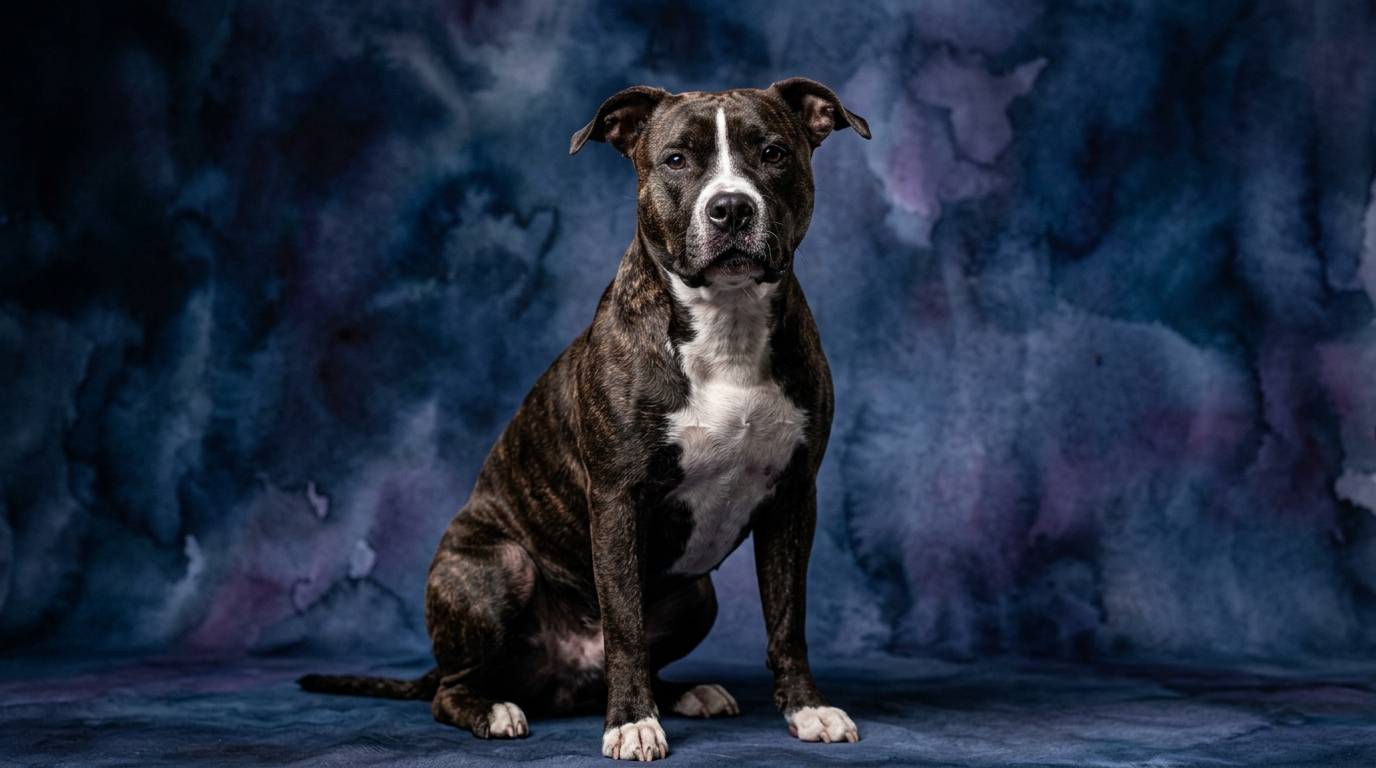
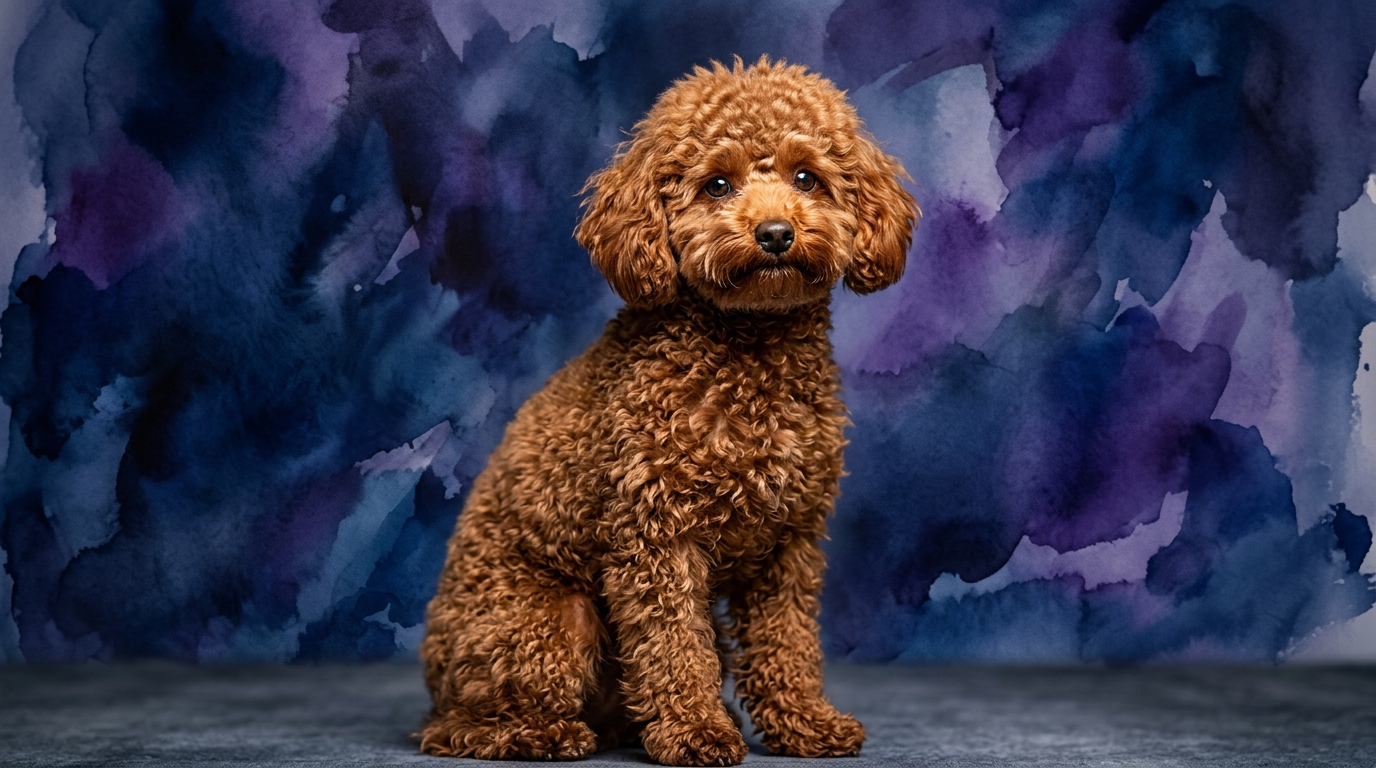
Side-by-Side IQ Profile
The Cosmic Pet Pet IQ Lab employs a multi-faceted approach to evaluate canine intelligence, moving beyond simple obedience to explore five distinct cognitive dimensions: problem-solving, training speed, social intelligence, instinctive drive, and memory. These scores, alongside Coren's ranking, provide a granular view of a breed's mental aptitude, revealing why the American Staffordshire Terrier and Toy Poodle, despite their disparate appearances, offer such compelling insights.
The American Staffordshire Terrier, ranking #48 on Coren's scale, presents a balanced cognitive profile. Their Problem Solving score of 3/5 suggests a practical, direct approach to challenges, preferring straightforward solutions over complex strategizing. Training Speed at 3/5 indicates they learn steadily but require consistent, clear instruction. Social Intelligence also stands at 3/5, meaning they read human cues adequately but might not always anticipate nuanced emotional states without specific experience. An Instinctive Drive of 3/5 points to a moderate inherent urge for typical dog behaviors like chasing or guarding, manageable with guidance. Their Memory, however, is a notable strength at 4/5, signifying that learned behaviors and associations stick well over time.
For an AmStaff, a practical problem might involve navigating an obstacle course; they will approach each barrier directly and remember the sequence of successful actions. Their memory aids in recalling established routines and boundaries, contributing to their reliability in familiar settings. When their moderate drive is channeled through structured activities, they demonstrate focused persistence.
In stark contrast, the Toy Poodle, holding the impressive #2 rank on Coren's scale, showcases a profile of exceptional cognitive agility. Their Problem Solving is a perfect 5/5, meaning they excel at figuring out novel situations, often displaying creative and multi-step solutions. Training Speed also reaches 5/5, highlighting their rapid learning and ability to generalize commands across various contexts. Surprisingly, their Social Intelligence is 3/5, mirroring the AmStaff, suggesting they understand human social cues effectively but aren't exceptionally predisposed to complex empathy. Instinctive Drive is also 3/5, moderate enough to provide motivation without being overwhelming, and their Memory is an outstanding 5/5, indicating they absorb and retain information with exceptional fidelity.
A Toy Poodle faced with a puzzle toy isn't just trying to brute force it; they might analyze its mechanisms, try different angles, or even use a paw strategically, demonstrating their high problem-solving capacity. Their superior memory means they can flawlessly recall complex sequences of tricks, obedience routines, or agility courses. This combination of mental prowess makes them highly adaptable and eager to engage in mentally stimulating tasks.
Where American Staffordshire Terrier Wins Cognitively
The American Staffordshire Terrier’s cognitive strengths often manifest in their steadfastness and reliability within established frameworks. Their Memory score of 4/5 is a significant asset, allowing them to retain complex routines, household rules, and learned responses over long periods. Once a behavior is ingrained through consistent training, an AmStaff is remarkably consistent in its execution, making them dependable companions in predictable environments. This robust memory contributes to their reputation for loyalty and predictable behavior.
While their Problem Solving (3/5) isn't as high as the Poodle's, it's a practical, grounded form of intelligence. They often prefer direct, physical solutions to challenges, which can be an asset in roles requiring tenacity and straightforward action rather than abstract thought. Their moderate Instinctive Drive (3/5), coupled with their physical build, makes them particularly adept at tasks requiring focused, sustained effort, such as scent work, protection sports, or even simply maintaining a consistent pace during a long hike, where their physical resilience complements their cognitive focus on the task at hand.
Where Toy Poodle Wins Cognitively
The Toy Poodle’s cognitive prowess shines brightest in areas demanding intricate thought and rapid learning. They excel in abstract Problem Solving (5/5), demonstrating an exceptional capacity to analyze novel situations and devise creative, often multi-step solutions. This ability isn't limited to physical puzzles; it extends to understanding complex sequences of commands, navigating new environments with strategic thinking, and adapting quickly to unforeseen challenges.
Their Training Speed (5/5) is a clear differentiator, signifying their remarkable efficiency in grasping new commands and concepts. This rapid acquisition of knowledge, combined with their superior Memory (5/5), allows them to build vast repertoires of behaviors and skills with ease. They can quickly learn intricate obedience routines, master agility courses, or even perform complex tricks, thriving on mental engagement and often becoming bored if not consistently challenged with new learning opportunities.
Which is Easier to Train and Why
Based on their cognitive profiles, the Toy Poodle, with its Training Speed of 5/5 and Problem Solving of 5/5, is generally easier to train. They possess an inherent eagerness to learn and a remarkable ability to generalize commands, meaning they can apply a learned behavior in various contexts quickly. Their exceptional Memory (5/5) ensures that once a concept is grasped, it's rarely forgotten, making retention high and refreshers minimal. This combination allows them to progress rapidly through training stages, often responding with enthusiasm to positive reinforcement and quickly associating actions with desired outcomes.
The American Staffordshire Terrier, while trainable with a Training Speed of 3/5, requires a more patient, consistent, and structured approach. Their learning curve is steadier, necessitating more repetition and clarity in commands. Owners need to understand their moderate Instinctive Drive and channel it productively, using motivation like play or food rewards effectively. While their Memory (4/5) is solid once a lesson is ingrained, the initial teaching phase demands more dedication and a firm, fair hand to establish foundational behaviors and ensure consistency.
Which Suits Active Owners vs Relaxed Owners
For owners who define “active” as engaging in physical sports, structured outdoor adventures, and consistent routines, the American Staffordshire Terrier can be an excellent fit. Their moderate Instinctive Drive (3/5) means they enjoy regular exercise but don't require constant, high-octane activity. They appreciate robust games, long walks, or even weight pulling, and their physical resilience allows them to participate enthusiastically. However, they also value downtime and a comfortable home environment, making them adaptable to owners who appreciate a balance of activity and relaxation, provided their memory and need for structure are respected.
The Toy Poodle, despite its smaller stature, often suits owners who are “active” in a cognitive sense, thriving on mental stimulation as much as physical exertion. Their superior Problem Solving (5/5) and Training Speed (5/5) mean they excel in dog sports like agility, obedience, or rally, which demand quick thinking and complex sequences. While they enjoy walks and playtime, their physical needs are often met with less space than an AmStaff. They are equally suited to relaxed owners who are committed to providing daily puzzle toys, engaging training sessions, or interactive games that challenge their keen minds, preventing boredom and potential behavioral issues that can arise from under-stimulation.
The Verdict
Choose an American Staffordshire Terrier if you value a loyal, robust companion that thrives on consistent, structured guidance and remembers its training well over time.
Opt for a Toy Poodle if you seek a highly adaptable, quick-thinking companion eager to master new challenges, perfectly suited for intricate training or dog sports.
🧠 Find Your Pet's IQ Score
Our Pet IQ Lab assessment covers 25+ tests across 5 cognitive dimensions — personalized to your breed.
Take the Full IQ Test →Frequently Asked Questions
Are American Staffordshire Terriers difficult to train?
American Staffordshire Terriers are not difficult to train, but they do require consistency and clear communication. With a training speed of 3/5, they learn steadily and retain information well thanks to their 4/5 memory, but owners must be patient and use positive reinforcement effectively.
Do Toy Poodles need a lot of exercise?
Toy Poodles need regular exercise, but their primary need is mental stimulation due to their high problem-solving and training speed. Daily walks are important, but engaging their minds with puzzle toys, training sessions, or dog sports is crucial to prevent boredom and promote well-being.
How do their social intelligence scores compare?
Both the American Staffordshire Terrier and the Toy Poodle have a social intelligence score of 3/5. This suggests both breeds are adequately attuned to human cues and social dynamics, but neither is exceptionally predisposed to anticipating complex emotional states without specific training or experience.