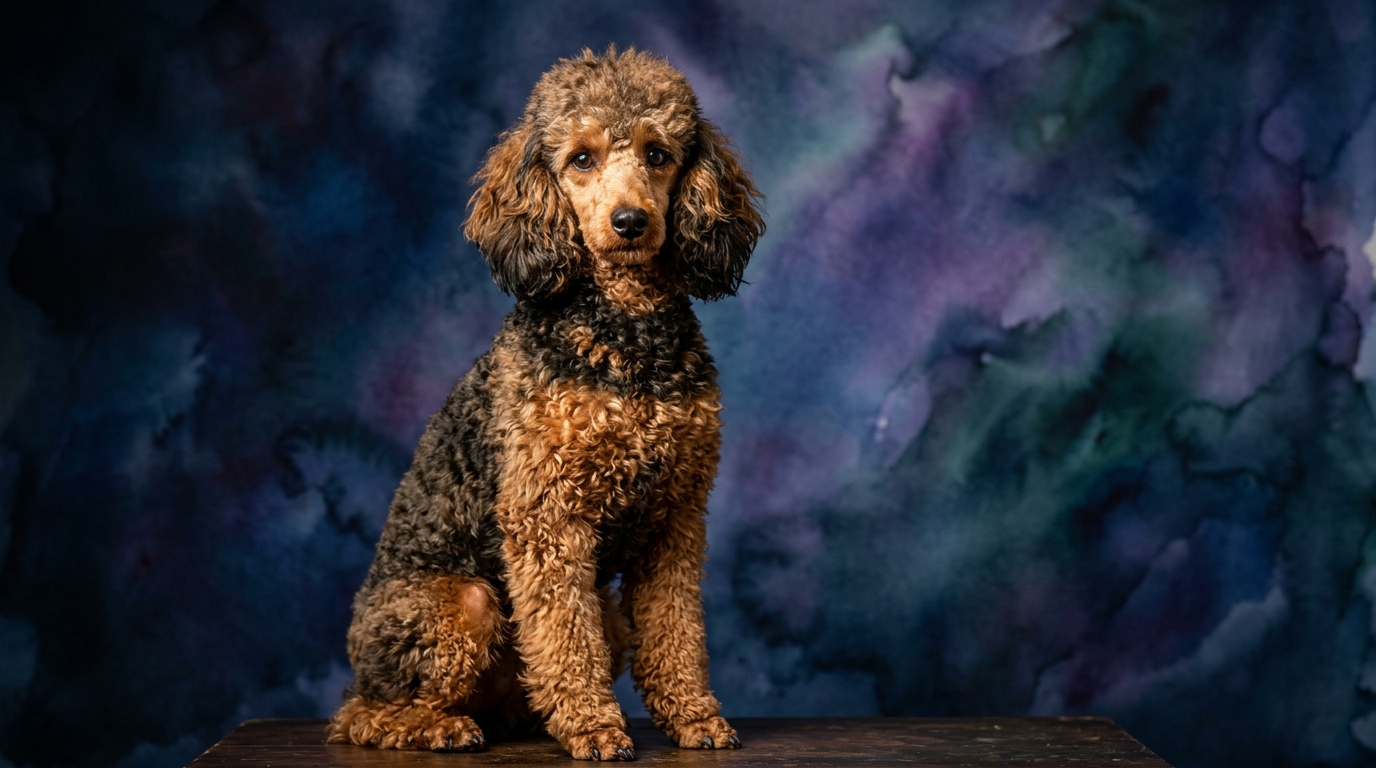
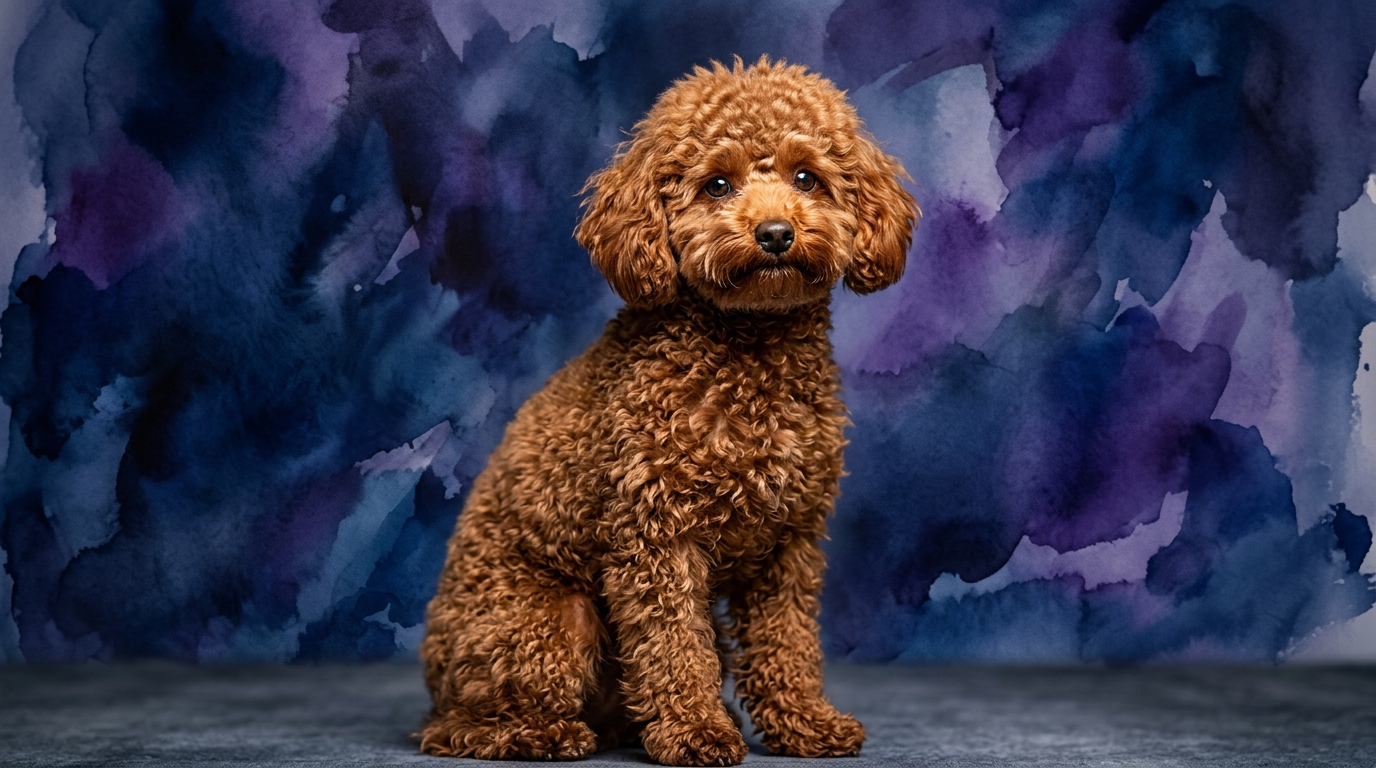
Side-by-Side IQ Profile: Standard vs. Toy Poodle
The Cosmic Pet Pet IQ Lab provides a granular view into the cognitive makeup of our canine companions, using a five-dimensional framework. Both the Standard Poodle and the Toy Poodle share an impressive Coren rank of #2, placing them among breeds with exceptional adaptive intelligence. However, a closer look at their individual scores unpacks the subtle yet significant differences within this shared high standing.
For the **Poodle (Standard)**, we observe: **Problem Solving 5/5**, indicating an outstanding capacity to independently navigate novel challenges and devise effective solutions. **Training Speed 5/5**, suggesting an extraordinary aptitude for quickly grasping and executing new commands. **Social Intelligence 5/5**, showcasing a profound ability to understand and respond to human emotions, body language, and complex social cues. **Instinctive Drive 4/5**, reflecting a strong, purposeful inclination towards specific tasks, often rooted in their ancestral working roles. Finally, **Memory 5/5**, demonstrating an exceptional ability to retain learned information and experiences over time.
The **Toy Poodle** presents a slightly different, yet equally impressive, profile: **Problem Solving 5/5**, matching its larger relative in analytical prowess and innovative thought. **Training Speed 5/5**, confirming its rapid learning capabilities are undiminished by its size. **Social Intelligence 3/5**, which, while respectable, suggests they might be less attuned to subtle human social cues than the Standard Poodle, potentially requiring more explicit communication. **Instinctive Drive 3/5**, indicating a moderate but less intense drive for task-oriented activities compared to the Standard Poodle. And mirroring its larger kin, **Memory 5/5**, underscoring an excellent capacity for recall and retention.
Where the Poodle (Standard) Excels Cognitively
The Standard Poodle's cognitive strengths truly shine in dimensions related to sophisticated interaction and purposeful engagement. Its perfect 5/5 in Social Intelligence sets it apart, indicating an unparalleled capacity to interpret complex human signals and emotional states. This isn't merely about obedience; it's about a deep, intuitive understanding of its human companions, making them exceptionally empathetic and responsive partners in intricate cooperative tasks, such as service work or advanced obedience routines where subtle cues are paramount.
Furthermore, the Standard Poodle's 4/5 in Instinctive Drive, a score higher than its Toy counterpart, points to a more pronounced internal motivation for engagement and work. This drive translates into a greater enthusiasm for sustained activity, whether it's navigating an agility course with focused determination, participating in scent work that taps into their innate abilities, or learning a series of complex tricks that require persistence. This higher drive means they often seek out opportunities for mental and physical exertion, thriving when given a 'job' that leverages their considerable intellect and physical stamina.
Shared Cognitive Strengths and Unique Adaptations of the Toy Poodle
While the Toy Poodle doesn't surpass its larger relative in any specific IQ dimension, its cognitive profile is noteworthy for its shared excellence across core intellectual domains. Achieving a 5/5 in Problem Solving, Training Speed, and Memory, the Toy Poodle demonstrates that its compact size does not diminish its capacity for complex thought, rapid learning, or information retention. This means a Toy Poodle is just as capable of figuring out puzzle toys, mastering new commands swiftly, and remembering them long-term as any Standard Poodle.
The Toy Poodle's slightly lower scores in Social Intelligence (3/5) and Instinctive Drive (3/5) are not deficits, but rather adaptations that cater to a different lifestyle. Their moderate social intelligence might mean they are less prone to being overly sensitive to every shift in human mood, offering a more straightforward and less demanding emotional connection for some owners. Similarly, a more moderate instinctive drive translates to less intense requirements for constant, high-energy mental and physical stimulation, making them excellent companions for those who appreciate their sharp wit without the demands of a high-octane working breed.
Which is Easier to Train and Why?
Both Poodle varieties boast an impressive 5/5 in Training Speed, suggesting an inherent ability to quickly grasp new commands and routines. This shared aptitude means that neither breed is inherently 'harder' to teach basic obedience or even moderately complex tricks. Where differences emerge is in the *depth* and *nuance* of training, influenced by their social intelligence and instinctive drive.
The Standard Poodle, with its 5/5 Social Intelligence, often appears to be 'easier' to train for advanced tasks because it is profoundly attuned to its trainer's subtle cues, intentions, and emotional states. This heightened sensitivity fosters a more seamless, almost telepathic partnership, allowing for complex, multi-step behaviors to be taught with greater fluidity. Their 4/5 Instinctive Drive also means they often possess a stronger intrinsic motivation to work and please, making them more persistent and eager participants in challenging, prolonged training sessions or competitive canine sports. They are more likely to seek out opportunities to engage their minds and bodies.
The Toy Poodle, while equally quick to learn (5/5 Training Speed), might require more explicit and consistent communication due to its 3/5 Social Intelligence. Trainers might need to be clearer with verbal cues and body language, as the Toy Poodle may not pick up on subtle nuances as readily. Their 3/5 Instinctive Drive means they might not possess the same tireless enthusiasm for repetitive or highly demanding training sequences as a Standard Poodle. While they will learn just as quickly, maintaining their engagement over long periods or through highly challenging tasks might require more varied reinforcement and shorter sessions to prevent boredom or disinterest. For general household manners and a wide array of tricks, both excel, but for competitive or professional-level work, the Standard Poodle's cognitive profile offers a distinct advantage in sustained, nuanced performance.
Which Suits Active Owners vs. Relaxed Owners?
The distinct cognitive profiles of the Standard and Toy Poodles make them suitable for different owner lifestyles, extending beyond mere physical size to their mental demands. Owners seeking a true canine partner for extensive activities and profound interaction will find the Standard Poodle an exceptional match. Its 5/5 Social Intelligence and 4/5 Instinctive Drive mean it thrives on consistent mental stimulation, complex problem-solving, and engaging in activities that require a deep, cooperative bond. These dogs excel in canine sports like agility, obedience trials, rally, or even scent work, and require owners who are prepared to meet their considerable need for purposeful engagement and exercise. An active owner who enjoys hiking, training, and involving their dog in daily life will find the Standard Poodle to be an endlessly rewarding and capable companion, eager for shared adventures and intellectual challenges.
Conversely, the Toy Poodle, with its identical Problem Solving, Training Speed, and Memory scores but more moderate Social Intelligence (3/5) and Instinctive Drive (3/5), is an ideal fit for more relaxed owners who still appreciate a sharp, trainable mind. While they certainly benefit from regular exercise and mental games, their demands for intense, sustained 'work' are typically lower than their larger relatives. They are content with engaging puzzle toys, learning new tricks, and enjoying walks, but may not require the same level of high-octane physical output or the constant, nuanced social interaction that a Standard Poodle craves. A relaxed owner who enjoys teaching their dog new things but prefers a more sedate pace, or who lives in a smaller space, will find the Toy Poodle to be a wonderfully intelligent and adaptable companion, offering all the mental sparkle without the high-drive intensity.
The Verdict
Choose the Standard Poodle if you seek an intensely interactive, highly empathetic companion for advanced training, canine sports, or a deeply engaged working partnership where profound social understanding and sustained drive are valued.
Opt for the Toy Poodle if you desire a brilliantly intelligent, easily trainable, and adaptable companion who excels in problem-solving and memory, but with a more moderate need for high-intensity physical and social engagement.
🧠 Find Your Pet's IQ Score
Our Pet IQ Lab assessment covers 25+ tests across 5 cognitive dimensions — personalized to your breed.
Take the Full IQ Test →Frequently Asked Questions
Do Standard Poodles and Toy Poodles have the same problem-solving abilities?
Yes, according to the Cosmic Pet Pet IQ Lab, both the Standard Poodle and the Toy Poodle achieve a perfect 5/5 in Problem Solving. This indicates that size does not impact their inherent capacity for analytical thought and independent solution-finding when faced with new challenges.
Are the training speeds of Standard and Toy Poodles identical?
Both Poodle varieties score 5/5 in Training Speed, meaning they both possess an exceptional ability to quickly grasp and learn new commands and routines. The difference in training experience often stems from their social intelligence and instinctive drive, which affect engagement and nuance, rather than the speed of initial learning.
How does social intelligence differ between Standard and Toy Poodles?
The Standard Poodle scores 5/5 in Social Intelligence, demonstrating an exceptional ability to interpret human cues and emotions, fostering a deep, intuitive bond. The Toy Poodle scores 3/5, indicating a respectable but less intense attunement to subtle social signals, which might mean they require more explicit communication from their owners.