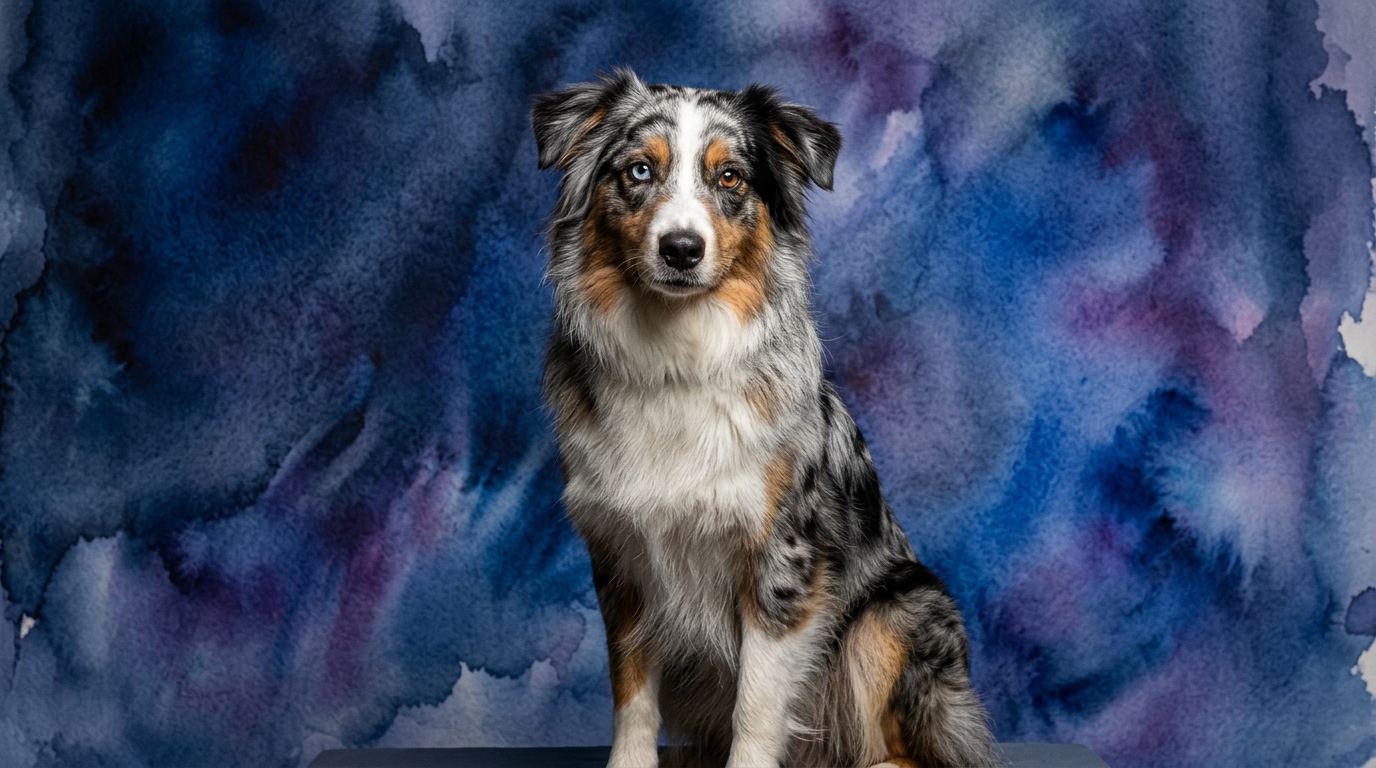

Side-by-Side IQ Profile: Australian Shepherd vs. Weimaraner
The Cosmic Pet Pet IQ Lab provides a granular look into canine cognition across five crucial dimensions, offering a detailed comparison of these two active breeds.
For the **Australian Shepherd (Herding)**, the profile is: **Problem Solving (5/5)**, **Training Speed (5/5)**, **Social Intelligence (4/5)**, **Instinctive Drive (5/5)**, **Memory (5/5)**. This breed excels at navigating complex scenarios, devising independent solutions, and strategizing to overcome obstacles, reflecting demanding herding work. They grasp new commands and routines with remarkable rapidity, often requiring minimal repetitions for solidifying behaviors due to their inherent eagerness. While perceptive to human moods and capable of forming strong bonds, their social cognition primarily supports a working partnership and understanding cues. They possess a profoundly strong innate drive to herd, chase, and control, manifesting as a tireless work ethic and deep desire for purpose-driven activity. Furthermore, they demonstrate exceptional recall for learned behaviors, routes, and past interactions, allowing retention of vast command repertoires and adaptation based on experience.
The **Weimaraner (Sporting)**, with a Coren ranking of #21, presents with: **Problem Solving (4/5)**, **Training Speed (4/5)**, **Social Intelligence (4/5)**, **Instinctive Drive (5/5)**, **Memory (4/5)**. This breed shows solid problem-solving, especially for hunting and retrieving tasks, strategizing to locate game or objects, though with a more focused approach than abstract ingenuity. They learn new tasks competently and quickly, absorbing instructions well, with focus and a desire to please aiding efficient learning, though consistent reinforcement helps. Weimaraners are highly attuned to human companions, often called 'Velcro dogs,' thriving on close partnership and reading emotional cues well due to their intense desire for proximity. They feature a deep-seated prey drive to hunt, point, and retrieve, fueling boundless energy and intense field focus, making them relentless in pursuit. They possess good memory for commands, routines, and familiar territories, a robust recall but perhaps not matching the expansive, task-oriented recall of top herding breeds.
Where the Australian Shepherd Wins Cognitively
The Australian Shepherd's cognitive advantage is most evident in its unparalleled capacity for adaptive problem-solving and rapid acquisition of complex, multi-step sequences. Their perfect 5/5 ratings in Problem Solving and Training Speed reflect an ability to analyze dynamic situations—like a flock of livestock scattering—and independently adjust strategy, often appearing to 'think ahead.' This breed doesn't just execute commands; it frequently anticipates the next step or finds novel solutions when presented with an obstacle, demonstrating a flexible intellect. Coupled with their 5/5 Memory, Aussies build extensive mental maps of strategies and retain intricate command chains over long periods, making them exceptional candidates for advanced obedience, agility, and search and rescue work where nuanced recall is critical. This combination allows them to master diverse tasks and apply past lessons to new challenges with remarkable efficiency.
Where the Weimaraner Wins Cognitively
The Weimaraner, while cognitively capable across the board, truly distinguishes itself through its singular, focused instinctive drive coupled with a profound social attunement in a working context. While both breeds score 5/5 on Instinctive Drive, the Weimaraner's drive is exquisitely channeled towards specific hunting and retrieving tasks, leading to an unwavering, persistent focus in the field. This isn't merely high energy; it's a dedicated cognitive engagement with a specific purpose. Their 4/5 Social Intelligence, though numerically equal to the Aussie's, manifests as an intense desire for collaboration and sensitivity to their handler's subtle cues during a hunt. This 'Velcro dog' quality means they are profoundly motivated by partnership, making them exceptionally responsive to direction when engaged in activities that align with their deep-seated instincts. Their cognitive strength lies in their ability to maintain intense, single-minded focus on a task, driven by an instinct to work *with* their human, translating to a very biddable and connected partner in their chosen field.
Which is Easier to Train and Why
Based on The Cosmic Pet Pet IQ Lab profiles, the Australian Shepherd generally presents as the easier breed to train, primarily due to its perfect 5/5 in Training Speed. This high rating indicates Aussies absorb new information and associate actions with commands almost instantly, often requiring very few repetitions before a behavior is solidified. Their natural inclination to work and their eagerness to please, combined with their exceptional Problem Solving and Memory scores, mean they don't just learn *what* to do, but often *why* it's relevant, allowing for quicker generalization of skills across varied scenarios.
The Weimaraner, with a robust 4/5 in Training Speed, is by no means difficult to train but may require slightly more consistency and patience to achieve the same level of mastery. Their strong instinctive drive (5/5) can be a double-edged sword; while it fuels their work ethic, it can also lead to distractions if not properly channeled or if their prey drive is engaged. Weimaraners are deeply bonded to their owners, and this social intelligence can be leveraged powerfully in training, but their focus might be more susceptible to environmental stimuli. An Aussie's cognitive flexibility allows them to adapt to a wider range of training methodologies and tasks with less perceived effort, making them perhaps more forgiving for a novice trainer.
Which Suits Active Owners vs. Relaxed Owners
Both the Australian Shepherd and the Weimaraner are breeds built for activity, making them unsuitable for truly 'relaxed' owners in the traditional sense of a sedentary companion. However, their activity needs manifest differently. The Australian Shepherd, with its 5/5 Instinctive Drive rooted in herding, thrives on mental and physical challenges that mimic its original purpose. This means not just long walks, but activities requiring strategy, problem-solving, and a sense of 'job.' Active owners who enjoy dog sports like agility, flyball, obedience, or trick training will find an Aussie to be an incredibly engaging and tireless partner. They need a purpose, and without it, their high cognitive and physical energy can lead to destructive behaviors or excessive 'self-employment' – often devising their own (unwanted) tasks.
The Weimaraner, also boasting a 5/5 Instinctive Drive, is a powerful sporting dog requiring extensive physical output. Their needs lean towards endurance and intense bursts of activity, such as long runs, hikes, or field work. They require owners who can provide consistent, vigorous exercise daily, often multiple times a day. While they appreciate mental engagement, their primary outlet is physical exertion, often in the company of their human. A 'relaxed' owner for a Weimaraner might be one who enjoys long, daily runs or extensive outdoor adventures, but not one who prefers quiet evenings without significant prior exercise. For both breeds, ignoring their profound instinctive drives will lead to frustration for dog and owner alike.
The Verdict
Opt for an Australian Shepherd if you are an experienced, active owner eager for a highly biddable, quick-witted partner adept at complex learning, problem-solving, and engaging in diverse dog sports or work that demands strategic thinking.
Select a Weimaraner if you seek an intensely loyal, physically robust companion for extensive outdoor adventures, field work, or long-distance running, and are prepared to provide consistent, vigorous exercise alongside close companionship.
🧠 Find Your Pet's IQ Score
Our Pet IQ Lab assessment covers 25+ tests across 5 cognitive dimensions — personalized to your breed.
Take the Full IQ Test →Frequently Asked Questions
Are Australian Shepherds good family dogs?
Australian Shepherds can be excellent family dogs, particularly with active families who understand their need for mental and physical engagement. Their social intelligence allows them to bond well, but their herding instincts mean they might try to 'herd' children, requiring supervision and training to manage.
Do Weimaraners have separation anxiety?
Weimaraners are known for their deep attachment to their owners, often leading to separation anxiety if left alone for extended periods without proper training and sufficient exercise. Their high social intelligence and desire for companionship make them thrive when integrated into family life.
Which breed is better for apartment living?
Neither breed is ideally suited for apartment living due to their high energy levels and profound instinctive drives. While an Australian Shepherd might adapt if given extensive daily exercise and mental stimulation, a Weimaraner's need for space and intense physical exertion makes apartment life particularly challenging for their well-being.
How much exercise do these breeds need daily?
Both breeds require significant daily exercise, often 1-2 hours of vigorous activity. For the Australian Shepherd, this should include mentally stimulating tasks; for the Weimaraner, it often means high-intensity physical exertion like running or field work to satisfy their sporting instincts.
Do Australian Shepherds bark a lot?
Australian Shepherds can be prone to barking, especially if their herding instincts aren't channeled or if they are bored or under-stimulated. They use their voice to communicate and alert, so early training is crucial to manage this behavior effectively.