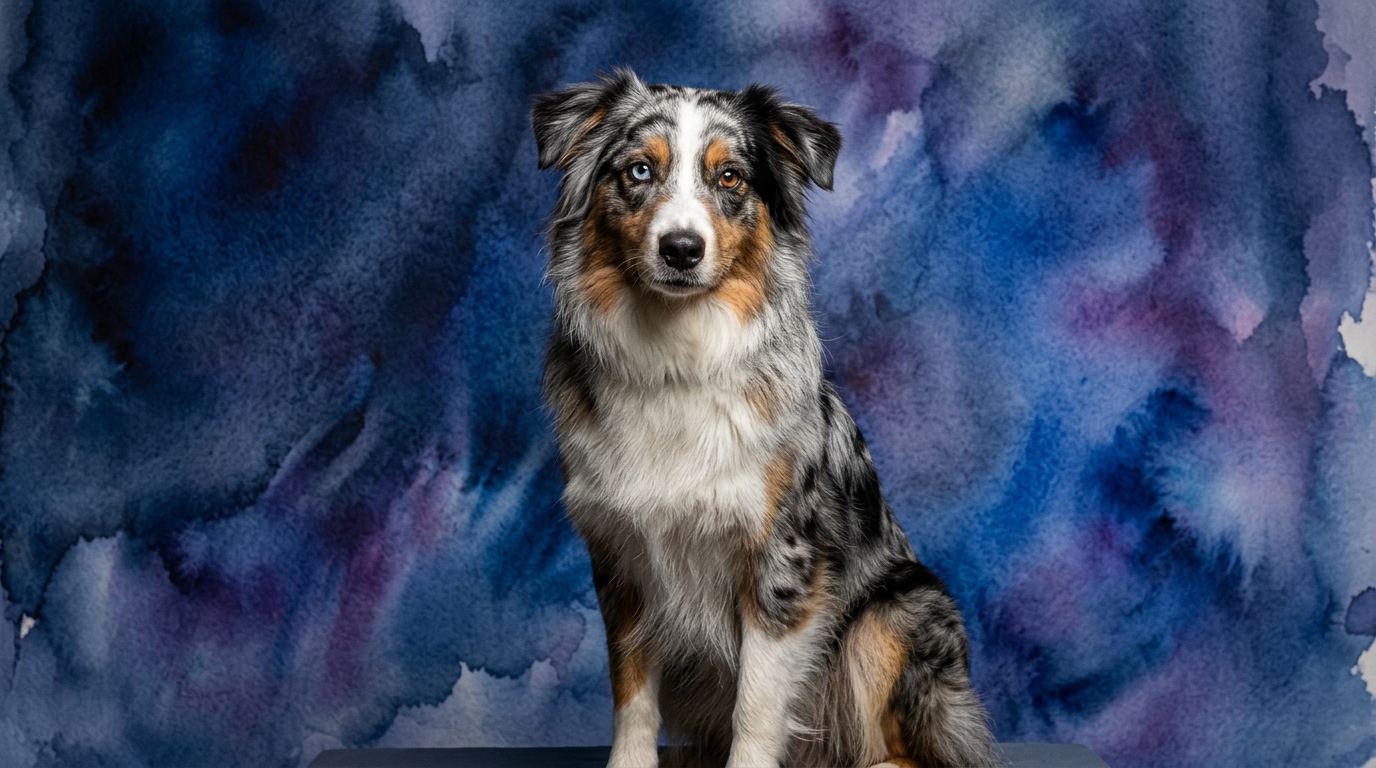
Australian Shepherd at a glance
| IQ Rank / Score | 24/25 |
|---|---|
| Trainability | ★★★★★ (5/5) |
| Social Intelligence | ★★★★☆ (4/5) |
| Lifespan | 11-14 years |
| Shedding | Low to moderate |
| Exercise Needs | High (60+ min/day + training) |
| Origin | United States (Basque origins) |
The Unconventional Genius of the Australian Shepherd
When we assess canine cognition, it's easy to focus on how quickly a dog learns commands or retrieves objects. However, the Australian Shepherd offers a fascinating twist: their brilliance lies not just in executing tasks, but in inventing novel solutions. These medium-sized herding dogs, originating from the United States, don't just follow patterns; they dynamically adapt and often improvise in complex, changing environments.
This capacity for creative problem-solving is their signature cognitive trait, allowing them to assess situations, generate new strategies on the fly, and even anticipate potential outcomes. Imagine a herding dog confronting an unexpected obstable or a particularly stubborn sheep – an Aussie might not just try harder with a known method, but rather devise an entirely new approach to move the flock. This isn't just clever; it's genuinely inventive.
Their approach to challenges is less about rote memorization and more about critical thinking and ingenuity. This makes them captivating to observe and uniquely rewarding to train, as they often surprise their human partners with their ingenious antics. It’s a testament to a breed whose cognitive design prioritizes dynamic thought over mere repetition.
A History of Innovation: The Aussie's True Roots
The Australian Shepherd's narrative is often intertwined with their name, leading many to assume an antipodean origin. However, despite the name, Australian Shepherds were developed in California by Basque shepherds. These European herders brought their traditional herding dogs to the American West, seeking new opportunities.
The 'Australian' link comes specifically from the Merle-coated sheep they managed. These distinctive sheep were imported to California from Australia, and as the Basque dogs became associated with herding these particular flocks, the 'Australian' moniker began to stick to the dogs themselves. This fascinating lineage reveals a breed forged in the crucible of diverse working environments, requiring adaptability and keen intelligence from its earliest days.
Beyond the Farm: Adapting Aussie Brilliance to Any Home
A common misconception about Australian Shepherds is the belief that they inherently need a ranch or farm to be truly happy and functional. This myth often deters potential owners who live in urban or suburban settings, unfairly pigeonholing a versatile and adaptable breed. While their herding instinct is undeniable, it's the *application* of their intelligence, not the landscape, that truly defines their well-being.
The truth is, an Australian Shepherd thrives on mental engagement and purposeful activity, which can be provided in myriad ways beyond traditional herding tasks. Their creative problem-solving brain means they excel in dog sports like agility, obedience, flyball, and even canine freestyle. Engaging puzzles, structured training sessions, and consistent enrichment activities are far more crucial than acreage for their contentment.
Owners who understand this distinction often find their Aussies to be exceptional companions in various home environments, as long as their cognitive needs are met. Regular walks are good, but mental stimulation – challenging their minds with new tasks, scent work, or complex training sequences – is paramount to harnessing their innate brilliance and preventing boredom-related behaviors.
Diving Deeper: The Australian Shepherd's Cognitive Blueprint
To truly appreciate the Australian Shepherd's mental makeup, let's examine their specific intelligence profile. In problem-solving, they score a top-tier 5/5, reflecting their inventive and adaptable approach to challenges. This isn't just about figuring out how to get a treat, but about devising entirely new strategies when old ones fail.
Their training speed also ranks at an an impressive 5/5, indicating their rapid ability to grasp new concepts and commands, often anticipating their handler's next move. Social intelligence, at 4/5, showcases their strong connection with their human families and their ability to read cues, though they might be slightly more reserved with strangers than some other breeds. Instinctive drive, another 5/5, fuels their relentless work ethic and focus, whether on a flock or a task. Finally, their memory, a perfect 5/5, allows them to retain complex sequences and past experiences, building on learned knowledge to refine their problem-solving skills over time.
3 At-Home Tests to Measure Your Australian Shepherd's IQ
These tests are adapted from peer-reviewed ethology research. No equipment is needed beyond items you have at home. Run each test 5–10 times for reliable results.
The Myth: "Australian Shepherds need a ranch or farm to be happy and functional"
✅ While Australian Shepherds possess strong herding instincts and thrive on purpose, their cognitive needs prioritize mental engagement over sheer acreage. These creative problem-solvers flourish with consistent training, interactive dog sports, complex puzzle toys, and plenty of structured mental challenges, which can all be provided successfully in suburban or even urban settings. Their happiness is contingent on having a 'job' for their brain, not necessarily a sprawling pasture.
Australian Shepherd vs. Similar Breeds
🧠 What's Your Dog's IQ Score?
Our full Pet IQ Lab assessment includes 12+ tests across 5 cognitive dimensions, calibrated for Australian Shepherds specifically.
Take the Full IQ Test →Frequently Asked Questions
How smart is a Australian Shepherd?
Our Pet IQ Lab framework scores cognition across five dimensions (max 25). The Australian Shepherd totals 24/25 — exceptionally high for a domestic dog. The full article breaks down each dimension with at-home tests.
Are Australian Shepherds easy to train?
Australian Shepherds learn new cues very quickly — often in 5-15 repetitions. They score 5/5 on Training Speed in our breed profile.
Are Australian Shepherds good with children and other pets?
Yes — their Social Intelligence rates 4/5 in our Pet IQ Lab framework. With early socialization and supervised play, most Australian Shepherds integrate well into families with respectful children and other pets.
Do Australian Shepherds need a lot of mental stimulation?
Absolutely. With Problem Solving 5/5 and Instinctive Drive 5/5, Australian Shepherds need daily mental work — puzzle feeders, scent games, training sessions, or nose-work — to avoid boredom.
How much exercise does a Australian Shepherd need?
Australian Shepherds need active engagement. Plan for 45-60 minutes of exercise and training per day, plus mental stimulation.
How good is a Australian Shepherd's memory?
Australian Shepherds score 5/5 on memory. They remember routines, hiding spots, and learned cues for months, sometimes years.
What is the typical lifespan of a Australian Shepherd?
Expect a lifespan of 11-14 years for a healthy Australian Shepherd.
The Australian Shepherd invites us to redefine what we mean by 'smart dog,' highlighting ingenuity and adaptability over mere rote learning. By understanding their unique cognitive blueprint, owners can unlock the full potential of these remarkable companions, fostering a partnership built on challenge, discovery, and mutual respect for a truly inventive mind.