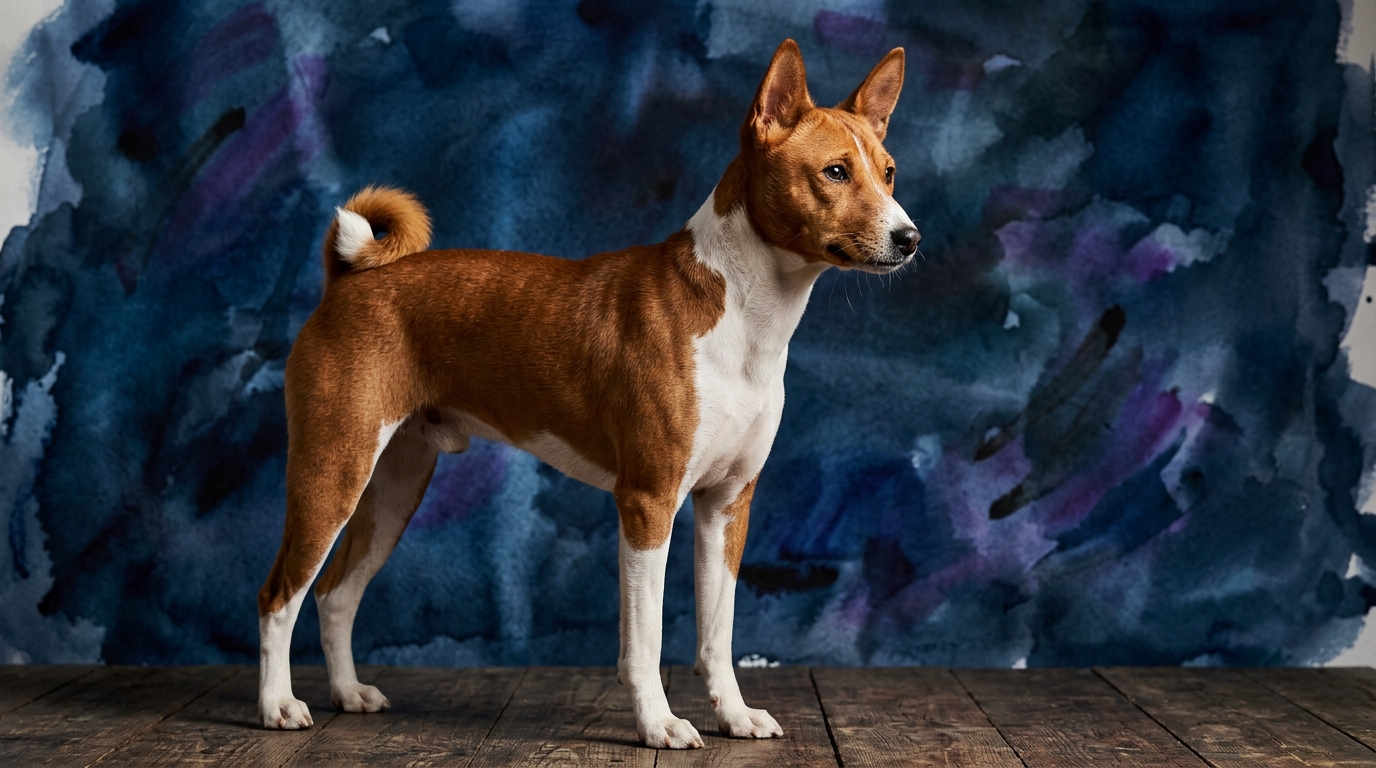

Side-by-Side IQ Profile: Basenji vs. Dandie Dinmont Terrier
At The Cosmic Pet Pet IQ Lab, we evaluate canine intelligence across five key dimensions. The Basenji, a hound breed not ranked by Coren but with specific cognitive scores, presents a unique intellectual blueprint. They excel in Problem Solving (5/5), demonstrating exceptional ingenuity in navigating their environment and overcoming obstacles, often devising clever ways to achieve their goals, sometimes to their owner's chagrin. Their Training Speed is a challenging 1/5, indicating that their independent nature means they require significant patience and creativity in training, often choosing to cooperate only if it aligns with their own interests. Social Intelligence stands at 3/5, as Basenjis form strong bonds with their primary caregivers but can be reserved with strangers and other dogs, preferring a more selective social circle. Their Instinctive Drive is a powerful 5/5, meaning their prey drive and keen senses are deeply ingrained, making them highly attuned to environmental stimuli and prone to chasing. Finally, their Memory is strong at 4/5, recalling past experiences and learned behaviors, which contributes to their problem-solving prowess and sometimes their ability to outwit owners.
The Dandie Dinmont Terrier, a terrier breed not Coren-ranked, offers a more consistent cognitive spread. In Problem Solving, they score 3/5, demonstrating a moderate capacity, able to learn routines and tackle straightforward challenges with persistence. Their Training Speed is also 3/5, suggesting they are receptive to learning when motivated, responding well to consistent, positive reinforcement methods. Social Intelligence is rated at 3/5; Dandies are generally amiable and sociable, enjoying interaction with their families and often tolerating strangers and other pets with appropriate introductions. Their Instinctive Drive is 3/5, meaning while possessing a terrier's typical pluckiness, their drive, particularly for hunting, is present but often less intense than some other terrier breeds, making it more manageable. Their Memory is a solid 3/5 for commands and experiences, allowing them to build on learned behaviors and recognize familiar faces and places.
Where the Basenji Wins Cognitively
The Basenji's cognitive strengths primarily lie in their exceptional problem-solving abilities and powerful instinctive drive. With a 5/5 in problem-solving, they are masters of independent thought, often finding creative, sometimes mischievous, solutions to reach desired objects or escape enclosures. This manifests as a dog that can unlock gates, open cupboards, or scale fences, driven by a deep-seated curiosity and self-reliance. Their 5/5 instinctive drive further fuels this, making them incredibly focused when a scent or moving object captures their attention, demonstrating remarkable persistence in pursuit. This combination means a Basenji excels at tasks requiring individual initiative and strategic planning rather than rote obedience, often outthinking their human companions in complex scenarios. Their 4/5 memory supports this by allowing them to recall successful past strategies and apply them to new situations, making them formidable intellectual adversaries for an unprepared owner.
Where the Dandie Dinmont Terrier Wins Cognitively
The Dandie Dinmont Terrier, while not possessing the Basenji's extreme scores in problem-solving or instinctive drive, offers a more balanced and often more agreeable cognitive profile. Their 3/5 scores across problem-solving, training speed, social intelligence, instinctive drive, and memory indicate a dog that is consistently capable without being overly challenging in any one domain. Where they win is in their blend of moderate trainability and social adaptability. Unlike the Basenji's singular focus on self-interest during training, Dandies are generally more willing to engage in cooperative learning (Training Speed 3/5), making them more approachable for a wider range of owners seeking a responsive companion. Their 3/5 social intelligence also means they are typically more open to new people and situations, fostering easier integration into diverse household dynamics. This balanced cognitive makeup means Dandies are less prone to the extreme independence or single-mindedness that can characterize Basenjis, leading to a more harmonious and predictable daily life.
Which is Easier to Train and Why
When it comes to ease of training, the Dandie Dinmont Terrier holds a distinct advantage over the Basenji. The Dandie's training speed is rated at 3/5, indicating a moderate willingness to learn and respond to cues, especially with consistent positive reinforcement. They typically enjoy the interaction of training sessions and are motivated by praise and treats, making the process generally rewarding for both dog and owner. Their instinctive drive, at 3/5, is present but often more manageable than that of many terriers, meaning they can be redirected more readily from distractions. In stark contrast, the Basenji's training speed is a challenging 1/5. This isn't due to a lack of understanding, but rather a profound independence and a strong selective hearing tendency. Basenjis often weigh whether a command is in their own best interest before complying, making traditional obedience a continuous negotiation. Their powerful 5/5 instinctive drive means they are easily distracted by intriguing scents or movement, often choosing to follow their nose rather than their owner's voice, making off-leash reliability particularly difficult. Therefore, for an owner seeking a dog that responds reliably and learns standard commands with relative ease, the Dandie Dinmont Terrier is the far more straightforward choice.
Which Suits Active Owners vs. Relaxed Owners
The choice between a Basenji and a Dandie Dinmont Terrier significantly depends on an owner's lifestyle and energy levels. Active owners who enjoy engaging in challenging training, exploring varied environments, and providing ample mental stimulation might find the Basenji a fascinating match. Their high problem-solving capacity (5/5) and strong instinctive drive (5/5) mean they thrive on activities like scent work, agility, or advanced puzzle toys that tap into their independent intellect and boundless curiosity. These dogs require consistent physical outlets and robust mental engagement to prevent boredom and potential destructive behaviors. Conversely, more relaxed owners, or those seeking a companion for a quieter home life, would likely find the Dandie Dinmont Terrier a better fit. While they certainly appreciate walks and playtime, their moderate instinctive drive (3/5) and more balanced energy levels mean they are typically content with regular, but not extreme, exercise. Their social intelligence (3/5) allows them to adapt well to various household routines, and their moderate problem-solving (3/5) means they aren't constantly seeking to outwit their environment. They are happy to curl up on the couch after a good walk, making them suitable for owners who prefer a more placid yet still engaging canine presence.
The Verdict
When contemplating a Basenji, prepare for a canine partner demanding intellectual engagement and a patient, creative approach to training. Choose a Basenji if you thrive on the challenge of a highly independent, problem-solving companion who will keep you on your toes with their cleverness and strong instincts.
Opt for a Dandie Dinmont Terrier if you desire a more cooperative, generally amiable companion with a balanced cognitive profile, offering a good blend of trainability and social ease for a harmonious home life.
🧠 Find Your Pet's IQ Score
Our Pet IQ Lab assessment covers 25+ tests across 5 cognitive dimensions — personalized to your breed.
Take the Full IQ Test →Frequently Asked Questions
Are Basenjis difficult to live with due to their independence?
Basenjis can be challenging due to their high problem-solving skills and strong independence, often finding ways to outsmart conventional barriers. They require consistent, creative training and secure environments to prevent them from exploring beyond boundaries.
Do Dandie Dinmont Terriers get along with children and other pets?
Dandie Dinmont Terriers generally have moderate social intelligence and can get along well with children and other pets, especially with proper socialization from a young age. Their balanced temperament makes them adaptable family companions.
What kind of mental stimulation do Basenjis need?
Basenjis, with their 5/5 problem-solving and 5/5 instinctive drive, thrive on mental stimulation that challenges their intellect and instincts. This includes advanced puzzle toys, scent work, trick training, and opportunities to explore safely in varied environments.