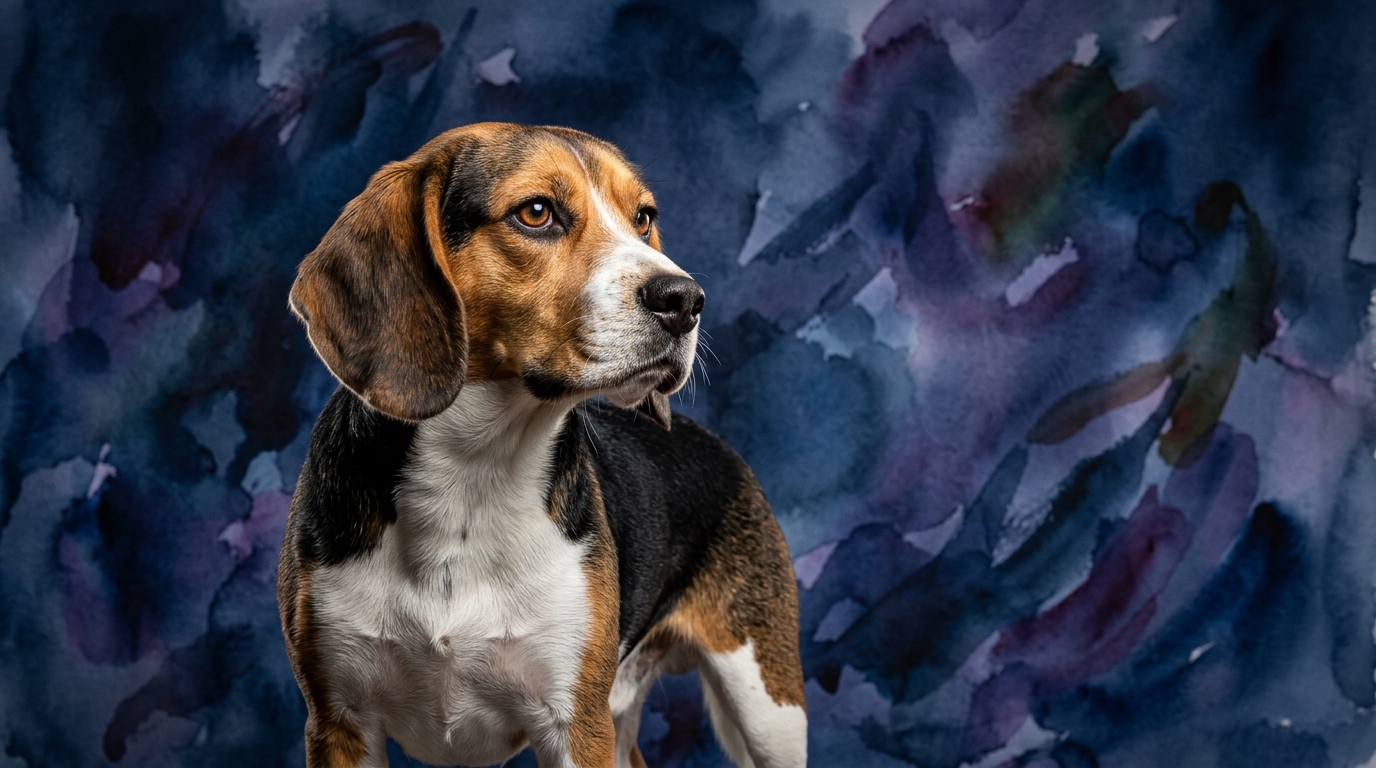

The Cognitive Blueprint: Beagle vs. Bloodhound IQ Profile
The Cosmic Pet Pet IQ Lab's profiling offers a granular look into the mental landscapes of these scent hounds, revealing that intelligence is not a monolithic trait but a tapestry of distinct capabilities. The Beagle, often ranked at Coren #72, presents a balanced cognitive profile, adept in several areas, making it a versatile companion. Its problem-solving capacity registers at 4/5, indicating a strong ability to navigate everyday challenges and learn from experiences, while its training speed, at 2/5, suggests a moderate receptiveness to command assimilation.
Social intelligence for the Beagle stands at 3/5, reflecting an engaging and adaptable nature in various social settings, and its memory, rated 4/5, allows for good retention of learned behaviors and environmental cues. Unsurprisingly, its instinctive drive, a hallmark of the breed, is a perfect 5/5, cementing its dedication to scent work.
In contrast, the Bloodhound, with a Coren rank of #74, displays a more specialized cognitive architecture, prioritizing traits crucial for its unparalleled tracking abilities. Its problem-solving prowess is exceptional at 5/5, indicating a mind capable of dissecting complex scent puzzles and navigating intricate environments with incredible focus. However, its training speed is notably lower at 1/5, highlighting a profound independence and a tendency to prioritize its inherent drive over human directives.
The Bloodhound’s social intelligence is rated 2/5, suggesting a more singular focus on its primary task rather than on broad human interaction, and its memory is a perfect 5/5, vital for retaining extensive scent maps and tracking patterns over vast distances and time. Like the Beagle, its instinctive drive is a commanding 5/5, underscoring its relentless pursuit of a trail. This side-by-side view reveals that while their overall Coren ranks are close, the allocation of their cognitive strengths diverges significantly. The Beagle demonstrates a broader, more generalized intelligence suitable for diverse domestic roles, whereas the Bloodhound exemplifies a highly specialized form of intelligence, optimized for an extraordinary singular purpose. Understanding these nuances moves beyond simple rankings to appreciate the distinct mental gifts each breed brings.
Where the Beagle's Mind Shines
The Beagle's cognitive strengths make it a compelling choice for many households, particularly due to its higher social intelligence and more amenable training speed. With a social intelligence score of 3/5, Beagles typically exhibit a greater inclination towards engaging with their human families and adapting to varied social situations compared to the Bloodhound's 2/5. This means a Beagle is often more attuned to human emotions and cues, making them more integrated members of a family dynamic, eager to participate in shared activities and less singularly focused on an independent task. Their capacity to read and respond to human intentions facilitates smoother interactions in a bustling home environment or during outings.
Furthermore, the Beagle's training speed of 2/5, while not the fastest among all breeds, is a distinct advantage over the Bloodhound's 1/5. This faster processing of commands translates into a dog that generally learns basic obedience and household rules with greater efficiency and fewer repetitions. While still possessing a formidable instinctive drive, the Beagle can more readily be redirected from a scent trail with consistent training, making them more manageable in everyday situations. Their problem-solving score of 4/5 also allows them to figure out common domestic challenges, like opening latches or navigating new environments, often with a playful curiosity that is easily channeled into positive reinforcement training. This combination of social awareness and moderate trainability allows Beagles to integrate into diverse family lifestyles with relative ease, offering a robust blend of companionship and engagement.
The Bloodhound's Unrivaled Cognitive Prowess
The Bloodhound's cognitive profile reveals a mind unparalleled in specific domains, particularly its problem-solving and memory, both rated a perfect 5/5, in conjunction with its supreme instinctive drive. This breed’s problem-solving isn't about domestic mischief; it's about the intricate, multi-layered puzzle of a scent trail. A Bloodhound can analyze incredibly subtle olfactory cues, differentiate between countless individual scents, and reconstruct a path over hours or even days, navigating complex terrain and environmental distractions that would baffle any other canine. This sustained, analytical focus on a singular, demanding task showcases a form of intelligence that is both profound and breathtakingly specific, far exceeding the Beagle's 4/5 problem-solving in this context.
Complementing this exceptional problem-solving is the Bloodhound's perfect 5/5 memory. For a breed whose purpose is to follow a trail that might be hours or days old, remembering the subtle shifts in scent, the terrain covered, and the last known direction is critical. This long-term olfactory memory allows them to retain vast "maps" of scent information, connecting past experiences with current stimuli to continue a pursuit relentlessly. This superior memory, combined with its unwavering 5/5 instinctive drive, makes the Bloodhound the undisputed champion of scent work, capable of feats of detection that are truly awe-inspiring. While their social intelligence (2/5) is lower and training speed (1/5) slower, these traits are secondary to their primary cognitive strengths, which are optimized for an almost singular, highly specialized purpose.
Training Dynamics: A Tale of Two Hounds
When it comes to training, the Beagle and the Bloodhound present markedly different experiences, largely due to their disparate training speed and social intelligence scores. The Beagle, with a training speed of 2/5, generally proves more amenable to conventional obedience training methods. While still possessing a powerful instinctive drive (5/5) that can lead its nose astray, Beagles tend to process commands and associate them with rewards more quickly than Bloodhounds. Their slightly higher social intelligence (3/5) means they are often more inclined to work *with* their human, seeking approval and enjoying the interaction involved in training sessions. This makes them more responsive to positive reinforcement and allows for a more straightforward path to mastering basic commands and house manners, provided their scent drive is managed appropriately.
The Bloodhound, however, presents a significant training challenge, underscored by its 1/5 training speed and lower social intelligence (2/5). This breed is inherently independent, driven almost exclusively by its unparalleled scenting ability (5/5 instinctive drive). When a Bloodhound is on a trail, its world shrinks to that scent, and human commands often become secondary or entirely ignored. Their problem-solving (5/5) and memory (5/5) are geared towards the intricate puzzle of tracking, not necessarily towards pleasing a handler. Training a Bloodhound requires immense patience, consistency, and a deep understanding of their unique motivations. Conventional obedience can be a slow, arduous process, often requiring specialized techniques that leverage their scent drive rather than fighting it. They are not "unintelligent," but their intelligence is channeled differently, making them less inclined to quickly comply with directives that don't align with their primary instinct.
Lifestyle Match: Adaptable Companion vs. Dedicated Pursuit Partner
Choosing between a Beagle and a Bloodhound also means aligning with distinct lifestyle requirements, largely dictated by their cognitive profiles and inherent drives. The Beagle, with its balanced intelligence, including a 4/5 problem-solving and 3/5 social intelligence, makes an excellent companion for active owners seeking an engaging, adaptable dog. Beagles thrive in environments where they can be part of family activities, enjoy varied forms of mental stimulation like puzzle toys or scent games, and receive consistent physical exercise. Their robust instinctive drive (5/5) means they need outlets for their nose, but their slightly faster training speed (2/5) allows owners to more easily incorporate this into structured activities like agility, obedience, or recreational scent work. They are generally more flexible in their daily routine, making them suitable for owners who enjoy a dynamic yet integrated pet experience.
Conversely, the Bloodhound is best suited for dedicated owners who are prepared to channel its extraordinary, specialized cognitive abilities into focused pursuits. While not necessarily requiring constant "running" exercise in the same way some high-energy breeds do, a Bloodhound absolutely demands immense mental stimulation related to its 5/5 instinctive drive, 5/5 problem-solving, and 5/5 memory. Owners must be prepared to engage in regular, prolonged scent work, tracking, or search and rescue training to satisfy their innate drive. A "relaxed" owner who cannot provide this specialized outlet will find themselves with a frustrated, potentially destructive dog. Bloodhounds are for individuals who appreciate a dog with an almost singular, intense focus and are committed to nurturing that specific genius, understanding that their low social intelligence (2/5) and slow training speed (1/5) mean they are not primarily motivated by human pleasing but by the profound satisfaction of following a scent.
The Verdict
Choose a Beagle if you seek an engaging, adaptable family companion that integrates well into varied social settings and responds reasonably to training, offering a versatile blend of companionship and activity.
Opt for a Bloodhound if you are a dedicated individual passionate about scent work or tracking, prepared to immerse yourself in fulfilling their profound, specialized cognitive needs for problem-solving and memory in pursuit of a trail.
🧠 Find Your Pet's IQ Score
Our Pet IQ Lab assessment covers 25+ tests across 5 cognitive dimensions — personalized to your breed.
Take the Full IQ Test →Frequently Asked Questions
Are Bloodhounds truly harder to train than Beagles?
Yes, based on their IQ profile, Bloodhounds (training speed 1/5) are generally more challenging to train than Beagles (training speed 2/5). This is due to the Bloodhound's profound independence and intense focus on scent, often making them less responsive to human commands when on a trail.
Which breed is better for a first-time dog owner?
The Beagle is generally a more suitable choice for a first-time dog owner due to its higher social intelligence (3/5) and faster training speed (2/5). Bloodhounds require a very experienced owner who understands their specialized needs and independent nature.
Do both breeds need a lot of exercise?
Both breeds have a high instinctive drive (5/5) and require significant mental and physical engagement. Beagles need consistent exercise and varied mental stimulation, while Bloodhounds demand prolonged, focused scent work or tracking activities to satisfy their specialized cognitive and instinctive needs.