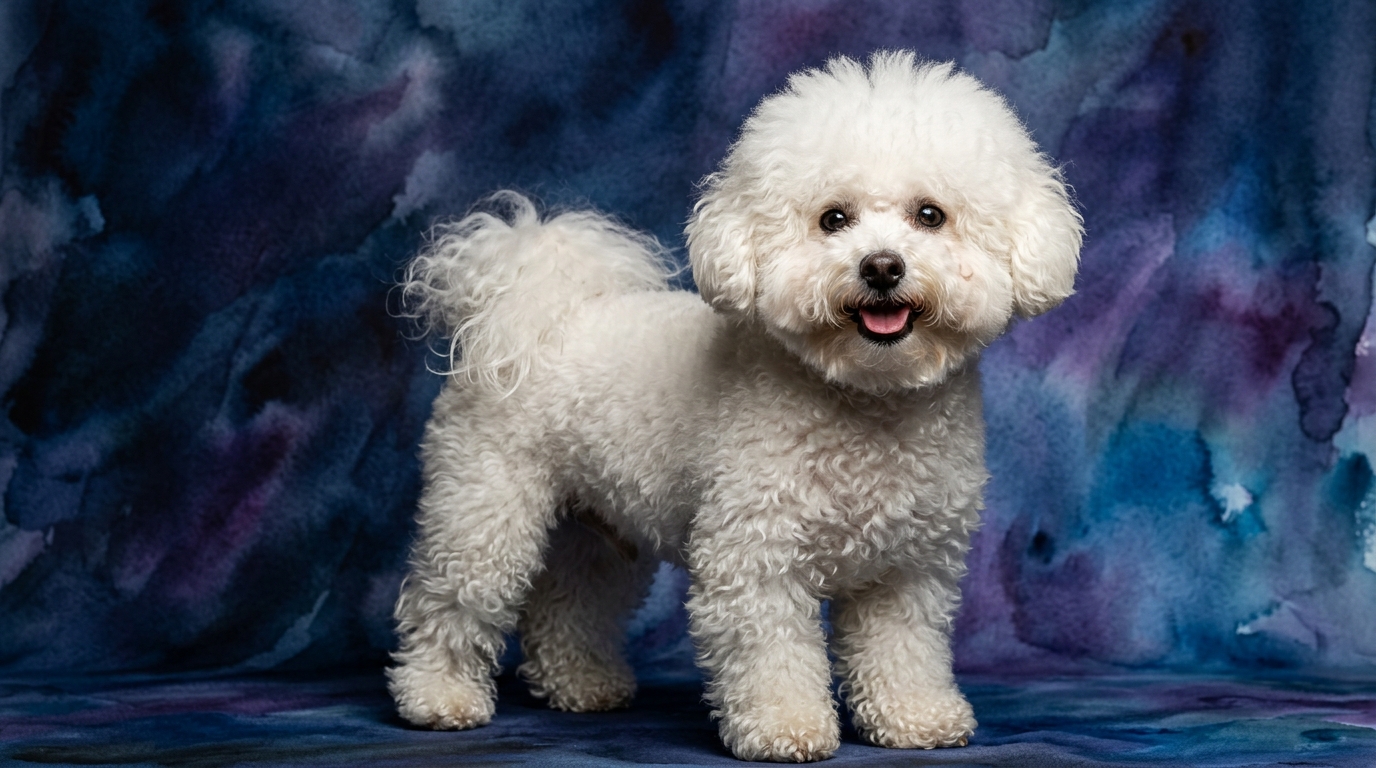

Side-by-Side IQ Profile: Bichon Frisé vs. Russian Toy
The Cosmic Pet Pet IQ Lab assesses canine intelligence across five critical dimensions: Problem Solving, Training Speed, Social Intelligence, Instinctive Drive, and Memory. While both the Bichon Frisé and the Russian Toy are cherished companion breeds, a closer look at their cognitive profiles reveals intriguing differences that influence their behavior and trainability. Understanding these specific scores helps paint a clearer picture of what to expect from each breed.
For the Bichon Frisé, a Non-Sporting breed with a Coren ranking of #45, their cognitive profile is as follows:
Problem Solving (3/5): This score indicates a moderate capacity for navigating challenges. A Bichon can typically figure out how to retrieve a toy stuck under furniture or solve a basic puzzle feeder, but they aren't predisposed to complex strategic thinking. Their approach to problems is often straightforward, and they may rely on human assistance for more intricate dilemmas.
Training Speed (3/5): Learning new commands and routines occurs at an average pace for the Bichon Frisé. They respond well to consistent positive reinforcement and clear instruction, grasping basic obedience cues with regular practice rather than instant comprehension. Patience and repetition are key to solidifying their understanding.
Social Intelligence (5/5): Here, the Bichon truly excels. Their perfect score signifies an extraordinary ability to read and respond to human emotions, intentions, and social cues. They are deeply attuned to their family's mood, often seeking to comfort or engage, and they thrive on reciprocal social interaction, making them highly responsive companions.
Instinctive Drive (2/5): The Bichon possesses a remarkably low instinctive drive. This means they have minimal inherent inclination for tasks like hunting, guarding, or herding. Their primary motivation is companionship and social engagement, rather than fulfilling a specific “job” driven by ancient instincts.
Memory (3/5): With an average memory score, Bichons retain learned commands, household routines, and significant experiences quite well. Consistent practice helps reinforce their recall, ensuring they remember what is expected of them in various situations.
The Russian Toy, a charming Toy breed not currently Coren-ranked, presents a slightly different cognitive makeup:
Problem Solving (3/5): The Russian Toy shares the Bichon's moderate problem-solving abilities. They can handle simple environmental challenges and basic puzzle toys, often approaching them with a directness that seeks immediate resolution. Complex, multi-step tasks might require more guidance or simplification.
Training Speed (3/5): Like the Bichon, Russian Toys learn at an average rate. They require clear, consistent training methods and benefit from positive reinforcement. While they will learn, their motivation might stem from a different place than the Bichon's, potentially requiring more focus on consistency rather than just social praise.
Social Intelligence (3/5): Scoring a solid 3 out of 5, the Russian Toy demonstrates a good understanding of social dynamics and human communication. They recognize their family members and respond to direct cues, but may not exhibit the same level of overt emotional attunement or universal friendliness as the Bichon, often showing a more selective bond.
Instinctive Drive (3/5): The Russian Toy exhibits a slightly higher instinctive drive than the Bichon. This can manifest as a keen curiosity, a desire to investigate new sounds or smells, or a spirited enthusiasm for chasing small, moving objects. While not a strong working drive, it suggests a more independent engagement with their environment.
Memory (3/5): Similar to the Bichon, Russian Toys have an average memory. They effectively remember commands, routines, and past experiences, making consistent training and a stable environment beneficial for reinforcing their learning and behavior.
Where the Bichon Frisé Wins Cognitively
The Bichon Frisé truly shines in the realm of social intelligence, scoring a perfect 5 out of 5. This exceptional capacity means they are masters at deciphering human emotions, body language, and vocal tones, making them remarkably empathetic and intuitive companions. Their cognitive processing is deeply intertwined with social connection; they actively seek and interpret cues from their human counterparts, often adjusting their behavior to maintain harmony and engagement. For instance, a Bichon might notice a subtle shift in its owner's mood and respond by offering a gentle nudge or settling quietly nearby, demonstrating a profound understanding of social context. This heightened social awareness contributes significantly to their adaptability in various family settings and their eagerness to participate in shared activities, marking them as profoundly people-oriented in their cognitive makeup and often ranked higher in general obedience due to this eagerness to please.
Where the Russian Toy Wins Cognitively
While both breeds share a similar baseline in problem-solving and training speed, the Russian Toy edges out the Bichon Frisé in instinctive drive, scoring 3 out of 5 compared to the Bichon’s 2 out of 5. This slightly elevated drive suggests a more pronounced natural curiosity and an intrinsic motivation that can manifest as a greater desire for independent exploration or a keener interest in environmental stimuli. Owners might observe a Russian Toy being more inclined to investigate new scents on a walk, chase a rolling toy with spirited focus, or demonstrate a more self-directed play style, perhaps even showing a mild inclination to “alert” to unusual sounds. This indicates a cognitive framework that values inherent engagement beyond purely social interaction, offering a subtle yet distinct difference in their approach to the world.
Which is Easier to Train and Why
On paper, both the Bichon Frisé and the Russian Toy share an identical training speed score of 3 out of 5, suggesting they learn new commands at an average pace. However, the Bichon Frisé often presents as 'easier' to train due to its superior social intelligence (5/5). A Bichon's deep desire to please and their acute sensitivity to human cues mean they are highly motivated by social praise and connection, making them more responsive to positive reinforcement and eager to comply. In contrast, the Russian Toy, with a social intelligence of 3/5, might require a more structured and consistent approach; while they learn just as quickly, their motivation might stem less from social appeasement and more from the inherent reward of the task or a strong bond with their primary trainer, necessitating clear, concise commands without as much reliance on emotional feedback.
Which Suits Active Owners vs. Relaxed Owners
Choosing between a Bichon Frisé and a Russian Toy largely depends on an owner’s lifestyle and their preferred level of interactive engagement. The Bichon Frisé, with its robust social intelligence (5/5) and lower instinctive drive (2/5), is an ideal companion for more relaxed owners who prioritize companionship and indoor activities. Their cognitive makeup thrives on being an integral part of family life, content with moderate exercise and extensive social interaction, making them superb lap dogs and agreeable companions for quiet evenings. Conversely, the Russian Toy, possessing a slightly higher instinctive drive (3/5) and more moderate social intelligence (3/5), might appeal to owners who appreciate a dog with a bit more independent spirit and a readiness for varied, albeit gentle, adventures. While still a toy breed, their cognitive framework suggests they might enjoy short bursts of playful exploration or puzzle toys, making them suitable for owners who are relaxed but still enjoy engaging in structured play or short, stimulating walks.
The Verdict
Choose a Bichon Frisé if you seek a highly socially intelligent companion who thrives on deep emotional connection and is motivated by your approval, perfect for a companion-centric lifestyle.
Opt for a Russian Toy if you appreciate a dog with a balanced social intelligence and a slightly more independent, curious streak, suitable for owners who enjoy gentle exploration and structured play.
🧠 Find Your Pet's IQ Score
Our Pet IQ Lab assessment covers 25+ tests across 5 cognitive dimensions — personalized to your breed.
Take the Full IQ Test →Frequently Asked Questions
Are Bichon Frisé good at learning tricks?
Yes, Bichon Frisé are quite capable of learning tricks. While their training speed is average (3/5), their exceptional social intelligence (5/5) makes them highly motivated by owner interaction and praise, often making them enthusiastic participants in trick training sessions.
Do Russian Toys need a lot of mental stimulation?
Russian Toys benefit from mental stimulation, similar to most breeds. Their 3/5 problem-solving and instinctive drive scores suggest they appreciate engaging toys and activities that tap into their curiosity, preventing boredom without requiring overly complex challenges.
How do their memory scores impact daily life?
Both breeds share an average memory score of 3/5. This means they will retain learned commands and routines effectively but benefit from consistent reinforcement, ensuring good recall and adherence to household rules over time.