
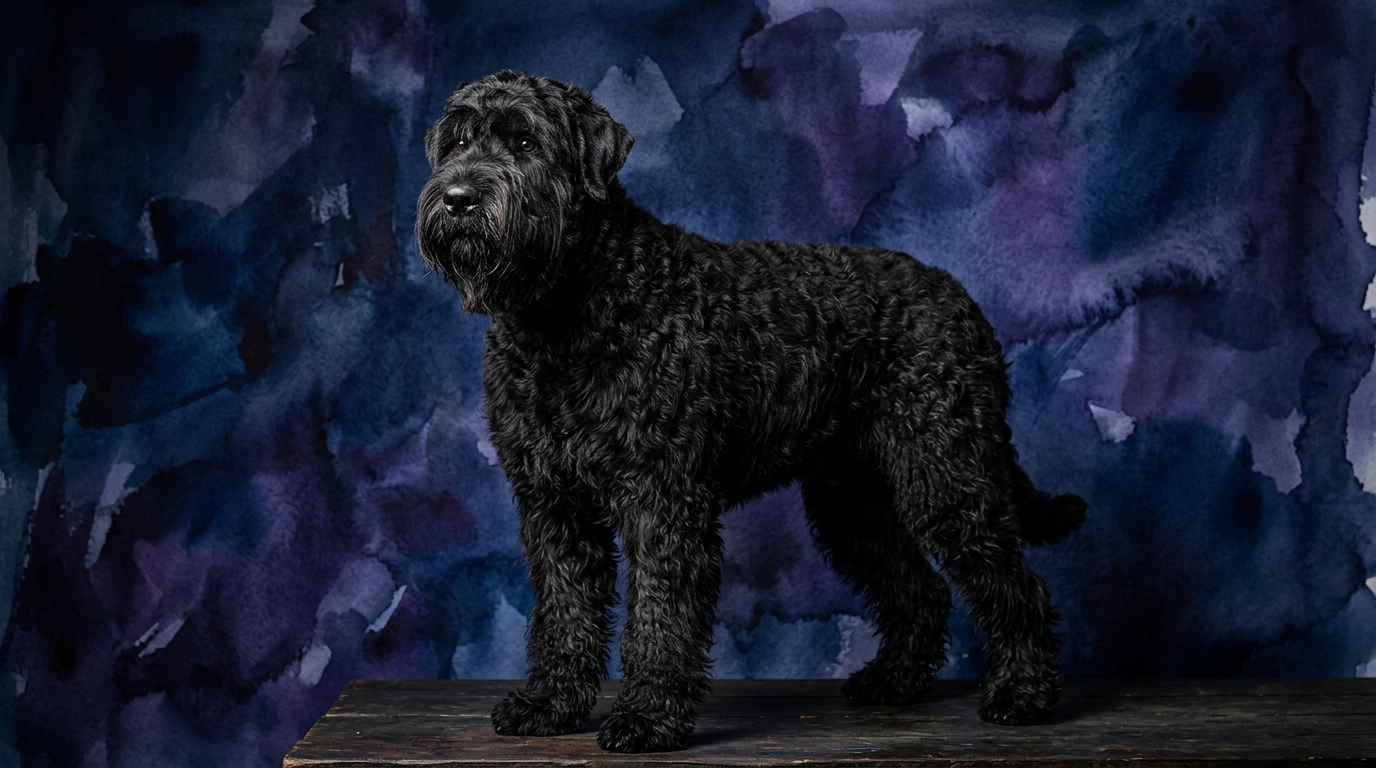
Side-by-Side Cognitive Profiles: Bloodhound vs. Black Russian Terrier
In our Cosmic Pet Pet IQ Lab, we dissect canine intelligence across five key dimensions. For the Bloodhound, ranked #74 by Coren, and the unranked but formidable Black Russian Terrier (BRT), these scores reveal vastly different cognitive landscapes.
**Problem Solving:** Bloodhounds (5/5) exhibit unparalleled prowess in scent-based problem-solving, meticulously unraveling complex scent trails with a single-minded focus that can astound observers. Their cognitive mapping relies heavily on olfactory input, allowing them to reconstruct events and navigate vast distances based solely on scent. In contrast, the Black Russian Terrier (3/5) approaches problem-solving with a more generalist perspective, excelling at practical challenges related to protection, territory management, and executing multi-step commands. Their solutions tend to be direct and purpose-driven, often involving physical manipulation or strategic positioning rather than intricate sensory deciphering.
**Training Speed:** This is where the breeds diverge significantly. The Bloodhound's (1/5) training speed is notably low, not due to an inability to learn, but because their overwhelming instinctive drive for scent work often overshadows compliance with human-initiated commands. They learn quickly what they find rewarding, particularly if it involves tracking, but integrating standard obedience requires immense patience and creative motivation. The Black Russian Terrier (3/5), on the other hand, presents a moderate training speed, demonstrating a readiness to absorb and apply new commands, especially when they perceive a clear purpose or benefit, such as pleasing their handler or fulfilling a protective role. Their intelligence allows for a more straightforward communication pathway during structured training sessions.
**Social Intelligence:** The Bloodhound (2/5) possesses a unique social intelligence. While generally amiable and tolerant, their primary focus during a 'task' or even just a walk is their nose, making them less attuned to subtle human social cues or complex emotional states. They form deep bonds but often interact with the world through a lens of olfactory information rather than reciprocal social nuance. The Black Russian Terrier (3/5) displays a more pronounced social intelligence, keenly observing and interpreting human body language, tone, and intent. This capacity is crucial for their historical role as guardians, allowing them to distinguish between friend and foe, and to respond appropriately to their family's needs and perceived threats.
**Instinctive Drive:** Here, the Bloodhound (5/5) truly shines, possessing an instinctive drive of immense intensity. Their entire cognitive framework is geared towards tracking; it is an intrinsic, non-negotiable aspect of their being. This drive dictates their behavior, their interests, and their motivation, often overriding all other stimuli. The Black Russian Terrier (3/5) possesses a strong, yet more modulated, instinctive drive. Their natural inclinations lean towards guarding, territorial defense, and partnership in working roles. While potent, this drive is more amenable to redirection and integration into structured tasks, rather than operating as an all-consuming singular focus.
**Memory:** Both breeds demonstrate impressive memory, but in different domains. The Bloodhound's (5/5) memory is exceptional for scent patterns, environmental associations linked to scent, and the intricate details of a trail, even one days old. Their recall for specific scent signatures is legendary, forming a complex internal map of the world through smell. The Black Russian Terrier (3/5) also has a robust memory, particularly for learned commands, routines, and the identification of individuals and perceived threats. Their memory serves their practical working capacity, allowing them to recall complex sequences of actions and to remember who belongs and who does not within their perceived territory.
Where the Bloodhound's Cognition Excels
The Bloodhound's cognitive superiority undeniably lies in its specialized olfactory processing and unwavering focus. Their problem-solving at a 5/5 rating is almost entirely dedicated to the intricate puzzle of scent. No other breed can rival their capacity to analyze, follow, and differentiate between minute scent particles, making them the ultimate biological tracking device. This isn't just about following a line; it's about interpreting a three-dimensional tapestry of odor, factoring in time, wind, and terrain. Their 5/5 memory for scent profiles and environmental cues related to trails allows them to retain an astonishing database of olfactory information, enabling them to pick up old trails or differentiate between multiple overlapping scents with precision. This highly specialized intelligence means they can perform complex tasks that are literally invisible to humans, demonstrating a depth of sensory processing that few other canines possess. Their instinctive drive, also at a 5/5, fuels this cognitive strength, providing them with the relentless motivation required to complete exhaustive, mentally taxing tracking assignments.
Where the Black Russian Terrier's Cognition Shines
Conversely, the Black Russian Terrier's cognitive strengths manifest in its versatility and balanced application of intelligence across various domains. While their problem-solving at 3/5 might not match the Bloodhound's scent-specific genius, it reflects a broader capacity for tackling diverse, practical challenges. They excel at understanding complex commands, adapting to new situations, and making independent decisions within a guardian context. Their 3/5 social intelligence allows them to be highly observant of their human companions, interpreting subtle cues to anticipate needs or potential threats, a skill far more developed for direct human interaction than the Bloodhound's. The BRT's moderate 3/5 instinctive drive, while strong, is also more pliable, allowing it to be channeled into various working roles beyond a singular pursuit. This adaptability, combined with a solid 3/5 memory for routines and commands, makes them exceptionally capable across a range of tasks, from obedience and protection work to agility, demonstrating a well-rounded, practical intellect.
Training Dynamics: Which Breed is Easier to Shape?
Evaluating ease of training requires understanding how a breed's entire cognitive profile influences its willingness and ability to learn human-directed tasks. The Black Russian Terrier, with its balanced scores across the board (3/5 for Training Speed, Social Intelligence, Instinctive Drive, and Memory), is generally considered easier to train for a wide array of obedience and working commands. Their moderate social intelligence means they are more attuned to their handler's instructions and desires, and their instinctive drive, while potent for guarding, is also more readily channeled into structured learning. They possess a practical understanding of cause and effect in human interactions, making them responsive to consistent training methods.
The Bloodhound, however, presents a significant challenge in conventional obedience training, rated at a low 1/5 for Training Speed. This isn't a deficit in learning capability, but rather a reflection of their overwhelmingly powerful 5/5 instinctive drive for scent work. When a Bloodhound's nose is engaged, all other stimuli, including human commands, often become secondary. Their 2/5 social intelligence further contributes to this, as they are less inclined to prioritize human approval over the allure of a compelling scent. While they possess incredible memory (5/5), it's primarily for olfactory information, not necessarily for arbitrary human commands unless those commands are intrinsically linked to their tracking passion. Training a Bloodhound demands extraordinary patience, creative motivation, and an understanding that their brain is wired for one supreme purpose, making standard compliance a continuous negotiation against their primal calling.
Owner Suitability: Active Pursuit vs. Structured Partnership
Neither the Bloodhound nor the Black Russian Terrier are truly suited for 'relaxed' owners in the conventional sense, as both possess significant cognitive and physical needs that demand engagement. However, the type of activity and engagement they require differs profoundly.
The Bloodhound, with its intense 5/5 instinctive drive and 5/5 problem-solving in scent work, is ideal for active owners who are passionate about scent sports, tracking, or search and rescue. Their physical activity needs are directly tied to their cognitive needs: they need to work their nose for extended periods. This means long, focused walks where they can follow scents, structured tracking exercises, and mental puzzles that engage their olfactory genius. An owner who can provide consistent, dedicated outlets for their tracking drive will find a deeply fulfilled companion, but someone seeking a casual walking partner or a dog content with minimal mental stimulation will find a Bloodhound's unfulfilled instincts leading to frustration and potentially destructive behaviors.
The Black Russian Terrier, while also requiring an active owner, thrives on structured activity that engages both body and mind in a more varied way. Their balanced 3/5 scores across most cognitive dimensions mean they respond well to diverse training, from advanced obedience and protection work to agility and rally. Owners who enjoy consistent training, providing clear leadership, and integrating their dog into family activities will find the BRT a rewarding partner. They need regular exercise, but also mental challenges that reinforce their working dog heritage and social connection. They are less about a singular, consuming passion like the Bloodhound, and more about versatile partnership, making them suitable for owners who enjoy a structured, active lifestyle with a capable and observant canine companion, rather than solely focusing on one specialized pursuit.
The Verdict
Choose a Bloodhound if you are a dedicated enthusiast of scent work or tracking, prepared to channel their singular, intense drive and specialized cognitive power into their natural calling, understanding that conventional obedience will be a lifelong, patient endeavor.
Opt for a Black Russian Terrier if you seek a versatile, trainable working companion capable of diverse tasks, valuing their balanced intelligence, protective instincts, and responsiveness to consistent, structured training and active partnership.
🧠 Find Your Pet's IQ Score
Our Pet IQ Lab assessment covers 25+ tests across 5 cognitive dimensions — personalized to your breed.
Take the Full IQ Test →Frequently Asked Questions
Are Bloodhounds difficult to live with due to their intelligence?
Bloodhounds are not difficult because they lack intelligence; rather, their profound and singular focus on scent can make them challenging if their specific cognitive needs are not met. Their strong instinctive drive for tracking means they prioritize following a scent over responding to commands, requiring owners to understand and work with their unique wiring rather than against it.
Can a Black Russian Terrier be a good family dog?
Yes, a Black Russian Terrier can be an excellent family dog, particularly with early socialization and consistent training. Their moderate social intelligence allows them to bond closely with their family, and their protective instincts, when properly managed, make them vigilant guardians, though they require an owner committed to providing structure and clear leadership.
Which breed is better for a first-time dog owner?
Neither breed is typically recommended for first-time dog owners due to their significant needs for training, socialization, and specialized management. However, if forced to choose, a Black Russian Terrier might be slightly more manageable for an experienced, committed first-timer due to their higher training speed and more balanced cognitive profile compared to the Bloodhound's intensely specialized and often challenging tracking drive.