
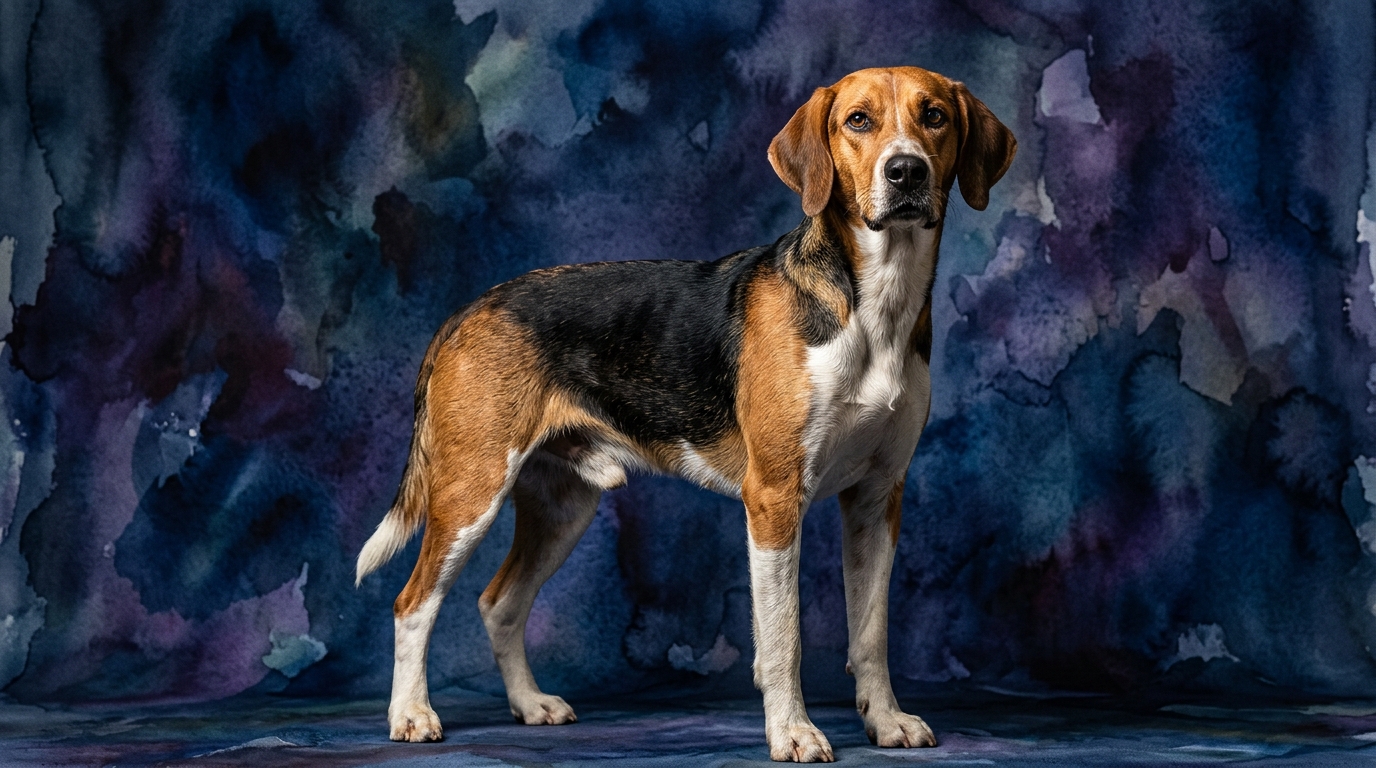
Side-by-Side IQ Profile: Bloodhound vs. English Foxhound
At The Cosmic Pet Pet IQ Lab, we evaluate canine intelligence across five key dimensions. For the Bloodhound, a Coren-ranked #74 breed, its profile is highly specialized: problem Solving 5/5, training Speed 1/5, social Intelligence 2/5, instinctive Drive 5/5, and memory 5/5. This paints a picture of a profound, single-minded specialist.
The English Foxhound, while not Coren-ranked, presents a more balanced cognitive spread: problem Solving 3/5, training Speed 3/5, social Intelligence 3/5, instinctive Drive 3/5, and memory 3/5. This breed exhibits a more generalized, yet capable, intelligence suited for cooperative work.
Delving into the Bloodhound's specifics, its 5/5 problem-solving reflects an unparalleled ability to decipher intricate scent trails, navigating time degradation and environmental obstacles with incredible deduction. Their 1/5 training speed, however, highlights a challenge in conventional obedience, as their profound 5/5 instinctive drive to track often overrides human commands. Social intelligence at 2/5 suggests they are less attuned to nuanced human social cues, prioritizing their olfactory world. Finally, their 5/5 memory is exceptional for scent profiles and complex path recall, a critical component of their tracking success.
The English Foxhound's 3/5 problem-solving capability is practical, focused on navigating terrain and flushing prey during a hunt, rather than complex deduction. Their 3/5 training speed indicates a moderate willingness to learn, responding well to consistent reinforcement, which contrasts sharply with the Bloodhound's. Social intelligence at 3/5 is well-developed for cooperative pack work, allowing them to read both canine and human group dynamics effectively. Their instinctive drive, rated 3/5, is robust for pursuit but more balanced, enabling them to shift focus. A 3/5 memory supports functional recall of tasks, routines, and familiar environments, sufficient for their working roles.
Where the Bloodhound Excels Cognitively
The Bloodhound's cognitive strengths are undeniably rooted in its olfactory capabilities, earning it top marks in problem-solving and memory. Its 5/5 problem-solving isn't about solving abstract puzzles but about an intricate mental process of analyzing scent particles over vast distances and varied conditions. This involves deciphering the age of a scent, differentiating between multiple trails, and systematically working through complex environmental interference, showcasing a highly specialized form of analytical deduction. This breed's mind constructs a detailed map of the olfactory world.
Furthermore, the Bloodhound's memory, also a perfect 5/5, is a marvel of retention. They can recall specific scent profiles and the paths associated with them days after initial exposure, allowing them to re-engage with a cold trail with impressive accuracy. This isn't merely remembering a command; it's an internal database of olfactory information, crucial for their persistent and successful tracking work. Their cognitive architecture is optimally designed for scent-driven tasks, making them peerless in this specialized domain.
Where the English Foxhound Demonstrates Cognitive Advantages
The English Foxhound demonstrates a cognitive edge in areas that highlight its more balanced and adaptable intelligence, particularly in supporting its role as a cooperative hunter. With a training speed of 3/5, they are more responsive to learning new commands and routines than the Bloodhound's 1/5. This means they can integrate new instructions and behavioral modifications more readily, making them more amenable to structured training sessions and varied tasks.
Their social intelligence, rated 3/5, also surpasses the Bloodhound's 2/5, reflecting their history of working in large packs. English Foxhounds are better at interpreting group dynamics, both among other dogs and their human handlers, fostering more cohesive team efforts during a hunt or in a domestic setting. This adaptability allows them to be more pliable to human direction in varied contexts beyond a singular scent pursuit, making them more versatile in a domestic partnership.
Training Dynamics: Which is Easier to Train?
When it comes to ease of training, the English Foxhound holds a distinct advantage over the Bloodhound. The English Foxhound's training speed of 3/5 indicates a moderate willingness to learn and retain commands, a stark contrast to the Bloodhound's 1/5. This significant difference stems from their primary drives; a Bloodhound's instinctive drive, a perfect 5/5, is singularly focused on scent. Once a Bloodhound catches a scent, their problem-solving mind is entirely dedicated to unraveling that trail, often rendering them oblivious to human commands, which they perceive as distractions from their 'work.' Their cognitive structure prioritizes the scent puzzle above all else, making redirection incredibly challenging.
The English Foxhound, while possessing a strong instinctive drive (3/5), has a more diffuse focus, allowing for better engagement with human instruction. Their higher social intelligence (3/5) also makes them more inclined to work cooperatively with a handler, understanding and responding to cues within a partnership, rather than being solely driven by an internal scent imperative. This cooperative nature and more balanced drive make the English Foxhound generally more receptive to conventional training methods and a broader range of commands.
Matching Breeds to Lifestyles: Active vs. Relaxed Owners
For owners considering an English Foxhound, a moderately active to highly active lifestyle is essential. Their instinctive drive (3/5) for chasing and their historical role in hunts mean they require regular, vigorous exercise to remain content and well-adjusted. These dogs thrive on activities that engage their stamina and allow them to run, making them ideal companions for hikers, runners, or those involved in canine sports. Their moderate training speed (3/5) also means they benefit from consistent mental stimulation and structured activities, making them a good fit for owners who enjoy engaging with their dog in various pursuits.
In contrast, the Bloodhound, despite its seemingly relaxed demeanor indoors, is suited for a very specific type of active owner: one dedicated to scent work. Their overwhelming instinctive drive (5/5) isn't for general running but for following a trail. A Bloodhound requires an owner who can channel this drive into extensive tracking exercises, providing profound mental and physical engagement that satisfies their deep-seated need to 'work' a scent. A relaxed owner who cannot provide this specialized outlet would find a Bloodhound challenging, as their unfulfilled drive can lead to frustration, vocalization, and destructive behaviors, despite their low general activity needs outside of tracking. Their activity needs are intense, but highly specialized.
The Verdict
Choose a Bloodhound if you are a patient, dedicated owner passionate about engaging in specialized scent work and can appreciate their unique, single-minded cognitive brilliance in tracking.
Opt for an English Foxhound if you seek an active, cooperative companion for outdoor adventures and are prepared for moderate training efforts to channel their balanced hunting drive.
🧠 Find Your Pet's IQ Score
Our Pet IQ Lab assessment covers 25+ tests across 5 cognitive dimensions — personalized to your breed.
Take the Full IQ Test →Frequently Asked Questions
Are Bloodhounds difficult to live with due to their low training speed?
Bloodhounds can be challenging for owners who expect quick obedience, given their 1/5 training speed. Their intense instinctive drive to track often overrides commands when a scent is present, requiring immense patience and specialized training. They are not inherently disobedient but are profoundly single-minded in their olfactory pursuits, which needs understanding.
What kind of activities do English Foxhounds excel at?
English Foxhounds excel in activities that leverage their stamina and pack mentality, such as long-distance running, field trials, or even competitive agility. Their moderate instinctive drive and social intelligence make them good candidates for cooperative sports and sustained physical challenges. They thrive on having a 'job' that involves movement and partnership.
How does a Bloodhound's problem-solving differ from other breeds?
A Bloodhound's 5/5 problem-solving is almost exclusively dedicated to scent puzzles. Unlike breeds that might figure out how to open a gate, a Bloodhound's cognitive strength lies in deducing the direction, age, and identity of a scent trail, even in complex environments. It's a highly specialized form of analytical reasoning focused on intricate olfactory data, making them unique problem-solvers.