
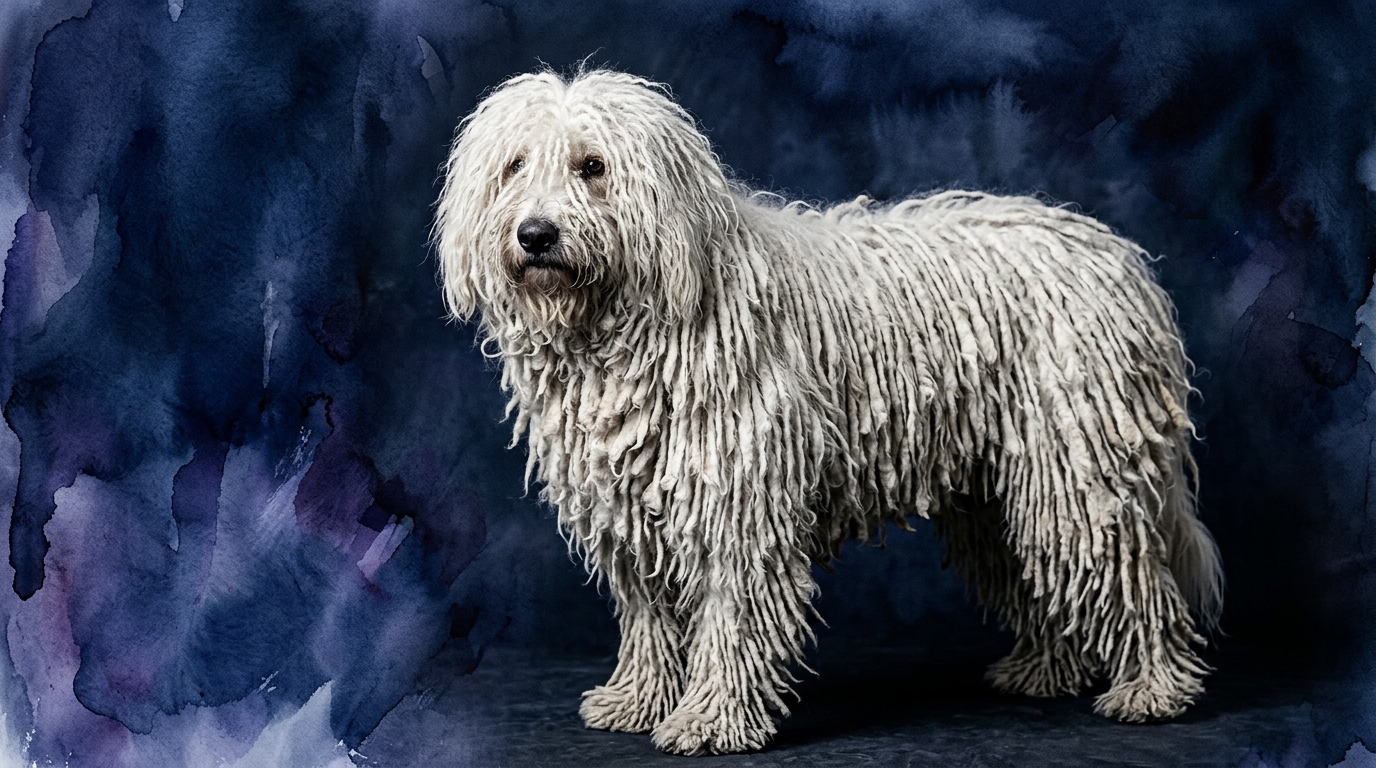
Side-by-Side IQ Profile: Bloodhound vs. Komondor
In the Cosmic Pet Pet IQ Lab, we dissect canine cognition across five crucial dimensions. For the Bloodhound, Problem Solving registers an impressive 5/5, reflecting their peerless ability to unravel intricate scent trails, distinguishing subtle nuances and following a fading "story" through complex environments. Their Training Speed, however, sits at a challenging 1/5, indicating a profound single-mindedness where their olfactory world often eclipses human directives. Social Intelligence scores 2/5; while generally gentle, their cognitive architecture prioritizes environmental scent data over intricate social cues from humans or other dogs when a trail is present. Instinctive Drive is a perfect 5/5, an overwhelming, deeply ingrained urge to track that defines their very existence. Finally, Memory is an equally perfect 5/5, showcasing an extraordinary capacity to recall specific scent patterns, routes, and the "history" of a trail, often over extended periods.
The Komondor presents a more balanced, versatile profile. Its Problem Solving is a solid 3/5, demonstrating an aptitude for assessing dynamic situations, particularly threats to its perceived territory or charges, and formulating appropriate protective strategies. Training Speed is a moderate 3/5, suggesting a reasonable capacity to learn commands and routines, especially when framed within its guardian role, though it maintains an independent streak. Social Intelligence is also 3/5, allowing it to navigate complex social hierarchies within a family unit and understand the nuances of group dynamics, essential for managing a flock. Instinctive Drive registers 3/5, a strong, inherent compulsion to protect and guard, but one that is more modulated and less singular than the Bloodhound's scent drive. Memory, at 3/5, reflects good recall for established routines, territorial boundaries, and distinguishing between familiar and unfamiliar individuals.
Where the Bloodhound Wins Cognitively
The Bloodhound's cognitive prowess is unequivocally superior in domains demanding hyper-specialized sensory processing and relentless, singular focus. Their Problem Solving score of 5/5 isn't about solving abstract puzzles or navigating mazes; it’s about decrypting the incredibly complex chemical language of a scent trail. This involves sophisticated pattern recognition, the ability to differentiate between countless layered odors, and making predictive judgments about a subject's trajectory based on minute, fading olfactory information. Their Instinctive Drive, a perfect 5/5, is the raw, indefatigable mental engine that fuels this pursuit, overriding almost all competing stimuli. When engaged on a scent, the Bloodhound's brain filters out extraneous visual or auditory data, dedicating immense, unparalleled processing power solely to the task at hand. This mental singularity, combined with a 5/5 Memory, allows them to construct and cross-reference a vast internal library of scent signatures and past trail experiences. They can pick up a cold trail, recognize a specific individual's scent after months, or even follow a trail over challenging terrains where the scent is highly fragmented. They excel where deep, specialized cognitive function is required for tasks of detection and pursuit that are beyond human sensory capabilities, making them indispensable in specific search and rescue or law enforcement applications.
Where the Komondor Wins Cognitively
The Komondor's cognitive strengths reside in its balanced, adaptable intelligence, perfectly suited for autonomous decision-making within dynamic social and environmental landscapes. Unlike the Bloodhound's deep dive into a single sensory input, the Komondor maintains a broader, integrated awareness of its surroundings. Its Problem Solving at 3/5 is less about tracking a physical path and more about assessing nuanced threats to its flock or family unit. This requires swift, practical judgments on potential dangers, evaluating body language, vocalizations, and environmental changes to formulate an appropriate, often independent, protective response. Its Social Intelligence, also 3/5, is a significant advantage, enabling it to navigate intricate relationships within its charges (whether livestock or human family) and understand complex group dynamics, roles, and expectations. This cognitive skill is vital for a guardian breed that must distinguish between a playful interaction and a genuine threat, or a familiar visitor and an intruder. The Komondor's balanced Instinctive Drive (3/5) ensures its protective impulses are robust yet modulated, preventing indiscriminate aggression while maintaining constant vigilance. This integrated cognitive framework allows for a comprehensive understanding of its world, making it adept at autonomous, context-aware guardianship rather than single-task specialization.
Which is Easier to Train and Why
When evaluating ease of training, the Komondor, with a Training Speed of 3/5, generally presents a more receptive pupil compared to the Bloodhound, which scores a challenging 1/5. The Komondor’s balanced cognitive profile allows for greater engagement with human instruction. While inherently independent and prone to making its own decisions, a Komondor can be taught obedience commands, house rules, and even complex tasks with consistent, patient effort, especially when the training aligns with its natural guardian inclinations. Its 3/5 Social Intelligence means it’s more inclined to form a working partnership with its human trainer, understanding expectations and responding to social cues, fostering a more collaborative learning environment. In stark contrast, the Bloodhound's formidable 5/5 Instinctive Drive for scent work often overrides all other learning priorities. When a Bloodhound catches a compelling scent, its cognitive resources are almost entirely diverted to tracking, making it exceptionally difficult to redirect with conventional commands or even high-value treats. Its 1/5 Training Speed reflects this profound specialization; teaching a Bloodhound to reliably "sit" or "stay" when a potent scent is present requires immense dedication, creative motivational strategies, and a deep understanding of its unique, olfactory-driven motivational framework. Their brain is simply not wired for immediate, generalized compliance when its primary instinct is engaged.
Which Suits Active Owners vs. Relaxed Owners
The suitability of a Bloodhound versus a Komondor for an owner's lifestyle hinges significantly on the type of activity and engagement desired. For an owner whose activity revolves around focused, mentally demanding work, particularly scent-based disciplines, the Bloodhound is an unparalleled partner. Its 5/5 Instinctive Drive and 5/5 Problem Solving demand an owner who can consistently channel its boundless olfactory energy into structured tracking, trailing, or scent detection sports. A "relaxed" owner who cannot provide this specialized, high-intensity mental outlet will inevitably find a Bloodhound to be a frustrated, and potentially destructive, companion, as its powerful brain seeks its own, often inconvenient or disruptive, scent adventures. Conversely, the Komondor, while requiring regular exercise and mental engagement, suits an owner who appreciates a vigilant, independent, and protective presence rather than constant 'go-go-go' activity. Its activity isn't about continuous movement but rather about patrolling, observing, and making autonomous decisions within its perceived territory. A "relaxed" owner for a Komondor might mean someone who spends considerable time at home, allowing the Komondor to fulfill its guardian duties through passive vigilance, but still provides structured walks, clear boundaries, and mental challenges that reinforce its protective nature. The Komondor’s 3/5 Social Intelligence also means it can integrate into a family dynamic more readily, albeit with a reserved, watchful disposition, compared to the Bloodhound's more singular, scent-driven cognitive focus.
The Verdict
Choose a Bloodhound if you are a dedicated enthusiast of scent work, prepared to channel their singular, profound olfactory intelligence into specialized activities and appreciate their independent, trail-driven nature.
Opt for a Komondor if you seek a balanced, independent guardian with a strong protective instinct, valuing a watchful companion capable of autonomous decision-making in a family or territorial context.
🧠 Find Your Pet's IQ Score
Our Pet IQ Lab assessment covers 25+ tests across 5 cognitive dimensions — personalized to your breed.
Take the Full IQ Test →Frequently Asked Questions
Are Bloodhounds difficult to live with due to their low training speed?
Bloodhounds can be challenging companions for owners not prepared for their intense scent drive. Their 1/5 training speed means they require immense patience and specialized training methods that leverage their olfactory instincts rather than fighting them, as their focus on scent often overrides conventional commands.
Does the Komondor's independence make it aloof or difficult to bond with?
While independent, a Komondor is not necessarily aloof. Its 3/5 social intelligence allows for strong bonds with its family, though it often expresses affection in a more reserved, watchful manner. They are devoted protectors who, once bonded, are incredibly loyal.
Can a Bloodhound be trained for protection work like a Komondor?
A Bloodhound's cognitive strengths are entirely geared towards scent detection and trailing, not direct protection or guarding. Their instinctual drive is to follow a scent, not to defend territory or individuals in a confrontational manner, making them unsuitable for traditional protection roles.