
The Cosmic Pet IQ Lab: Bloodhound vs. Miniature Bull Terrier Cognitive Profiles
The Cosmic Pet Pet IQ Lab employs a five-dimensional framework to assess canine intelligence, moving beyond simplistic notions to provide a nuanced understanding of each breed's mental strengths and tendencies. For the Bloodhound, a breed celebrated for its ancient and specialized abilities, its profile paints a picture of profound sensory mastery.
The Bloodhound’s Problem Solving is rated a perfect 5/5, reflecting its unparalleled capacity to decipher complex scent trails and navigate intricate environments purely by smell. Its Training Speed, however, stands at a modest 1/5, indicating an independent spirit that prioritizes instinctual drives over human directives. Social Intelligence is assessed at 2/5, suggesting amiability but a lower drive for deep social engagement or people-pleasing. Instinctive Drive is a commanding 5/5, dominated by an all-consuming scenting passion. Memory, also a 5/5, highlights an exceptional ability to recall and process scent information over long periods and vast distances, crucial for its tracking vocation.
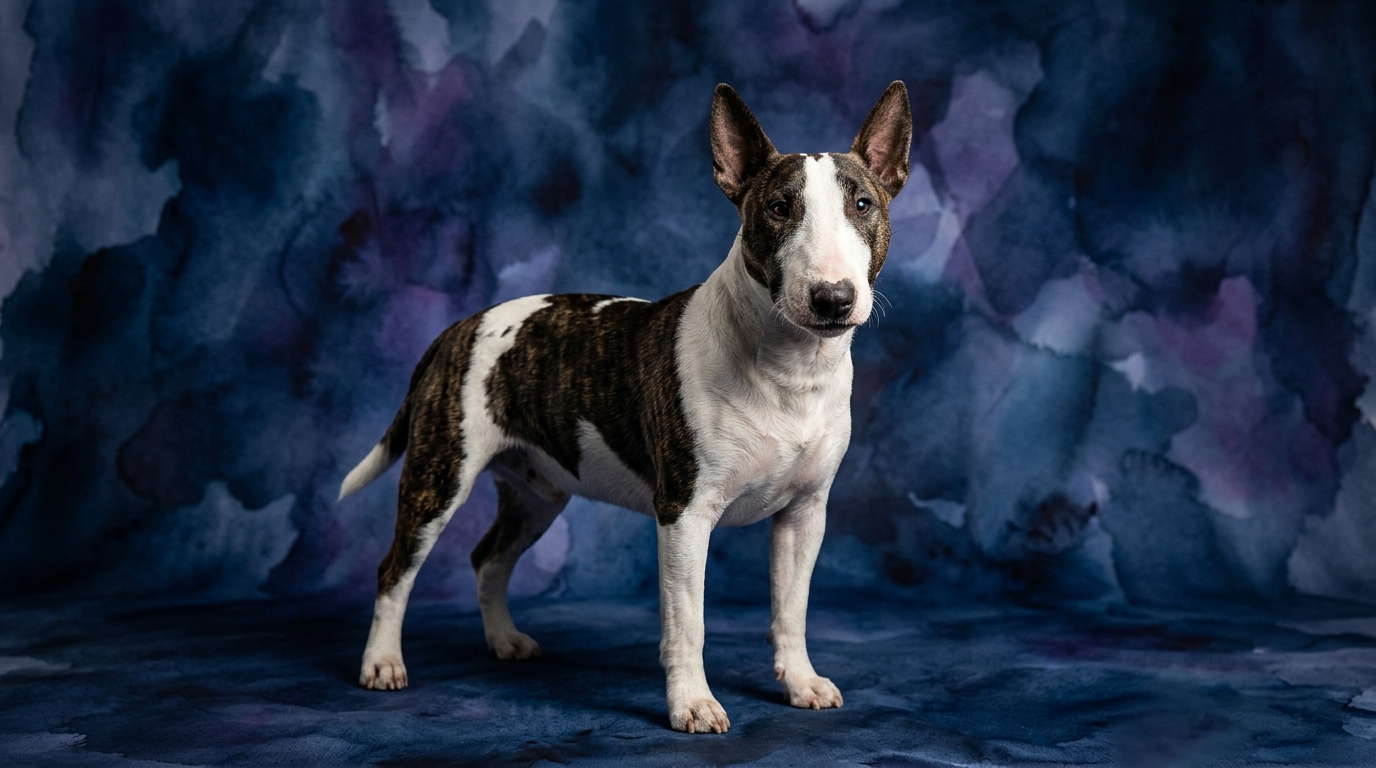
In contrast, the Miniature Bull Terrier presents a more balanced, generalized cognitive profile, reflecting its role as a companion and versatile terrier. Its Problem Solving is rated 3/5, demonstrating a respectable capacity to figure out puzzles and adapt to new situations with a characteristic terrier wit. Training Speed is 3/5, indicating a moderate pace for learning new commands, responsive to engaging and consistent methods. Social Intelligence is also 3/5, signifying a genuine enjoyment of human interaction and an ability to read social cues, fostering strong bonds. Instinctive Drive sits at 3/5, encompassing a moderate prey drive and a strong desire for companionship rather than a singular, overwhelming instinct. Memory, at 3/5, shows good retention for learned behaviors, routines, and familiar experiences, contributing to its adaptability.
Where the Bloodhound's Mind Excels
The Bloodhound's cognitive superiority lies in its exquisitely specialized sensory processing and an internal problem-solving engine dedicated almost entirely to olfaction. Its perfect 5/5 in Problem Solving isn't about opening cabinets, but about disassembling a 'scent puzzle' – differentiating individual human odors from a cacophony of environmental smells, aging a trail, and predicting its trajectory over varied terrain. This is a highly sophisticated form of analytical thinking, a testament to its evolutionary purpose.
Coupled with a 5/5 Instinctive Drive and 5/5 Memory, the Bloodhound's mind is a master database of olfactory information. It remembers specific scent signatures, the context in which they were encountered, and how they evolve over time. This isn't rote memorization of commands, but a dynamic, real-time mapping of its world through its nose. For instance, a Bloodhound can systematically track a missing person through a bustling urban park, filtering out hundreds of distracting scents, a feat of cognitive focus and discernment few other breeds can replicate.
Their 'memory' extends to the intricate patterns of scent dispersion, wind currents, and ground conditions, allowing them to make intelligent deductions about where a trail might lead. This specialized brilliance makes them indispensable in search and rescue, law enforcement, and any task requiring precise, persistent scent work, showcasing a profound cognitive depth in their chosen domain.
The Miniature Bull Terrier's Unique Cognitive Strengths
While not possessing the Bloodhound's singular olfactory genius, the Miniature Bull Terrier's cognitive strengths lie in its balanced adaptability and generalized intelligence, particularly evident in its 3/5 scores across the board. Its problem-solving, though not hyper-specialized, is more versatile and often applied to navigating its human-centric world with a clever, sometimes mischievous, ingenuity. A Mini Bull Terrier might excel at figuring out how to manipulate a puzzle toy for a treat or devise a strategy to gain its owner's attention, demonstrating a practical and self-serving form of mental agility.
Their moderate Social Intelligence (3/5) allows them to engage more readily in two-way communication with humans, making them more receptive to varied forms of training and interaction beyond pure instinct. This capacity for social bonding and understanding human cues allows them to thrive in diverse family environments and participate in activities that require a partnership, such as obedience or agility. Their 'wins' are often in their ability to integrate seamlessly into human lives, responding to social feedback and adapting their behavior accordingly.
The Miniature Bull Terrier's 3/5 Training Speed, paired with its social intelligence, means it is more amenable to learning a wide array of behaviors and tricks that rely on human direction and motivation. Unlike the Bloodhound, whose primary motivation is often the scent itself, a Mini Bull Terrier is more likely to be motivated by praise, play, or food from its owner, making it a more flexible student for diverse learning tasks.
Training Dynamics: A Tale of Two Approaches
Training a Bloodhound is a test of patience, consistency, and an understanding of its profound instinctual drives. With a Training Speed of 1/5 and an Instinctive Drive of 5/5, a Bloodhound's mind is often singularly focused on its nose. When a compelling scent is present, persuading a Bloodhound to perform a 'sit-stay' or 'come' command becomes a battle against its very nature. They learn, but at their own pace, and often only when the reward is intrinsically tied to their scenting work, or if the distraction is minimal. Owners must learn to work with, rather than against, this powerful drive.
Conversely, the Miniature Bull Terrier, with its 3/5 Training Speed and 3/5 Social Intelligence, is generally more responsive to traditional positive reinforcement methods. They are quicker to generalize commands and adapt to new training environments, often enjoying the interaction and mental stimulation that training provides. While their terrier tenacity can sometimes manifest as stubbornness or a mischievous streak, they are typically more willing partners in a training session focused on human direction and engagement. Their challenges are more about consistent motivation and managing their spirited personality than overcoming an all-consuming instinct.
Matching Minds to Lifestyles
For owners with an active lifestyle, the definition of 'active' varies dramatically between these two breeds. A Bloodhound suits an owner who is 'active' in providing outlets for its supreme scenting abilities. This means dedicated tracking work, scent games, or even formal search and rescue training, which are mentally taxing for the dog. While their physical exercise needs are moderate, their mental need for scent work is immense; a relaxed owner who doesn't engage this drive will likely find themselves with a bored, potentially destructive, or wandering Bloodhound.
The Miniature Bull Terrier, on the other hand, thrives with owners who are 'active' in a more generalized sense, enjoying varied physical and mental activities. They flourish with daily walks, play sessions, training for tricks or sports like agility, and plenty of interactive companionship. They need to be an integral part of family life and appreciate mental stimulation that involves their human. Their energy is often higher and more generalized than a Bloodhound's, requiring consistent engagement to prevent boredom and unwanted behaviors.
Neither breed is truly suited for a purely 'relaxed' or passive owner. A Bloodhound's independent, scent-driven nature demands a specific type of engagement, and ignoring it will lead to frustration for both dog and owner. A Miniature Bull Terrier's spirited and often boisterous personality requires consistent attention and structure. While a Mini Bull Terrier might adapt better to a typical family schedule, both breeds need owners prepared to invest significant time and effort into understanding and fulfilling their unique cognitive and behavioral needs.
The Verdict
Opt for a Bloodhound if you are captivated by the profound world of scent and are prepared to dedicate significant time to nurturing their unparalleled tracking abilities, valuing instinctual brilliance over conventional obedience. They are a match for owners who understand and respect their singular, ancient purpose.
Select a Miniature Bull Terrier if you seek a spirited, adaptable companion eager to engage in diverse activities and form a strong, interactive bond, appreciating a balanced cognitive profile that thrives on partnership and playful learning.
🧠 Find Your Pet's IQ Score
Our Pet IQ Lab assessment covers 25+ tests across 5 cognitive dimensions — personalized to your breed.
Take the Full IQ Test →Frequently Asked Questions
Do Bloodhounds make good family pets despite their low social intelligence score?
Bloodhounds are generally gentle and tolerant with family members, but their social intelligence score reflects their primary focus on scent rather than nuanced human interaction. They are amiable but might not be as socially responsive or 'eager to please' in typical family scenarios as other breeds, often preferring to follow their nose.
Is a Miniature Bull Terrier easy to train for a first-time dog owner?
A Miniature Bull Terrier has a moderate training speed (3/5), making them trainable for a first-time owner who is committed to consistent, positive reinforcement. Their intelligence allows them to learn readily, but their terrier tenacity means owners must be patient and engaging to keep them motivated and focused.
How do their problem-solving abilities manifest differently in daily life?
A Bloodhound's problem-solving is intensely specialized in deciphering complex scent trails, demonstrating remarkable analytical skill in navigation and identification through smell. A Miniature Bull Terrier, conversely, applies its problem-solving more broadly, perhaps figuring out how to access a forbidden treat or cleverly manipulate situations to gain attention, showcasing a more generalized, often mischievous, ingenuity.