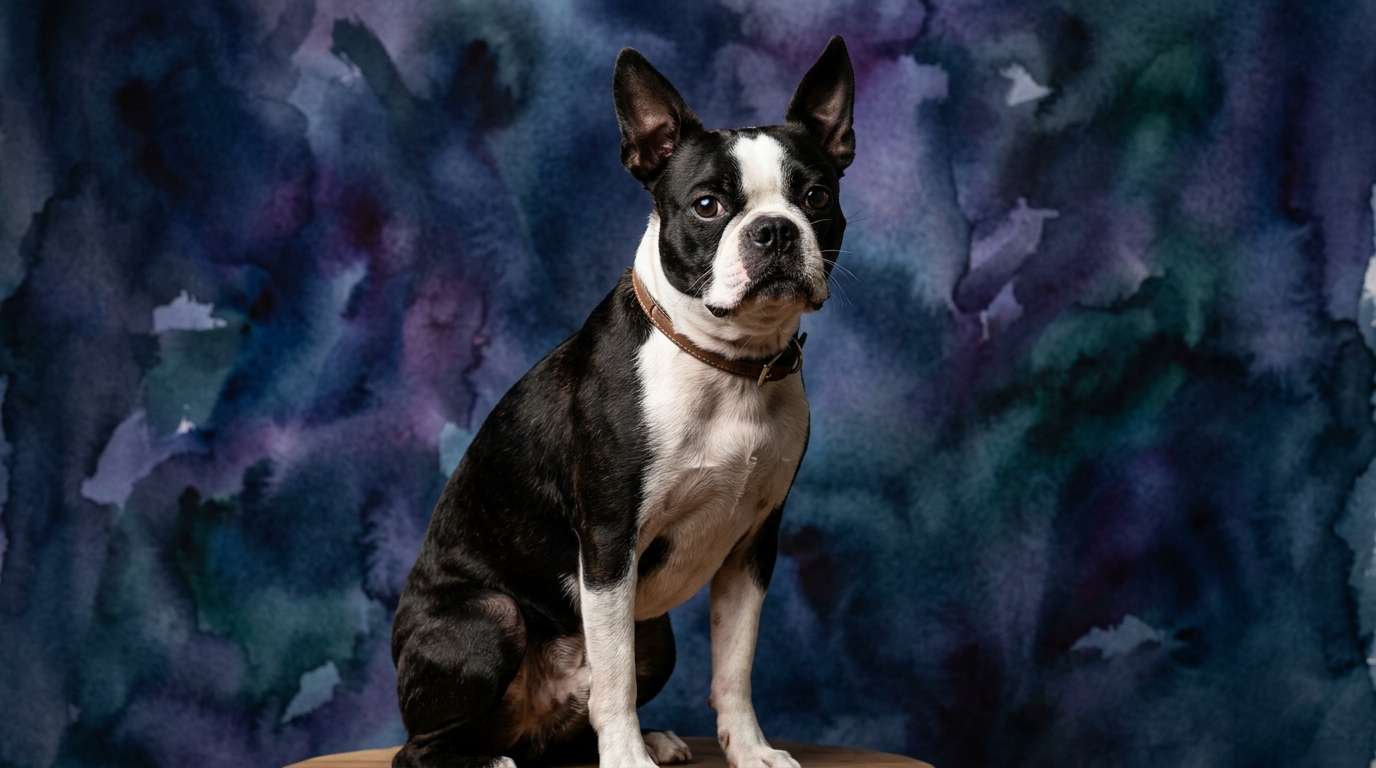

Side-by-Side Cognitive Profiles: Boston Terrier vs. Glen of Imaal Terrier
To truly understand the cognitive makeup of these two breeds, The Cosmic Pet Pet IQ Lab employs a five-dimensional framework, allowing for a granular comparison of their mental aptitudes. While both breeds register similar scores in several areas, the subtle distinctions reveal different approaches to the world around them.
The **Boston Terrier**, a member of the Non-Sporting Group, holds a Coren rank of #54, indicating a respectable capacity for obedience and working intelligence. Their Problem Solving is rated at 3/5, meaning they possess a moderate ability to navigate novel situations and figure out solutions, often with a keen eye on their human companions for guidance. Training Speed is also 3/5; they absorb new commands consistently, benefiting from positive reinforcement and their inherent desire to interact. Where they truly stand out is in Social Intelligence, scoring a high 4/5. Bostons are remarkably attuned to human emotions and social dynamics, making them highly empathetic and adaptable family members. Their Instinctive Drive is a lower 2/5, meaning their inclination for traditional canine tasks like hunting or guarding is minimal, primarily focusing their energy on companionship. Memory is a solid 3/5, enabling them to recall learned behaviors and routines effectively over time.
The **Glen of Imaal Terrier**, belonging to the Terrier Group and not listed on the Coren ranking, presents a profile shaped by its working heritage. Their Problem Solving is also 3/5, indicating a moderate capacity for independent thought, though often applied with a terrier's characteristic determination. Training Speed matches the Boston at 3/5; they are capable learners but might require more patience and understanding of their independent streak. Social Intelligence is rated 3/5; Glens form deep bonds with their immediate family and are observant, but may be more reserved or less overtly expressive with strangers compared to the Boston. Their Instinctive Drive is a notable 3/5, reflecting their ancestral purpose of hunting vermin, which translates into a strong interest in digging, scent work, and pursuit. Memory, like the Boston, is a 3/5, allowing them to retain information and experiences, though their recall might sometimes be influenced by their strong independent focus.
Where the Boston Terrier Excels Cognitively
The Boston Terrier distinctly shines in the realm of social intelligence, registering a 4/5 compared to the Glen of Imaal Terrier's 3/5. This higher social acumen means Bostons are exceptionally adept at reading and responding to human emotions and social cues. They often exhibit a profound empathy, sensing when their owner is happy, sad, or stressed, and adjusting their behavior accordingly – perhaps offering a comforting nudge or initiating playful interaction to lighten the mood. Their ability to integrate seamlessly into diverse social settings, from bustling family gatherings to quiet evenings at home, stems from this cognitive strength. They are more likely to seek out and thrive on human interaction, making them highly responsive companions in shared activities. This strong social connection also translates into a greater willingness to cooperate, as they are tuned into their human's desires and intentions, often anticipating needs or responding to subtle body language. Their lower instinctive drive (2/5) further supports this, as their mental energy is less diverted by independent hunting or digging urges, allowing more focus on the human-canine bond.
Where the Glen of Imaal Terrier Shows its Cognitive Strengths
Conversely, the Glen of Imaal Terrier edges out the Boston Terrier in instinctive drive, registering a 3/5 against the Boston's 2/5. This isn't about being inherently superior, but about a different cognitive specialization rooted in their working heritage. A Glen's strong instinctive drive manifests as a deep-seated desire to engage with their environment through scent work, digging, and a tenacious pursuit of perceived “prey” – be it a rustling leaf or a hidden toy. This drive imbues them with a distinctive focus and persistence when engaged in tasks that tap into these ancestral instincts. They possess an internal motivation to explore, investigate, and “solve” environmental puzzles using their nose and paws, often demonstrating remarkable determination in the face of obstacles. While a Boston might look to its owner for direction, a Glen might independently decide to unearth a fascinating smell in the yard, demonstrating a cognitive process geared towards self-directed exploration and execution of instinctual behaviors. This robust internal motivation can be a powerful asset in activities like earthdog trials or scent work, where their cognitive focus aligns with their inherent drives.
Training Dynamics: Which Breed is Easier to Shape?
Both breeds share a similar Training Speed rating of 3/5, suggesting neither is inherently a “fast-track” learner. However, the Boston Terrier generally proves easier to train for obedience and household manners due to its superior social intelligence (4/5). A Boston's strong desire to please and its attunement to human emotional states mean it is often more motivated by positive reinforcement and praise from its owner. They thrive on connection and cooperation, making them more receptive to instruction. Their lower instinctive drive (2/5) also means fewer distractions from ingrained urges to chase or dig, allowing them to maintain focus on the task at hand. For instance, teaching a Boston to “stay” might be more straightforward because their primary motivation is often to remain close and engaged with their human.
The Glen of Imaal Terrier, while equally capable of learning (Training Speed 3/5), presents a different training dynamic due to its more pronounced instinctive drive (3/5) and slightly lower social intelligence (3/5). Their independent terrier spirit means they can sometimes be more stubborn or less inclined to blindly follow commands if they perceive a more interesting, instinct-driven activity. Training a Glen often requires more patience, creativity, and a deeper understanding of their motivations. While they are loyal and form strong bonds, their inherent drive to investigate or dig might occasionally override their desire to comply, making consistency and clear, engaging methods crucial. They respond best to training that makes sense to them or taps into their natural drives, rather than simply seeking to please.
Matching Owners: Active Lifestyle vs. Relaxed Companionship
The choice between these two breeds depends significantly on an owner's lifestyle and how they prefer to engage with a canine companion. The Boston Terrier, with its lower instinctive drive (2/5) and strong social intelligence (4/5), tends to be a better fit for more relaxed owners or those seeking a highly adaptable indoor companion. While they enjoy walks and playtime, their need for vigorous, instinct-driven activity is moderate. Their contentment often stems from being close to their people, participating in family routines, and receiving affection. They are generally content with moderate daily exercise, such as a couple of brisk walks and indoor play, making them suitable for apartment living or owners with less time for extensive outdoor adventures. Their cognitive energy is often directed towards social interaction and observation within the home environment.
The Glen of Imaal Terrier, conversely, with its more robust instinctive drive (3/5) and inherent terrier tenacity, is better suited for active owners who appreciate and can channel these traits. While not hyperactive, Glens require more than just a leisurely stroll; they benefit from opportunities to engage their minds and bodies in purposeful activities. Owners who enjoy earthdog trials, scent work, or even just long, exploratory walks where the dog can sniff and investigate to its heart's content will find a Glen to be a rewarding companion. Their problem-solving (3/5) and instinctive drive (3/5) mean they enjoy tasks that require a bit of independent thought and persistence. A relaxed owner who cannot provide outlets for a Glen's inherent drives might find themselves with a dog that invents its own “work,” potentially through digging or persistent exploration, making them a better match for those who actively engage in their dog's mental and physical enrichment.
The Verdict
Choose the Boston Terrier if you prioritize a highly socially attuned companion that thrives on human interaction and adapts readily to a relaxed, indoor-centric lifestyle with moderate exercise needs.
Opt for the Glen of Imaal Terrier if you are an active owner who can appreciate and channel a dog's strong instinctive drives, enjoying activities that engage their tenacity, scenting ability, and independent problem-solving.
🧠 Find Your Pet's IQ Score
Our Pet IQ Lab assessment covers 25+ tests across 5 cognitive dimensions — personalized to your breed.
Take the Full IQ Test →Frequently Asked Questions
Are Boston Terriers good with children?
Yes, Boston Terriers often excel with children due to their high social intelligence and adaptable nature, typically being patient and playful companions within a family setting. Always supervise interactions between children and any dog.
Do Glen of Imaal Terriers bark a lot?
Glen of Imaal Terriers are generally not excessive barkers, but they will use their voice to alert to perceived threats or interesting occurrences, especially if their strong instinctive drives are not adequately met. Consistent training can help manage their vocalizations.
Which breed is better for first-time dog owners?
For first-time dog owners, the Boston Terrier might be slightly more manageable due to its eagerness to please and lower demands for instinctual outlets, while a Glen of Imaal Terrier requires an owner ready to understand and work with its independent terrier spirit.