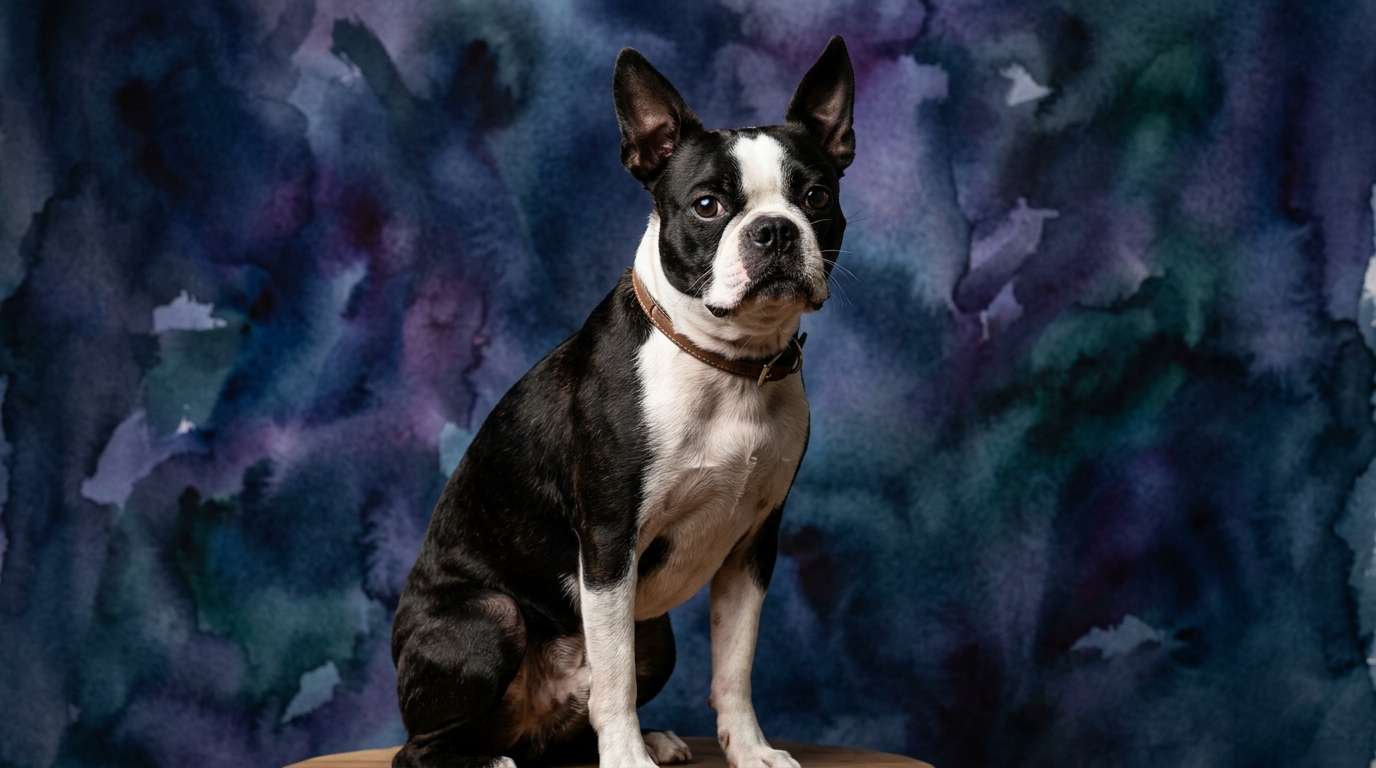

Unpacking Their Cognitive Blueprints: A Side-by-Side IQ Profile
At The Cosmic Pet Pet IQ Lab, we evaluate canine cognition across five crucial dimensions, offering a nuanced view beyond simple labels. The Boston Terrier, a charming member of the Non-Sporting group, holds a Coren rank of #54, while the elegant Toy Poodle, from the Toy group, is noted at an impressive #2. These rankings hint at their overall cognitive aptitude, but our detailed breakdown paints a clearer picture of their individual strengths.
For Problem Solving, the Boston Terrier scores 3/5. This indicates an ability to navigate moderately complex situations, such as figuring out how to access a favored toy or understanding simple household routines. They learn through observation and trial-and-error, often finding practical solutions to immediate environmental challenges without extensive forethought.
In Training Speed, Boston Terriers register a 3/5. They are receptive to learning new commands, particularly when positive reinforcement is consistently applied. While they may require more repetitions than some breeds to solidify a behavior, their willingness to engage with their human companions facilitates progress. Patience and clear communication are key to unlocking their learning potential.
Where the Boston Terrier truly shines is in Social Intelligence, earning a 4/5. These dogs possess a remarkable capacity to read human emotions and social cues. They often intuit their owner's mood, offering comfort or initiating play at opportune moments. This attunement makes them deeply empathetic companions, highly adaptable to the social dynamics of a family.
Their Instinctive Drive is rated 2/5. Boston Terriers are not typically driven by strong predatory instincts or complex working behaviors like herding or intense retrieving. Their focus tends to be more on companionship and interaction within the home environment, rather than fulfilling specific, task-oriented drives.
Finally, for Memory, the Boston Terrier scores 3/5. They effectively remember learned commands, daily routines, and the locations of familiar objects. While they may not recall intricate sequences or events with the precision of some breeds, their memory is certainly sufficient for stable home life and basic obedience.
Turning to the Toy Poodle, its Problem Solving aptitude is exceptional, achieving a 5/5. These dogs consistently demonstrate a superior ability to analyze novel situations, devise strategies, and manipulate their environment to achieve desired outcomes. They thrive on mental challenges, often outsmarting puzzle toys or figuring out how to open cabinets.
Their Training Speed is equally impressive, scoring 5/5. Toy Poodles grasp new commands and concepts with remarkable swiftness, often requiring only a few repetitions to master a behavior. Their eagerness to learn and their capacity for forming strong associations make them highly responsive partners in any training endeavor, from basic obedience to advanced tricks.
In Social Intelligence, the Toy Poodle scores 3/5. While they are affectionate and bond closely with their families, their focus may lean more towards engaging in activities or tasks rather than a deep, intuitive reading of subtle human emotional states. They understand cues but might interpret them more literally than a Boston Terrier.
The Toy Poodle's Instinctive Drive is 3/5. They possess a moderate drive, often expressed in an enjoyment of retrieving games, agility courses, or other structured activities that tap into their innate desire to work alongside their human. This drive is adaptable and channelable into various dog sports.
Regarding Memory, the Toy Poodle stands out with a 5/5. They exhibit an outstanding capacity for retaining a vast repertoire of commands, complex sequences, and specific spatial information over extended periods. This contributes significantly to their ability to excel in performance events and maintain a wide range of learned behaviors.
Where the Boston Terrier Excels Cognitively
The Boston Terrier’s primary cognitive advantage lies in its elevated Social Intelligence. Scoring 4/5, they possess a more pronounced aptitude for emotional attunement compared to the Toy Poodle’s 3/5. This means a Boston Terrier is often quicker to pick up on subtle shifts in human mood or body language, offering unsolicited comfort or adjusting their behavior to match the household's emotional climate. They are adept at integrating into family dynamics, often becoming intuitive emotional anchors without needing specific training for such roles. Their propensity for companionship is deeply rooted in this cognitive strength, making them exceptional at forming reciprocal, understanding bonds.
Where the Toy Poodle Demonstrates Superior Cognitive Aptitude
Conversely, the Toy Poodle's cognitive strengths are evident across multiple dimensions, particularly in Problem Solving (5/5), Training Speed (5/5), and Memory (5/5). A Toy Poodle's capacity to quickly analyze new situations and formulate solutions far surpasses that of a Boston Terrier. This translates into rapid acquisition of complex skills, whether it's navigating an agility course, learning a multi-step trick, or deciphering a challenging puzzle toy. Their superior memory ensures these learned behaviors are retained with remarkable precision over time, allowing them to build an extensive repertoire of commands and routines. This makes them highly adaptable to varied learning environments and sophisticated training curricula.
Ease of Training: A Tale of Two Learning Styles
When considering ease of training, the Toy Poodle generally presents a more straightforward experience for owners seeking rapid progress. Their 5/5 scores in both Training Speed and Memory mean they grasp new concepts and commands with exceptional efficiency, often requiring minimal repetitions. This translates to quicker mastery of basic obedience and a strong foundation for advanced activities like dog sports or complex trick training. Owners will observe them actively trying to figure out what is being asked, eager to engage in the learning process.
The Boston Terrier, with its 3/5 scores in Training Speed and Memory, requires a different approach. While certainly trainable, they benefit significantly from consistent, positive reinforcement methods and a patient instructor. They may exhibit moments of independent thought or a charming stubbornness, necessitating more repetitions and creative motivation to solidify behaviors. For example, a Toy Poodle might quickly learn to retrieve a specific item from a group, while a Boston Terrier might need more directed guidance and encouragement to consistently differentiate and fetch the correct object. Understanding these inherent differences allows owners to tailor their training strategies for optimal success with either breed.
Matching Breeds to Lifestyles: Active vs. Relaxed Owners
The distinct cognitive profiles of the Boston Terrier and Toy Poodle naturally align with different owner lifestyles. For active owners who enjoy engaging in mentally stimulating activities, advanced training, or dog sports, the Toy Poodle is an ideal match. Their high problem-solving capacity and rapid training speed mean they thrive on challenges like agility, competitive obedience, or learning intricate tricks. They require consistent mental engagement to prevent boredom and channel their considerable brainpower constructively, making them excellent partners for those who enjoy an intellectually dynamic relationship with their dog.
Conversely, the Boston Terrier is often a better fit for relaxed owners who prioritize companionship and emotional connection over complex training regimens. Their elevated social intelligence makes them content with being a beloved family member, often happy with moderate daily exercise and ample cuddle time. While they appreciate play and walks, their cognitive needs are more centered on social interaction and understanding their human's emotional world, rather than constant intellectual puzzles. They excel in households where their affectionate and perceptive nature is valued as a central part of the family dynamic, without the pressure of needing to perform elaborate tasks.
The Verdict
Choose a Boston Terrier if you seek an emotionally intuitive companion, content with moderate mental stimulation, and valuing deep social bonds above complex trick learning.
Choose a Toy Poodle if you desire a highly trainable partner for dog sports or advanced obedience, who thrives on mental challenges and can learn a vast array of behaviors.
🧠 Find Your Pet's IQ Score
Our Pet IQ Lab assessment covers 25+ tests across 5 cognitive dimensions — personalized to your breed.
Take the Full IQ Test →Frequently Asked Questions
Are Boston Terriers difficult to train?
Boston Terriers are not inherently difficult to train, but their moderate training speed means they benefit from patience and consistent, positive reinforcement. They may require more repetitions than some breeds to solidify new commands, but their eagerness to please their owners contributes to their eventual success.
Can Toy Poodles be good family dogs?
Yes, Toy Poodles can be wonderful family dogs. While their social intelligence is rated moderately, they form strong bonds with their families and enjoy being involved in household activities. Their adaptability and eagerness to learn make them suitable for various family dynamics, especially those willing to provide mental engagement.
Which breed is better for first-time dog owners?
For first-time dog owners, the choice depends on lifestyle and commitment. A Boston Terrier's intuitive social nature can be forgiving, while a Toy Poodle's rapid learning requires consistent direction. Both can thrive with novice owners who are prepared to understand and meet their specific cognitive and social needs.