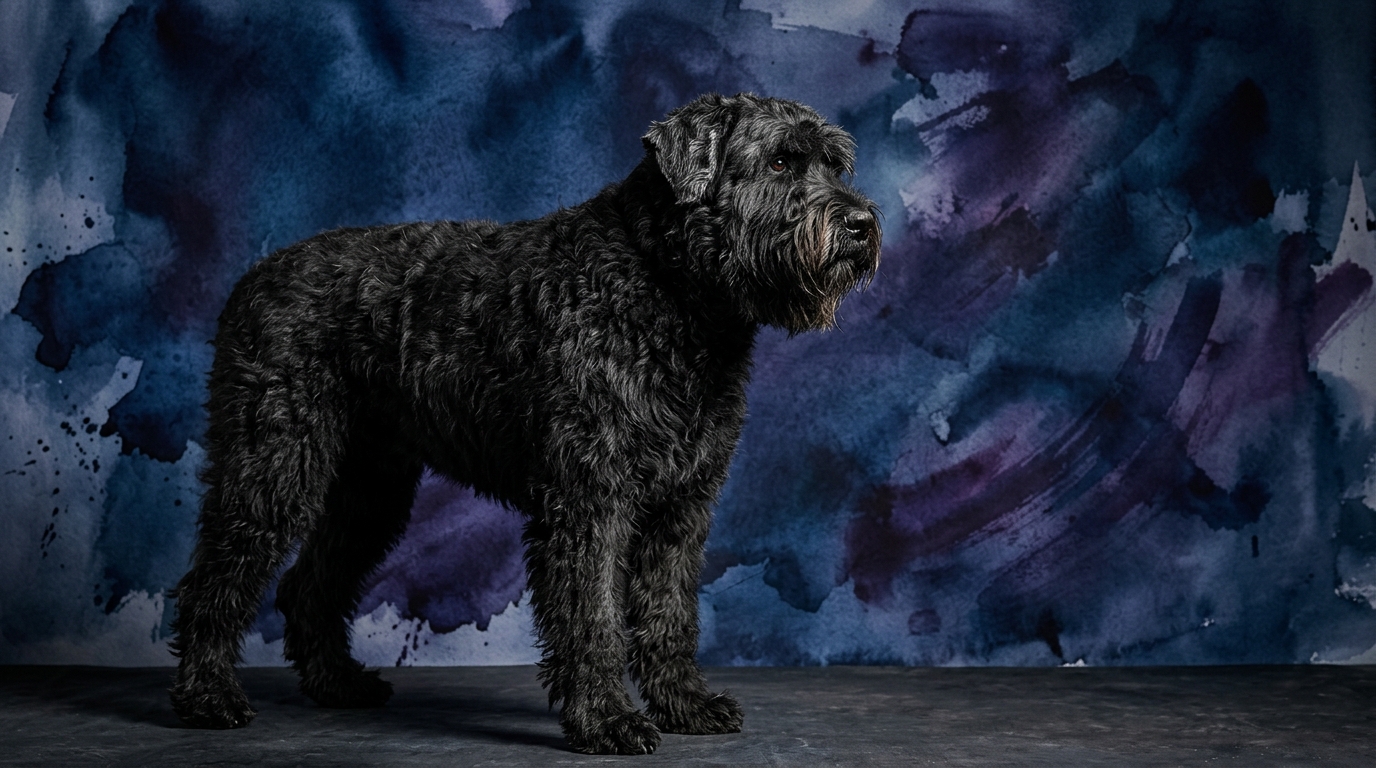

Side-by-Side IQ Profile: Herding vs. Hound Minds
**Bouvier des Flandres (Not Coren-ranked):**
**Problem Solving (3/5):** A Bouvier's problem-solving involves practical, real-time decisions for managing livestock or family protection. This manifests as strategically guiding a flock, retrieving a toy from a tight spot, or assessing new environmental situations. Their solutions are direct, aiming for clear objectives within their perceived 'work.'
**Training Speed (3/5):** Bouviers absorb new commands at a moderate pace, responding well to consistent, clear instruction. Attentive to their handler, they desire to understand expectations. While not mastering complex sequences instantly, their retention is solid with regular reinforcement, making them capable students over time.
**Social Intelligence (3/5):** This breed displays moderate capacity for understanding human emotions and social cues within their family. They are discerning, quickly identifying family versus strangers, making them effective guardians. Interactions can be reserved with outsiders but deeply loyal and communicative within their inner circle.
**Instinctive Drive (3/5):** The Bouvier's drive stems from their herding heritage, a moderate impulse to gather, control, and protect. This translates into a strong desire for purpose and a tendency to 'supervise' family activities. Channeled appropriately, it makes them diligent workers and vigilant companions; unmanaged, it can lead to 'herding' attempts.
**Memory (3/5):** Bouviers possess moderate memory for commands, routines, and territory. They recall learned tasks and associate places with events, like where treats are stored or preferred walk routes. This memory aids consistent training and familiar environment navigation.
**Basset Hound (Coren rank #71):**
**Problem Solving (3/5):** A Basset Hound's problem-solving typically revolves around achieving a scent-related goal, navigating complex environments to follow a trail. This involves bypassing obstacles to reach a fascinating smell or persistently working through thickets. Their solutions are methodical and persistent, driven by their powerful olfactory senses.
**Training Speed (3/5):** Basset Hounds learn at a moderate pace, but training is challenging due to their powerful, often overriding, scent drive. Capable of understanding commands, their focus easily diverts to enticing smells. Effective training requires immense patience, high-value rewards, and understanding how to work with their natural instincts.
**Social Intelligence (3/5):** This breed generally exhibits moderate social intelligence, displaying a gentle, amiable nature within their 'pack.' They understand household dynamics and communicate needs via vocalizations and body language. They tend to be tolerant and accepting, forming strong, affectionate family bonds.
**Instinctive Drive (3/5):** The Basset Hound's instinctive drive is overwhelmingly tied to their olfactory capabilities, a moderate yet incredibly potent impulse to track scents. Their world is largely interpreted through their nose, leading them to follow smells with single-minded determination, often overriding other commands or distractions.
**Memory (3/5):** Basset Hounds have a moderate memory, especially strong for scent-related associations. They remember where specific interesting smells were encountered and can recall familiar people and routines. While their memory for obedience is solid, immediate recall might be compromised if a compelling scent has captured their full attention.
Where the Bouvier des Flandres Wins Cognitively
The Bouvier des Flandres, despite matching numerical IQ scores, shows a cognitive advantage in areas demanding dynamic interaction and responsive decision-making. Their herding legacy fosters a problem-solving approach focused on actively manipulating their environment and applying learned behaviors quickly. This means they adapt faster to new situations requiring human-directed solutions, such as learning complex agility sequences or multi-step commands. Their social intelligence, while rated similarly, manifests as more overt attentiveness to handler cues and a proactive guarding instinct, making them more inclined to seek guidance. This responsiveness, combined with their moderate drive to control, gives them an edge in tasks needing consistent, directed partnership.
Where the Basset Hound Wins Cognitively
The Basset Hound's unique cognitive strengths, despite identical IQ scores, lie in their profound sensory processing and unwavering persistence. Their problem-solving excels in navigating intricate scent landscapes, demonstrating an almost meditative focus to untangle complex olfactory puzzles. This isn't about rapid, agile responses but rather methodical, relentless information gathering through their nose. Their memory, while 3/5, is especially specialized for scent recall, allowing them to remember specific trails or intriguing odor locations with remarkable accuracy. This deep, specialized ability, driven by their potent instinctive drive, makes them masters of their olfactory world, excelling where sustained, independent focus on sensory input is paramount.
Which is Easier to Train and Why
For general obedience, the Bouvier des Flandres often presents fewer immediate challenges than the Basset Hound, even with identical 3/5 training speed scores. The Bouvier's herding background makes them inherently more inclined to partner with a human, taking direction and seeking to understand expectations. While independent, their moderate desire to please their handler means they typically respond well to consistent, positive reinforcement.
Conversely, the Basset Hound, though capable, faces a significant behavioral hurdle: their all-consuming scent drive. A Basset on a trail is often deaf to commands, as their powerful instinctive focus overrides all other stimuli. This isn't a lack of intelligence, but a prioritization of their primary cognitive function. Training a Basset requires exceptional patience, creative motivation, and understanding their 'stubbornness' as a manifestation of their breed's purpose. Thus, for readily performing obedience in varied environments, the Bouvier's inherent handler-focus makes their 3/5 training speed feel more accessible.
Which Suits Active Owners vs. Relaxed Owners
For active owners seeking a canine partner for adventures and structured activities, the Bouvier des Flandres is the ideal choice. Their moderate instinctive herding drive and problem-solving capabilities mean they thrive on having a 'job,' whether competitive dog sports, long hikes, or vigilant guardianship. They require consistent physical and mental stimulation to prevent boredom and channel their purposeful energy. An owner who enjoys training and engaging their dog in various tasks will find the Bouvier a rewarding and eager participant.
Relaxed owners, or those preferring a sedate pace, would find the Basset Hound more suitable. While they still need daily walks to satisfy their need to explore and sniff, their energy expenditure is generally lower, content to lounge. Their primary 'activity' involves leisurely following scent trails, easily integrated into casual strolls. Owners appreciating an independent, affectionate nature, and not requiring intense, high-energy participation, will find the Basset's calm demeanor a perfect fit for a less demanding lifestyle.
The Verdict
Opt for the Bouvier des Flandres if you seek a dedicated, working companion who thrives on learning, problem-solving in real-time, and active participation in family life and protection.
Select the Basset Hound if you desire a patient, affectionate, and scent-driven companion who enjoys a relaxed pace, and you appreciate a dog whose profound olfactory world enriches your own.
🧠 Find Your Pet's IQ Score
Our Pet IQ Lab assessment covers 25+ tests across 5 cognitive dimensions — personalized to your breed.
Take the Full IQ Test →Frequently Asked Questions
Are Bouvier des Flandres difficult to train?
Bouviers are moderately easy to train, earning a 3/5 training speed score. They respond well to consistent, clear methods and positive reinforcement, though their independent nature means patience and firm guidance are essential for success.
Is a Basset Hound truly intelligent despite its stubborn reputation?
Yes, Basset Hounds possess a distinct intelligence, scoring 3/5 in problem-solving and memory. Their 'stubbornness' is often a manifestation of their powerful instinctive drive to follow scents, which takes precedence over other stimuli, showcasing a specialized, rather than generalized, cognitive strength.
Which breed is better with children, Bouvier des Flandres or Basset Hound?
Both breeds can be good with children, scoring 3/5 in social intelligence, but their approaches differ. Bouviers are often protective and watchful, while Bassets are typically more tolerant and gentle, making them suitable for families who understand their specific temperaments.