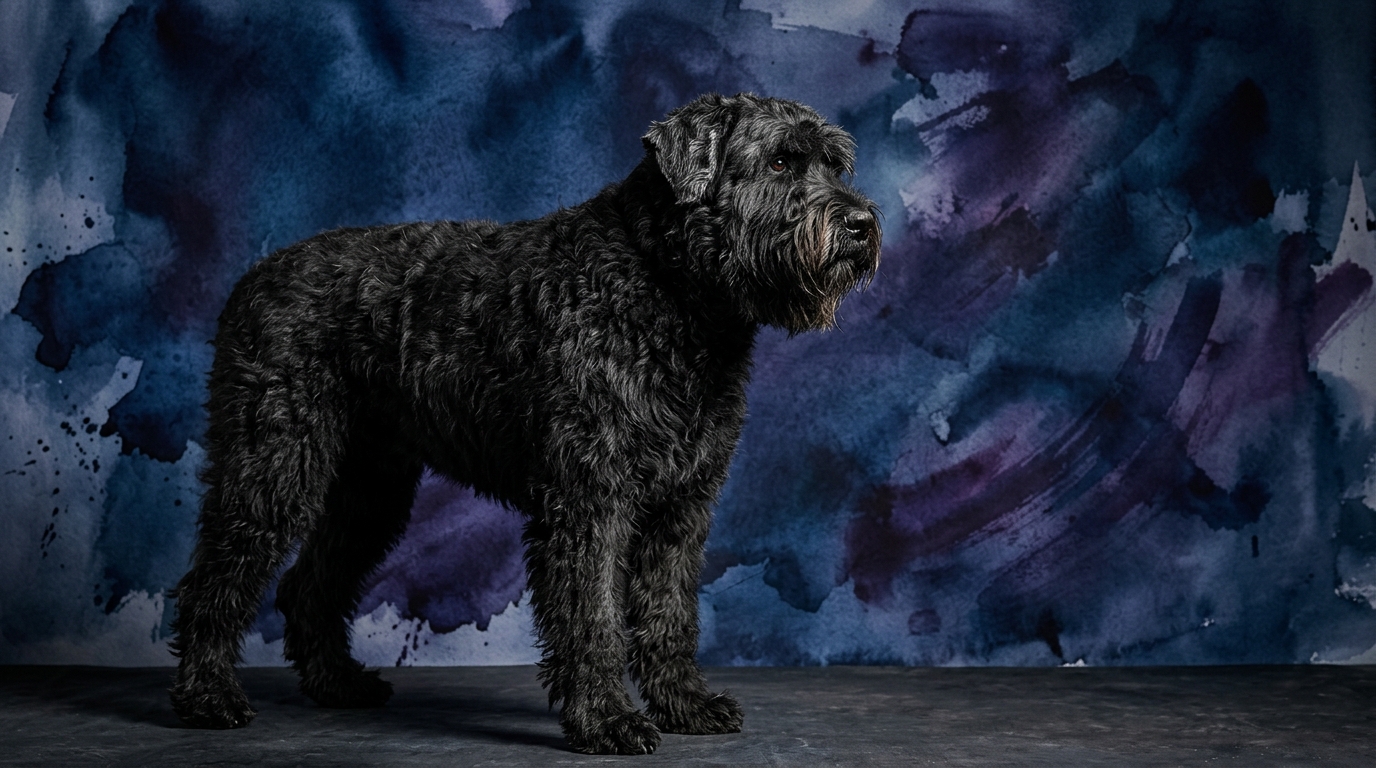

Side-by-Side IQ Profile: Bouvier vs. Dandie
While both the Bouvier des Flandres and the Dandie Dinmont Terrier register identical scores of 3/5 across all five cognitive dimensions – Problem Solving, Training Speed, Social Intelligence, Instinctive Drive, and Memory – their historical roles deeply influence how these aptitudes manifest. Understanding these nuances is key to appreciating their unique mental makeups.
For the Bouvier des Flandres, a breed rooted in herding and guarding, a Problem Solving score of 3/5 indicates a practical, methodical approach to challenges. They excel at understanding and executing multi-step tasks, particularly those involving spatial reasoning and managing dynamic groups, such as guiding livestock or navigating complex obedience courses. Their 3/5 Training Speed means they learn new commands and routines at a steady pace, thriving on consistency and clear instruction, becoming reliable performers once a behavior is ingrained. Social Intelligence, also 3/5, is characterized by a watchful, discerning nature; they adeptly interpret human cues and understand their role within a family unit, forming deep, protective bonds. Their Instinctive Drive, rated 3/5, manifests as a purposeful herding and guarding impulse, a desire to oversee and protect. Finally, their 3/5 Memory ensures good retention of learned information, contributing to their dependable nature in established routines.
The Dandie Dinmont Terrier, contrastingly, is a terrier through and through, originally bred for hunting vermin. Their 3/5 Problem Solving score translates into a focused, tenacious resolve, particularly when an objective involves scent or a perceived 'prey.' They are adept at persistent investigation, clever maneuvering around obstacles, and determined digging to achieve a goal. Their 3/5 Training Speed means they can grasp concepts quickly, but their independent spirit often means their willingness to perform depends heavily on motivation and reward, requiring creative, engaging training methods. Social Intelligence, also 3/5, involves forming strong, affectionate bonds with their chosen humans, being observant of household dynamics, and showing clear understanding of their trusted circle, though often reserved with strangers. Their Instinctive Drive, a moderate 3/5, is a strong, persistent prey drive for chasing, digging, and investigating scents. Their 3/5 Memory is particularly sharp for locations, scents, and specific routines tied to their natural instincts, allowing them to recall details with impressive accuracy.
Where the Bouvier des Flandres Wins Cognitively
Despite identical numerical IQ scores, the Bouvier des Flandres often demonstrates a cognitive advantage in tasks demanding structured cooperation and broad environmental awareness. Their herding lineage primes them for understanding complex, multi-step commands that involve spatial reasoning and anticipating movement, such as guiding livestock or participating in advanced obedience routines. While a Dandie might focus intently on a single target, the Bouvier’s 3/5 problem-solving is geared towards managing a dynamic environment, requiring them to process multiple variables simultaneously and adapt their strategy to a changing 'flock' or situation. Their social intelligence, while not overly effusive, translates into a more consistent willingness to collaborate on tasks, making them particularly adept at intricate, handler-directed work where understanding nuanced human intentions is paramount for success.
Where the Dandie Dinmont Terrier Wins Cognitively
The Dandie Dinmont Terrier, with its identical 3/5 cognitive scores, shines in scenarios demanding independent, persistent problem-solving and specialized sensory focus. Their terrier heritage means their problem-solving is often intensely goal-oriented, particularly when a scent or a perceived 'prey' is involved. A Dandie’s 3/5 problem-solving manifests as exceptional tenacity in figuring out how to access a confined space or retrieve a hidden object, often employing clever maneuvers or determined digging. Their instinctive drive, also rated 3/5, is a powerful engine for focused, sustained effort, allowing them to concentrate on a singular objective for extended periods with remarkable determination. This hyper-focus, combined with a keen memory for specific locations and scents, gives them an edge in tasks requiring detailed exploration and unyielding pursuit, where a broader, more cooperative approach might be less effective.
Which is Easier to Train and Why
When considering training ease, both breeds have a 3/5 training speed, yet their inherent temperaments dictate different approaches and outcomes. The Bouvier des Flandres generally presents as easier to train for obedience and multi-step tasks due to their cooperative herding mindset. They possess an inherent desire to work alongside their handler, and their social intelligence (3/5) makes them responsive to human direction and eager to please. This means they are more likely to consistently follow commands once learned, thriving on clear, consistent communication and structured routines. Their substantial physical presence, however, necessitates early and unwavering training to manage their strength effectively, ensuring they learn appropriate manners from a young age. In contrast, the Dandie Dinmont Terrier, while quick to grasp new concepts (3/5 training speed), often brings an independent terrier spirit to the training process. Their problem-solving (3/5) and instinctive drive (3/5) mean they are highly motivated by their own interests, sometimes making them appear selectively deaf if a task isn't immediately rewarding or if their attention is captured by an intriguing scent or sound. Training a Dandie requires significant creativity, high-value rewards, and patience to channel their tenacity. Their persistence, a hallmark of their breed, can be a double-edged sword: excellent for mastering a desired behavior if properly motivated, but equally effective for persisting in an undesired one if left unchecked.
Suited for Active vs. Relaxed Owners
The suitability of these breeds for active versus relaxed owners hinges not just on raw energy levels, but on the *nature* of the activity required to satisfy their cognitive and instinctive needs. The Bouvier des Flandres, with its herding background and 3/5 instinctive drive, decidedly suits active owners who can provide consistent, structured engagement. Their physical size and mental acuity demand more than just a short daily walk; they thrive on long, purposeful walks, herding games, or dog sports like obedience, agility, or even protection work. Owners must be prepared to provide regular mental stimulation and physical outlets that channel their innate desire to work and patrol. A relaxed owner who cannot meet these demands might find a Bouvier becoming bored, destructive, or overly watchful. The Dandie Dinmont Terrier, while smaller, also requires a specific kind of engagement that might surprise those expecting a purely sedentary companion. Their 3/5 instinctive drive and problem-solving translate into a need for focused mental stimulation and outlets for their natural terrier behaviors. While they don't necessarily need miles of running, they do require engaging play, scent work, puzzle toys, and opportunities to dig in designated areas. A 'relaxed' owner who is willing to provide consistent, interactive play sessions and mental challenges will find the Dandie adaptable and content, but one who expects a passive lapdog might encounter a tenacious, bored terrier seeking its own entertainment. They are adaptable to apartment living if their cognitive needs are met through structured indoor and outdoor activities.
The Verdict
Choose the Bouvier des Flandres if you seek a substantial, cooperative working companion capable of structured tasks and protective oversight, and are prepared to invest in consistent training and substantial physical and mental activity.
Opt for the Dandie Dinmont Terrier if you appreciate a tenacious, independent spirit in a smaller package, and are ready to engage in focused games and provide mental challenges that satisfy a keen instinctual drive.
🧠 Find Your Pet's IQ Score
Our Pet IQ Lab assessment covers 25+ tests across 5 cognitive dimensions — personalized to your breed.
Take the Full IQ Test →Frequently Asked Questions
Are Bouvier des Flandres dogs good for first-time owners?
Bouviers possess a strong will and require consistent, experienced handling and early socialization due to their protective instincts and physical power. While intelligent, their training demands a confident leader, making them generally more suitable for owners with prior dog experience.
Do Dandie Dinmont Terriers get along with other pets?
Dandie Dinmont Terriers can coexist with other pets, especially if raised with them from a young age. However, their strong prey drive (3/5 instinctive drive) means they might view smaller, fast-moving animals as targets, requiring careful supervision and introductions with cats or small rodents.
What kind of mental stimulation do these breeds need daily?
The Bouvier thrives on purpose-driven tasks like obedience drills, puzzle toys, and structured "jobs" that engage their herding intelligence. The Dandie benefits from scent games, digging opportunities (in designated areas), and interactive toys that allow them to "hunt" and solve problems independently.