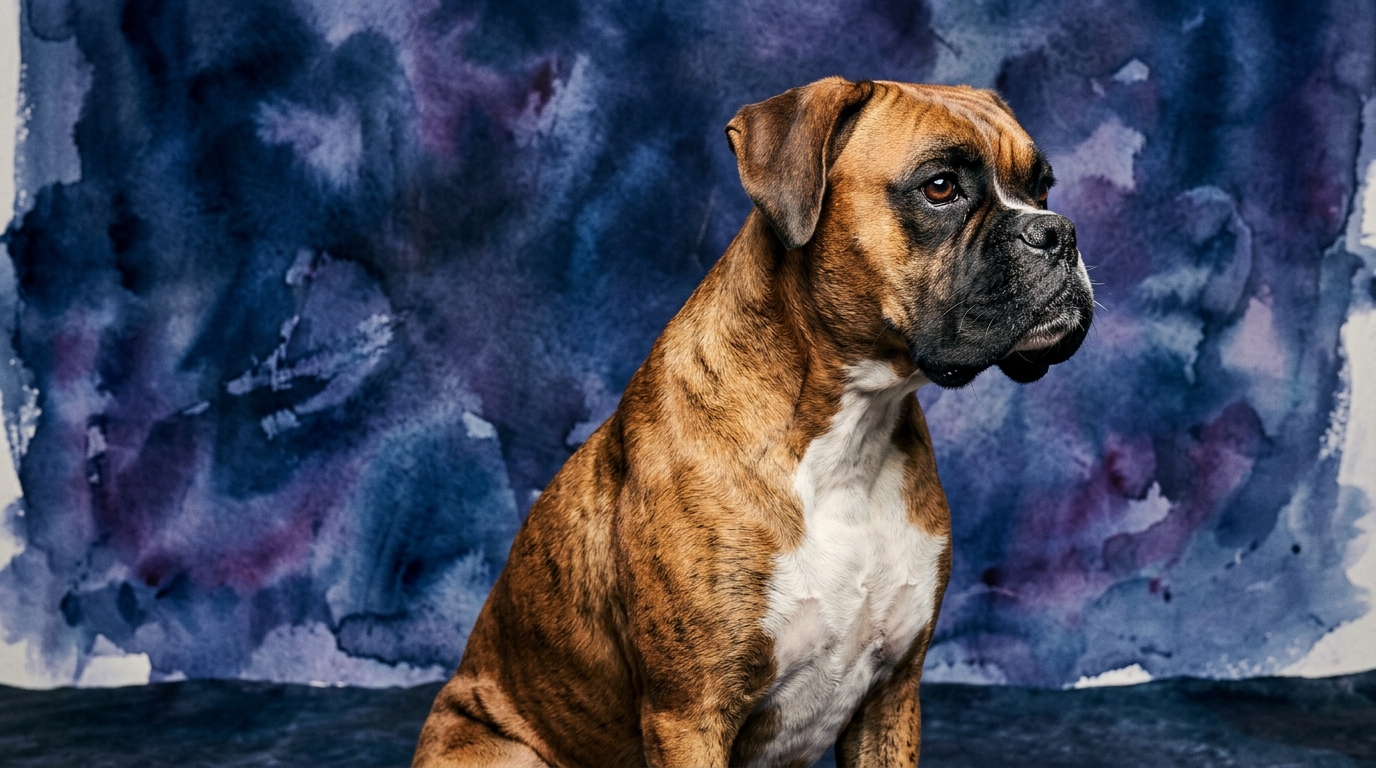
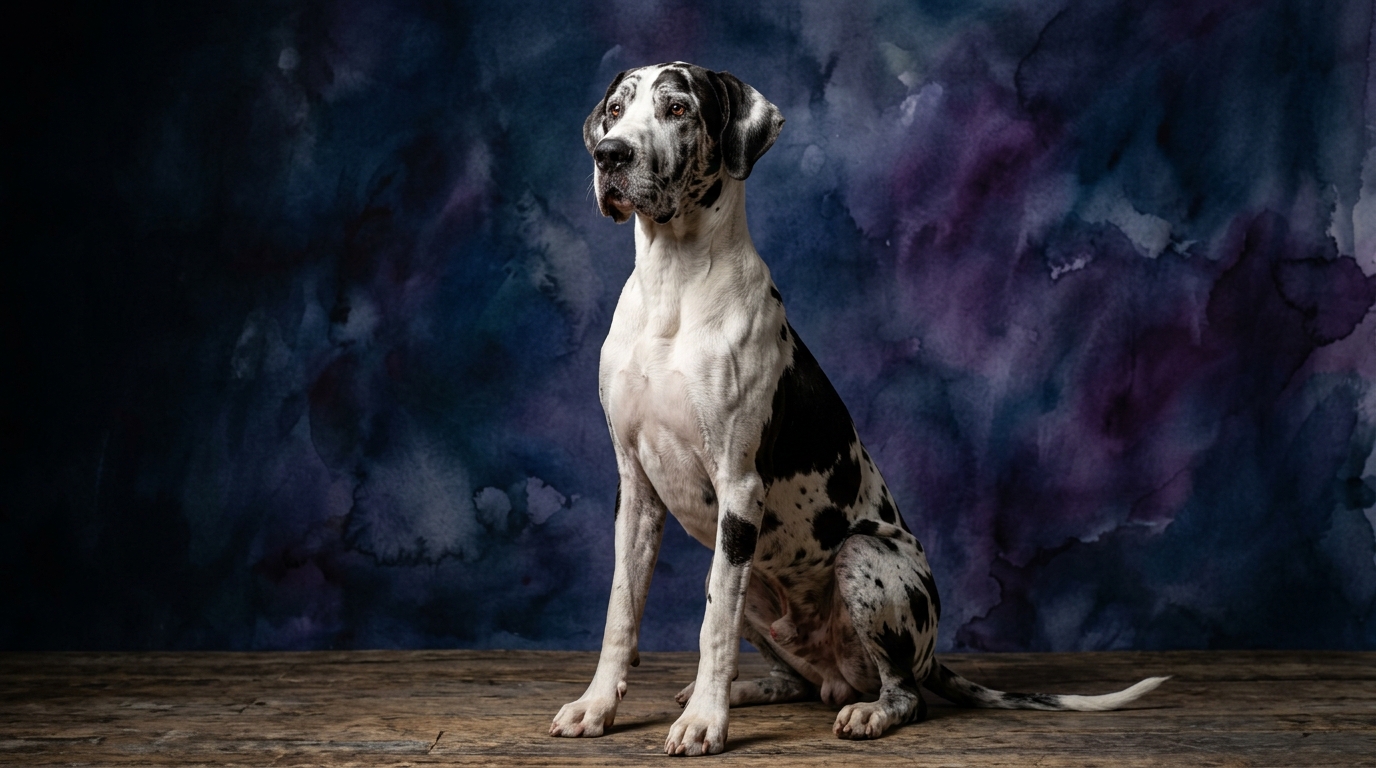
Side-by-Side IQ Profile: Boxer vs Great Dane
Both the Boxer and the Great Dane share the Coren rank of #48, suggesting a similar foundational capacity for learning and obedience in a general sense. However, The Cosmic Pet Pet IQ Lab delves deeper, revealing distinct cognitive nuances across five dimensions. For the Boxer, problem-solving registers at 3/5, indicating a capacity for navigating challenges and learning through experience, but not without some deliberation. Their training speed is also 3/5, meaning they require consistent, clear instruction to master new commands. Where Boxers truly shine is in social intelligence, scoring an exceptional 5/5, reflecting their profound ability to understand and respond to human cues, emotions, and household dynamics. Their instinctive drive is a robust 4/5, fueling their characteristic enthusiasm for play and engagement, while their memory stands at a steady 3/5, capable of retaining routines and learned behaviors over time.
The Great Dane presents a parallel yet distinct profile. Their problem-solving ability also rates 3/5, suggesting they can work through tasks with patience, much like the Boxer. Training speed is likewise 3/5, emphasizing the need for structured, calm training sessions. Their social intelligence, while still strong at 4/5, is a touch less intensely attuned than the Boxer's, suggesting a slightly more direct, less nuanced interpretation of human interaction. The Great Dane’s instinctive drive is 3/5, indicating a present but generally more subdued internal motivation compared to the Boxer. Finally, their memory also scores 3/5, allowing for retention of commands and routines, albeit without extraordinary recall.
Where the Boxer Wins Cognitively
The Boxer's cognitive profile showcases clear advantages in areas that foster dynamic companionship and responsiveness. Their exceptional social intelligence, rated at 5/5 compared to the Great Dane's 4/5, allows them to perceive and interpret human emotions and intentions with remarkable sensitivity. This means a Boxer is often quicker to pick up on subtle cues, anticipate a family member's mood, or adjust their behavior based on the social context of a room. They possess an innate understanding of their role within the human 'pack,' making them incredibly empathetic and engaged family members. This acute social awareness often translates into a dog that feels deeply connected and responsive to their human companions.
Furthermore, the Boxer’s instinctive drive, scoring 4/5 against the Great Dane's 3/5, translates into a more vigorous internal motivation. This drive manifests as a pronounced zest for life, play, and active participation in daily routines. While requiring careful channeling, this higher drive means Boxers are often more self-propelled to initiate interaction, engage in games, or pursue tasks, making them highly enthusiastic partners for activities and training alike. This intrinsic motivation can make them appear more 'on the ball' in various situations, always ready for the next adventure or interaction, provided they receive appropriate outlets for their energy.
Where the Great Dane Wins Cognitively
While the Great Dane doesn't outscore the Boxer numerically in any single cognitive dimension, their specific profile offers distinct advantages, particularly for certain lifestyles. Their instinctive drive, at 3/5 compared to the Boxer's 4/5, means they possess a naturally calmer disposition. This reduced intrinsic motivation for high-octane activity translates into less mental 'busyness' and a lower demand for constant, vigorous stimulation to prevent boredom or destructive behaviors. For owners seeking a more placid home environment, this cognitive trait is a significant benefit, as the Great Dane is often content with fewer intense play sessions and more relaxed companionship.
This inherent serenity means their mental energy is often directed towards calm observation and gentle interaction rather than constant exploration or high-intensity engagement. Their social intelligence, at 4/5, combined with this lower drive, results in a dog that is affectionate and understanding but without the same persistent, high-energy demands for interaction that a Boxer might exhibit. They process their environment with a stately grace, often demonstrating a patient and composed demeanor that requires less proactive management from their human companions, making them excellent choices for those who prioritize tranquility.
Which is Easier to Train and Why
Comparing the training ease of Boxers and Great Danes reveals a nuanced picture, as both breeds share identical 3/5 scores for training speed and problem-solving. This suggests neither is inherently a 'quick study' in the traditional sense, and both will benefit immensely from consistent, positive reinforcement methods. However, the Boxer’s superior social intelligence (5/5) provides a distinct edge in responsiveness. Boxers are deeply attuned to human intentions and emotional states, making them highly motivated to please and incredibly receptive to feedback. They often pick up on subtle cues from their trainer and are eager to engage, channeling their strong instinctive drive (4/5) into learning tasks.
This enthusiasm, while sometimes translating into playful distractions, ultimately makes the training process feel more interactive and rewarding for both dog and owner, as the Boxer actively seeks to understand and comply. In contrast, the Great Dane, with a social intelligence of 4/5 and a lower instinctive drive of 3/5, might present a different training dynamic. While they are certainly capable of learning and desire to please their owners, their motivation might be less intense and their interpretation of human cues slightly less nuanced. They may require more patient, calm repetition and consistent reinforcement, potentially responding better to a gentle, steady approach rather than a boisterous one. Their sheer size necessitates early and thorough training for manners and leash behavior, but their generally placid nature can make managing a trained Great Dane less physically demanding than a high-energy Boxer. Ultimately, while both require dedication, the Boxer's inherent social attunement often makes the *process* of training feel more fluid and engaging due to their eager participation.
Active Owners vs. Relaxed Owners
The differing cognitive profiles of the Boxer and Great Dane make them suited for distinct owner lifestyles. Active owners, those who thrive on outdoor adventures, engaging in dog sports, or simply having a constant, energetic companion, will find the Boxer to be an ideal match. Their robust instinctive drive (4/5) means they possess an inherent need for physical activity and mental engagement, eagerly participating in games of fetch, agility courses, or long hikes. Their high social intelligence (5/5) further ensures they are not merely present but actively involved and responsive during these activities, making them enthusiastic partners in an energetic lifestyle.
Conversely, relaxed owners, who prefer a more serene home environment and value calm companionship over constant activity, would likely find the Great Dane more compatible. With an instinctive drive of 3/5, Great Danes are generally less demanding of vigorous exercise and mental stimulation. They are often content with a daily walk and then settling down for extended periods of lounging, providing a comforting, gentle presence. While they still require regular exercise to maintain health, their overall cognitive disposition leans towards a more tranquil existence, making them excellent companions for those who appreciate quiet evenings and a majestic, calm friend by their side.
The Verdict
Choose a Boxer if you are an active individual or family seeking a highly interactive, empathetic dog with a strong drive for play and participation, capable of deeply integrating into your social dynamics and thriving on consistent engagement.
Opt for a Great Dane if you desire a gentle, calm, and affectionate giant who will offer a serene presence and devoted companionship, requiring a less intense daily activity regimen but still appreciating loving interaction and a comfortable spot by your side.
🧠 Find Your Pet's IQ Score
Our Pet IQ Lab assessment covers 25+ tests across 5 cognitive dimensions — personalized to your breed.
Take the Full IQ Test →Frequently Asked Questions
Are Boxers and Great Danes equally smart given their Coren rank?
While both breeds share the Coren rank of #48, indicating a similar general capacity for obedience learning, their specific cognitive strengths differ. The Boxer excels in social intelligence, while the Great Dane's lower instinctive drive can be an advantage for a calmer home environment, making them 'smart' in different, context-dependent ways.
Do Great Danes need less mental stimulation than Boxers?
Generally, yes. The Great Dane's instinctive drive is rated 3/5 compared to the Boxer's 4/5. This means Great Danes are often content with less intense and frequent mental challenges, favoring calm companionship over constant, vigorous engagement, though all dogs benefit from some enrichment to prevent boredom.
Which breed is better with children, considering their intelligence?
Both breeds can be excellent with children, but their approaches differ. The Boxer's superior social intelligence (5/5) means they are often highly attuned to children's moods and play, while the Great Dane's placid nature and lower instinctive drive (3/5) can make them remarkably gentle giants, requiring less management of exuberant play. Supervision is always essential with any dog and children.