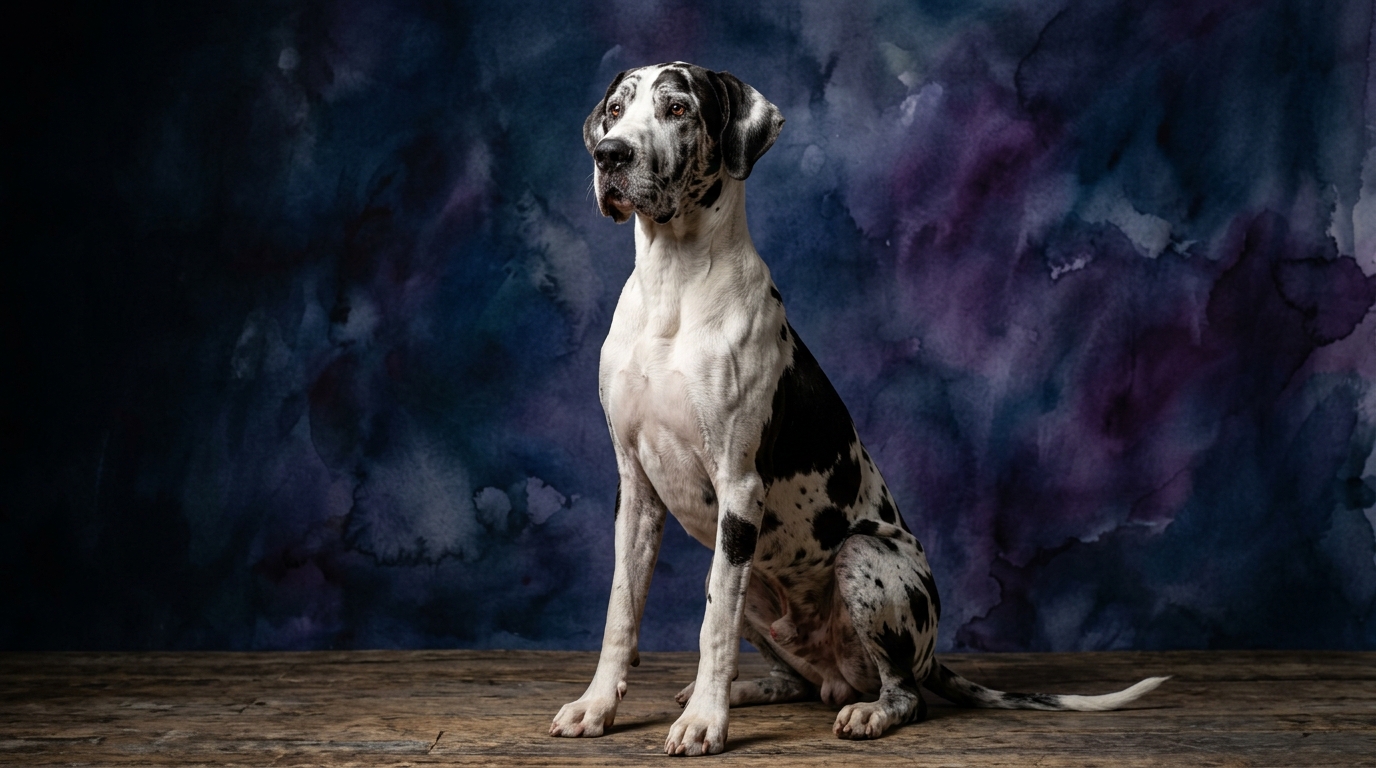
Great Dane at a glance
| IQ Rank / Score | #48 |
|---|---|
| Trainability | ★★★☆☆ (3/5) |
| Social Intelligence | ★★★★☆ (4/5) |
| Lifespan | 10-12 years |
| Shedding | Moderate to high |
| Exercise Needs | Moderate (30-45 min/day) |
| Origin | Germany |
The Brains Behind the Brawn: Understanding Great Dane Intelligence
While Stanley Coren’s obedience ranking places Great Danes at #48 out of 138 breeds, this single metric doesn't capture their full intellectual scope. Our intelligence profile reveals Problem Solving at 3/5, Training Speed at 3/5, a notable Social Intelligence at 4/5, Instinctive Drive at 3/5, and Memory at 3/5. These scores illuminate a dog whose cognitive strengths lie in specific types of mental engagement and interaction.
Far from being just a large presence, Great Danes possess a thoughtful disposition that requires specific outlets for mental stimulation. Understanding their unique intelligence profile helps owners provide enriching environments that cater to their specific cognitive strengths, fostering a well-adjusted and highly responsive companion. It's a journey into the mind of a truly remarkable giant.
Applied Size Intelligence: Navigating the World as a Giant
One of the most remarkable aspects of Great Dane intelligence is their 'applied size intelligence.' Imagine navigating a world not built for your massive frame, where every movement carries significant impact. Great Danes develop an acute social awareness of their own scale, learning to modulate their powerful physicality with a precision smaller dogs never require. This isn't clumsiness; it's sophisticated spatial reasoning and a constant calibration of their physical presence.
This unique intelligence is evident daily: from carefully stepping over a napping cat to gently nudging a child with surprising delicacy. They constantly process and adapt their movements, demonstrating a subtle yet powerful form of problem-solving and social responsibility. It proves their thoughtful nature that they move with surprising grace and consideration rather than simply barreling through their environment, showcasing a profound self-awareness.
From Wild Boar to Couch Companion: A History of Tactical Smarts
To truly appreciate a Great Dane's mental depth, we must examine their origins. Great Danes were originally boar hunters in Germany. A dog bred to stop a 200kg wild boar needed tactical intelligence — pure aggression would have gotten them killed. They relied on strategic thinking, immense courage, and precise movements to hold their quarry without injury to themselves or the hunting party, a testament to their complex problem-solving abilities in high-stakes situations.
This legacy of tactical intelligence continues to influence the breed's modern temperament. Though now cherished companions, their underlying capacity for strategic thought and measured interaction remains. It helps explain why such an imposing dog can also be remarkably sensitive and discerning in its social behaviors, demonstrating a cognitive adaptability from hunting fields to living rooms.
Decoding Great Dane Cognition: A Deeper Look at Their Profile
Let's delve deeper into the Great Dane's cognitive scores. Their Problem Solving (3/5) indicates they are capable of navigating complex situations, especially those involving spatial reasoning or cause-and-effect in their environment, allowing them to figure out new routines or retrieve a dropped toy from an awkward spot. Training Speed (3/5) means they learn new commands steadily, responding well to consistent, positive reinforcement and retaining lessons effectively over time, making them a rewarding breed to teach.
Where Great Danes truly excel is in their Social Intelligence, scoring a high 4/5. This reflects their deep capacity for empathy, understanding human cues, and forming strong, intuitive bonds. They are acutely aware of family members' emotions and often respond with a comforting presence or a gentle nudge, showcasing their profound relational insight. Their Instinctive Drive (3/5) is balanced, manifesting as a discerning protective instinct and natural curiosity, while Memory (3/5) ensures established routines and learned behaviors stick reliably.
Training Your Thoughtful Giant: Leveraging Their Intelligence
Training a Great Dane effectively means understanding and leveraging their specific cognitive strengths rather than relying on generic methods. Their moderate Training Speed necessitates patience and consistency. Positive reinforcement works best, as their high Social Intelligence makes them exceptionally eager to please and sensitive to feedback, thriving on praise and clear guidance. They respond well to clear communication and structured lessons over repetitive drills, which can lead to boredom.
Don't mistake their calm demeanor for a lack of need for mental stimulation. Great Danes thrive on challenges that engage their problem-solving skills, like scent work, interactive puzzle toys designed for their size, or learning complex command sequences that build on prior knowledge. Encouraging their 'applied size intelligence' through varied interactions also helps them hone their unique spatial awareness and social grace, making them even more well-adjusted and confident members of your household.
3 At-Home Tests to Measure Your Great Dane's IQ
These tests are adapted from peer-reviewed ethology research. No equipment is needed beyond items you have at home. Run each test 5–10 times for reliable results.
The Myth: "Great Danes are gentle giants because they're too lazy and dumb to cause trouble."
✅ This is a dangerous misconception; Great Danes possess sophisticated intelligence, particularly in social and tactical contexts, and their gentleness is a conscious choice and a result of their precise social intelligence, not a deficit of wit or energy. They are capable of immense harm but choose not to because of their thoughtful nature and self-awareness of their surroundings, proving their cognitive strength.
Great Dane vs. Similar Breeds
🧠 What's Your Dog's IQ Score?
Our full Pet IQ Lab assessment includes 12+ tests across 5 cognitive dimensions, calibrated for Great Danes specifically.
Take the Full IQ Test →Frequently Asked Questions
How smart is a Great Dane?
Our Pet IQ Lab framework scores cognition across five dimensions (max 25). The Great Dane totals 16/25 — high for a domestic dog. The full article breaks down each dimension with at-home tests.
Are Great Danes easy to train?
Great Danes can learn most cues, but expect to repeat lessons and keep sessions short. They score 3/5 on Training Speed in our breed profile.
Are Great Danes good with children and other pets?
Yes — their Social Intelligence rates 4/5 in our Pet IQ Lab framework. With early socialization and supervised play, most Great Danes integrate well into families with respectful children and other pets.
Do Great Danes need a lot of mental stimulation?
Great Danes benefit from 10-15 minutes of focused enrichment a day: food puzzles, short training drills, or novel toys rotated weekly.
How much exercise does a Great Dane need?
Great Danes do well with 20-40 minutes of daily walks and play plus a few short training moments.
How good is a Great Dane's memory?
Great Danes score 3/5 on memory. They remember high-value associations well; less-used cues fade without refresher sessions.
What is the typical lifespan of a Great Dane?
Typical lifespan is 10-12 years for a giant dog like the Great Dane.
The Great Dane is far more than just a 'gentle giant'; they are complex thinkers with a unique form of applied intelligence centered on their impressive size and profound social awareness. By understanding their true cognitive profile, owners can unlock the full potential of these magnificent, thoughtful companions, truly appreciating the intelligent spirit within.