
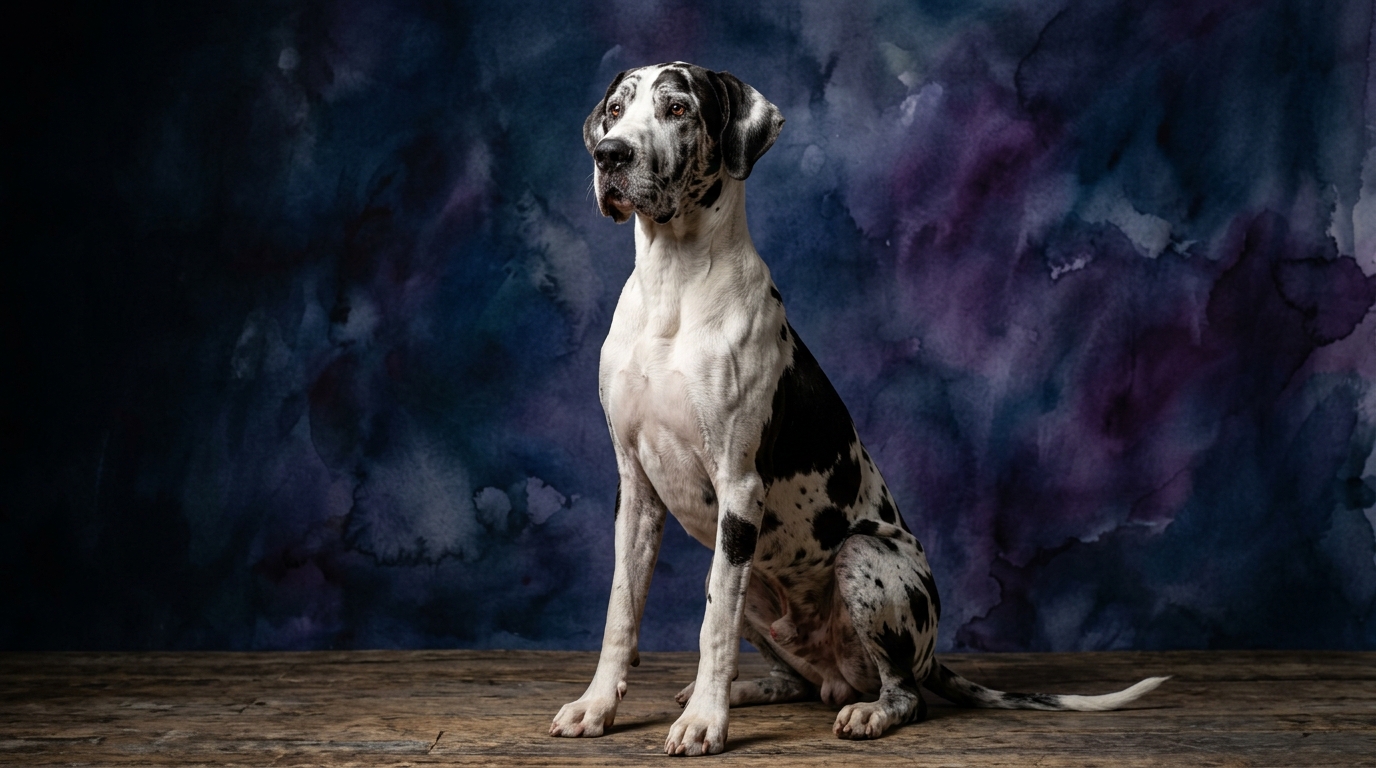
Side-by-Side Cognitive Profiles: German Shepherd vs. Great Dane
From The Cosmic Pet Pet IQ Lab, we understand canine intelligence across five key dimensions. The German Shepherd, a Herding breed, holds a Coren rank of #3, indicating its exceptional cognitive abilities across the board. The Great Dane, a Working breed, with a Coren rank of #48, presents a different, yet equally valuable, set of mental strengths.
The German Shepherd's profile shows a remarkable consistency: Problem Solving 5/5, Training Speed 5/5, Social Intelligence 5/5, Instinctive Drive 5/5, and Memory 5/5. This breed demonstrates an exceptional capacity to analyze novel situations and devise effective solutions, manifesting in their ability to navigate complex tasks, understand multi-step commands, and adapt strategies. They possess an unparalleled ability to grasp new commands and routines with minimal repetition, allowing for rapid skill acquisition and making advanced obedience remarkably efficient. Their profound understanding of human emotions, intentions, and social cues enables deep bonds and appropriate responses to environmental shifts. A powerful inherent motivation for tasks, particularly those involving herding, guarding, and protection, fuels their dedication and persistent engagement. Finally, their robust memory retains complex information, commands, and experiences over extended periods, contributing to their reliability and consistency.
In contrast, the Great Dane's profile, while strong in its own right, exhibits a different distribution: Problem Solving 3/5, Training Speed 3/5, Social Intelligence 4/5, Instinctive Drive 3/5, and Memory 3/5. This breed shows moderate ability to resolve new problems, often relying on learned behaviors or human guidance rather than immediate independent strategizing. They learn new commands at a steady pace, but typically require more repetition and consistent reinforcement than breeds with higher scores. Their good understanding of human moods and social interactions allows them to form strong, affectionate bonds with their families, generally being sensitive and responsive to emotional cues. A moderate level of inherent motivation, often expressed as a desire for companionship and comfort rather than intense task orientation, defines their drive. They retain information and commands reasonably well, though perhaps not with the same intricate detail or long-term recall as breeds excelling in this dimension, with consistent practice helping solidify their learned behaviors.
Where the German Shepherd Excels Cognitively
The German Shepherd's superior Problem Solving (5/5) and Adaptability mean they excel at navigating complex, unpredictable scenarios. Unlike the Great Dane, a German Shepherd can independently assess a new situation, like figuring out how to open a tricky gate or understanding a nuanced, multi-step command, and then execute a solution. This cognitive flexibility allows them to adapt rapidly to changing environments or novel tasks without constant human intervention.
Their Unrivaled Training Efficiency, with a 5/5 in Training Speed, means German Shepherds absorb new information and commands with remarkable swiftness. They require far fewer repetitions to master a skill compared to the Great Dane's 3/5, making advanced obedience, protection work, or intricate task learning a much faster process. Their focused attention and intrinsic desire to engage with their handler's instructions create an incredibly efficient learning loop.
Furthermore, the German Shepherd's Profound Instinctive Drive for Purpose (5/5) translates into an inherent, powerful motivation for work and meaningful tasks. This isn't just about energy; it's a deep-seated desire to engage in roles like herding, guarding, or performing complex search-and-rescue operations. This contrasts with the Great Dane's moderate drive, which often leans more towards companionship, meaning the German Shepherd actively seeks out challenges and thrives on having a job.
Unique Cognitive Strengths of the Great Dane
While the German Shepherd scores 5/5 in social intelligence due to their acute understanding of human cues for working purposes, the Great Dane’s 4/5 score often manifests differently, emphasizing a Calm Social Presence and Emotional Stability. Their cognitive processing tends towards a less reactive, more placid interpretation of social dynamics, making them inherently less prone to overstimulation in busy family environments. This allows them to maintain a composed demeanor, contributing to a stable and comforting household atmosphere where their understanding of human emotion translates into quiet, reassuring companionship.
The Great Dane's Lower Instinctive Drive (3/5) is not a deficit but a defining characteristic aligning perfectly with a more relaxed, companion-focused existence. Unlike the German Shepherd, whose high drive demands consistent mental and physical engagement, the Great Dane’s moderate drive means they are generally content with less structured "work." Their cognitive energy is less directed towards problem-solving or task execution and more towards enjoying their immediate environment and human interaction, making them naturally suited for homes seeking a giant, gentle presence without an intense need for constant mental challenges.
With moderate scores across Problem Solving (3/5) and Training Speed (3/5), the Great Dane exhibits Adaptability to Less Demanding Mental Engagement. They thrive in environments where constant, complex cognitive challenges are not the primary focus. While capable of learning, their cognitive processes are less geared towards rapid, intricate skill acquisition or independent strategic thinking. This means they are often more forgiving of less experienced trainers and do not become anxious or destructive if not constantly stimulated with advanced mental puzzles, making them a more straightforward choice for owners who prefer a less cognitively demanding canine companion.
Training Dynamics: German Shepherd vs. Great Dane
Training a German Shepherd is a highly rewarding and efficient experience due to their exceptional cognitive attributes. Their 5/5 Training Speed means they grasp new commands almost immediately, often after just a few repetitions. This rapid assimilation is coupled with a 5/5 Problem Solving ability, allowing them to understand the *why* behind a command and apply it to varied contexts, not just rote memorization. For instance, teaching "stay" involves their understanding of the handler's intention and the expectation of holding position despite distractions. Their high Instinctive Drive (5/5) means they possess an innate desire to work and please, acting as a powerful internal motivator that fuels engagement and focus during training sessions. This combination allows for nuanced and advanced training outcomes.
Training a Great Dane, while successful, requires a different approach. With a 3/5 Training Speed, they need more repetition and consistent reinforcement to solidify new commands. Their Problem Solving score of 3/5 means they might take longer to generalize learned behaviors to new situations, often needing specific guidance in each context. For example, teaching "stay" might require more patience and consistent practice in various locations. Their moderate Instinctive Drive (3/5) means they are generally cooperative but may not possess the same intense intrinsic motivation for complex tasks. Training is most effective when framed as a positive, bonding experience, utilizing their 4/5 Social Intelligence to leverage their desire for companionship and approval. Owners must be patient, consistent, and use positive reinforcement.
Matching Canine Intelligence to Owner Lifestyles
German Shepherds are ideally suited for Active, Engaged Owners who lead dynamic lifestyles and are prepared to provide substantial mental and physical engagement. Their 5/5 Instinctive Drive and Problem Solving abilities mean they thrive when given a "job" to do, whether advanced obedience, agility, protection sports, or complex scent work. These dogs require consistent intellectual stimulation to prevent boredom. An active owner for a German Shepherd means someone who enjoys daily long walks, runs, or hikes, and is committed to ongoing training and mental challenges, treating their dog as a true partner.
Great Danes, with their moderate Instinctive Drive (3/5) and Problem Solving (3/5) scores, are a better match for Relaxed, Companion-Oriented Owners who prioritize companionship and a calm home environment. While they benefit from regular, moderate exercise—like daily walks—they don't possess the same intense need for constant mental tasks or high-octane physical activity. Their Social Intelligence (4/5) shines in a home where their gentle nature and affectionate disposition are valued. A relaxed owner for a Great Dane enjoys quiet evenings, comfortable companionship, and a giant, loving presence that doesn't demand constant, structured engagement.
The Verdict
Choose a German Shepherd if you are an experienced, active owner dedicated to providing consistent mental stimulation and structured training, seeking a highly capable, purpose-driven partner for demanding tasks or an engaged lifestyle.
Opt for a Great Dane if you desire a gentle, affectionate giant companion for a calmer household, valuing a dog with moderate activity needs and a serene presence over intense working drive or complex cognitive challenges.
🧠 Find Your Pet's IQ Score
Our Pet IQ Lab assessment covers 25+ tests across 5 cognitive dimensions — personalized to your breed.
Take the Full IQ Test →Frequently Asked Questions
How does a German Shepherd's memory (5/5) impact daily life?
A German Shepherd's exceptional memory allows them to recall intricate commands, routines, and experiences over long periods, making them incredibly reliable in complex tasks and consistent in their learned behaviors. This means less reteaching and more dependable responses in various situations.
Does a Great Dane's 3/5 training speed mean they are difficult to train?
Not at all. A 3/5 training speed simply indicates they may require more repetition and patience than a German Shepherd to master new commands. They are still very capable of learning, especially with positive reinforcement and consistent methods, making them trainable for most household needs.
How does social intelligence differ between these two breeds?
While both breeds have good social intelligence, the German Shepherd's 5/5 score often translates to an acute, task-oriented understanding of human cues for work, whereas the Great Dane's 4/5 often manifests as a gentle, empathetic understanding that fosters deep, calm companionship within a family setting.